

You just bought a new car. The design is stunning, the ride is smooth, but a voice inside your head keeps saying, “This engine has so much more potential.” At Nordgestimmt, we know that feeling all too well! Due to strict emissions regulations, varying global climates, and unpredictable fuel qualities, manufacturers often release cars significantly “detuned” from the factory.
To remove these restrictions and unleash your car’s true power, the most effective solution is ECU Tuning (Remapping/Chiptuning). However, for anyone owning a brand-new car or one still under factory warranty, the million-dollar question is always: “Will tuning my ECU void my warranty?”
In this comprehensive guide, we separate myth from reality. From how dealerships actually detect tunes to which parts of your warranty are actually at risk, here is everything you need to know.
What Exactly is ECU Tuning?
The ECU (Engine Control Unit) is the brain of your car. It dictates every vital engine function, including the air-to-fuel ratio, turbo boost pressure, ignition timing, and throttle response. ECU tuning, or remapping, involves altering the factory software to optimize these parameters and extract the engine’s true performance potential.
A proper Stage 1 tune by professionals like North Tuned provides a significant increase in horsepower and torque without exceeding the safe physical limits of your engine’s hardware.
The Big Question: Is My Warranty Completely Voided?
The short answer: No, your entire warranty is not voided.
The long and accurate answer is a bit more nuanced. Dealerships and automakers generally do not like unauthorized modifications. However, your vehicle’s warranty is not a single, fragile contract that shatters at the first modification. When you flash your ECU, only the components directly affected by that modification are at risk of losing coverage.
Warranty Boundaries: What’s Covered and What’s Not?
Under laws like the Magnuson-Moss Warranty Act (in the US) and similar consumer protection laws globally, a dealership cannot void your entire vehicle warranty just because you modified one part. They must prove that your modification directly caused the failure in question.
- Highly Likely to be Denied (The Drivetrain): Engine block, turbocharger, transmission, differentials, and axles. (For example, if you tune your engine and your turbo blows up a week later, the dealership will almost certainly blame the tune and deny the warranty claim.)
- Still Fully Covered: Power windows, infotainment system, AC compressor, heated seats, or windshield wiper motors. (A dealership must fix your broken AC under warranty, even if your car is pushing 100 extra horsepower from a tune.)
How Do Dealerships Detect a Tune?
The old myth of “I’ll just flash it back to stock before I go to the dealer, and they’ll never know” might have worked 15 years ago. Today, dealership diagnostic systems are incredibly smart.
1. The Flash Counter
Every time a file is written to your car’s ECU, an internal digital counter goes up by one. If the dealership plugs into your car and sees the flash counter sits at “3” when the factory record says it should be “1”, they immediately know the ECU has been tampered with.
2. The TD1 Flag (Automatic Detection)
This is especially prominent in the VAG group (VW, Audi, Porsche, Seat, Skoda) and increasingly in BMW and Mercedes. When your car is plugged in for routine service using ODIS (or equivalent OEM software), the system automatically cross-references your ECU’s parameters with the central servers in Germany. If there’s a mismatch, the system automatically brands your VIN with a “TD1” flag (indicating a modified powertrain). The mechanic doesn’t even have a choice; it happens automatically in the background.
3. Freeze Frame & Data Logging
Modern ECUs record “freeze frame” data for extreme values. Even if you revert to the stock tune, the logs might show that your engine hit 1.6 bar of boost two months ago, whereas the factory maximum is 1.2 bar. This historical data proves the car ran higher-than-stock parameters.
Types of Tuning and Warranty Risks
The method you choose can affect how dealerships view your car:
- OBD Flash Tuning: The most common and reliable method. The original file is read via the OBD2 port, and the modified North Tuned file is written. It leaves no physical traces but is easily detectable via software (TD1 / Flash Counter).
- Piggyback / Tuning Boxes: These are modules plugged in between the ECU and engine sensors, tricking the ECU into delivering more boost and fuel. The Pro: You can physically remove the box before a dealer visit. Since it doesn’t flash the ECU, the flash counter doesn’t increase. The Con: It doesn’t offer the smooth, comprehensive parameter control of a true remap, and dealerships can sometimes still detect historical “overboost” codes left behind.
- Bench Tuning: Used for newer locked ECUs. The ECU must be physically removed from the car and opened. Because this breaks the factory seal on the ECU housing, a visual inspection by a technician will instantly void the powertrain warranty.
What to Consider Before Tuning Your Warrantied Car
If you are thinking about tuning your brand-new car, we at North Tuned believe in complete transparency:
- Accept the “Pay to Play” Reality: Modifying a car carries inherent risks. If you tune a warrantied car, you must be financially and mentally prepared to cover the cost of a blown turbo or transmission out of your own pocket.
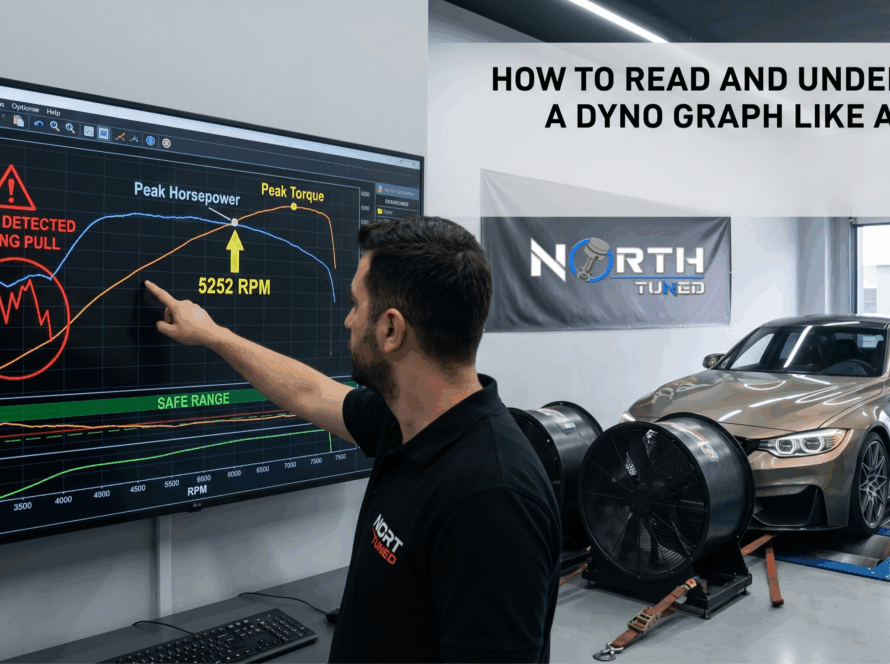
- A Quality Tune is Everything: Most catastrophic engine failures aren’t caused by the concept of tuning; they are caused by bad, aggressive tuning. Trusting experts like North Tuned—who monitor Exhaust Gas Temperatures (EGT), ignition knock, and Air/Fuel Ratios (AFR) to keep them within safe tolerances—drastically minimizes the risk of hardware failure.
The North Tuned Approach: Power Meets Reliability
At the North Tuned garage, we don’t chase dangerous, ego-boosting dyno numbers by pushing your engine to the absolute brink of destruction. Our goal is to unlock the smooth, satisfying power your car was always meant to have, keeping it well within safe operational limits.
If you have a car under warranty, we will sit down with you, explain the risks transparently, and apply a well-researched, highly stable Stage 1 file designed for daily driving longevity.
The Verdict: Tuning is a passion, and when done right, it completely transforms your driving experience. If preserving your powertrain warranty is your absolute top priority, waiting until the warranty expires is the most stress-free route. But if you’re ready to feel that extra pull right now and want it done by professionals who prioritize your engine’s health, the Nordgestimmt team is ready for you!

 English
  Turkish
  German
  Spanish
  Hindi
Hindi  Arabic
  Italian
  Greek
Greek  Vietnamese
  Chinese
  Malay
Malay