

For performance enthusiasts, a Stage 1 software calibration is typically the first exciting step into the world of automotive tuning. Stage 1 calibrations deliver noticeable power increases while remaining within the tolerance limits of factory mechanical hardware. However, when aiming for higher torque targets, sharper throttle response, and sustained high-RPM output, mechanical restrictions within the factory exhaust system become the primary bottleneck capping the engine’s true potential. This is where the core hardware upgrades of a Stage 2 transformation come into play: downpipes and high-flow catalytic converters.
In turbocharged engines, how quickly, smoothly, and efficiently exhaust gases exit the turbine housing dictates everything from boost threshold (spool-up time) to maximum top-end power output. In this comprehensive technical guide, North Tuned breaks down the engineering behind downpipe systems, their critical role in Stage 2 power delivery, exhaust fluid dynamics, and the operational differences between catless configurations and high-flow metallic catalytic converters.
1. What Is a Downpipe and What Is Its Engineering Role?
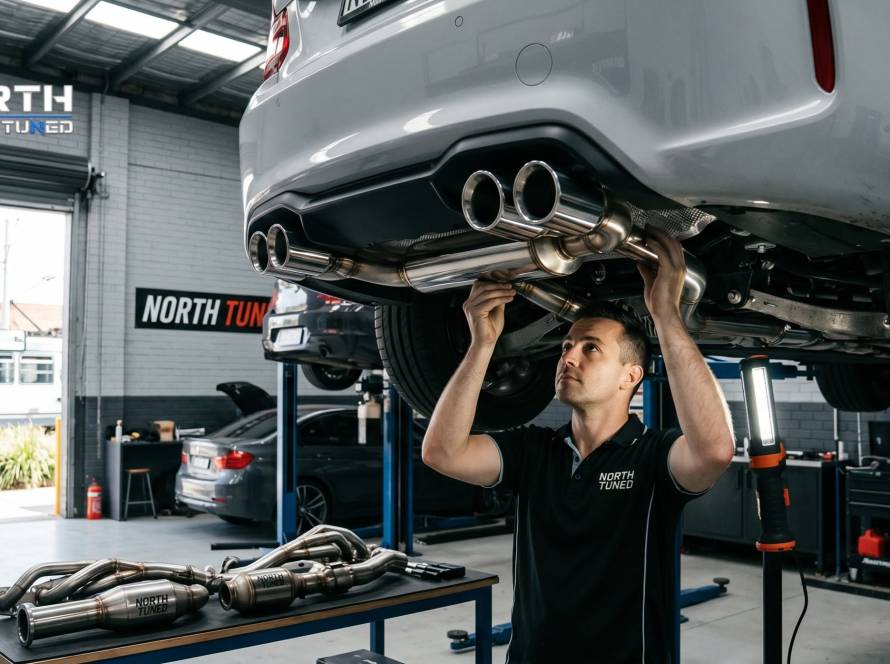
In turbocharged engines, the downpipe is the vital section of the exhaust system that connects the turbine housing outlet directly to the mid-pipes and undercar exhaust components. Factory stock downpipe units are designed with narrow piping diameters, sharp bend angles, and dense ceramic catalytic converters to comply with stringent global emissions standards and production cost constraints.
This restrictive factory architecture slows down exhaust gas velocity and introduces turbulent air pockets, creating substantial backpressure behind the turbocharger. At stock power levels, this backpressure is manageable for the engine. However, when ECU tuning increases boost pressure and fuel delivery, the massive volume of expanding hot exhaust gas simply cannot pass through the restrictive factory downpipe quickly enough. Trapped thermal energy forces exhaust gases to back up against the turbine wheel, preventing it from spinning freely, restricting heat extraction from the combustion chambers, and causing destructive thermal buildup throughout the entire turbo assembly.
A performance downpipe resolves this bottleneck by expanding the internal pipe diameter (typically upgrading from stock 2.0″-2.25″ diameters to 3.0″ or 3.5″ mandrel-bent piping) and smoothing out internal flow geometry, allowing high-velocity exhaust gases to evacuate immediately upon exiting the turbine wheel.
2. The Engineering Role of Downpipes in Stage 2 Performance
A Stage 2 ECU software optimization is not merely a digital tweak; its underlying calibration principles rely directly on the removal of mechanical exhaust flow restrictions. Installing a high-flow performance downpipe yields several vital engineering advantages:
- Elimination of Exhaust Backpressure: With minimal flow resistance behind the turbine wheel, counter-pressure forces acting on the turbocharger are eliminated. This significantly reduces turbo lag, sharpens transient throttle response, and enables the turbocharger to reach target boost levels much earlier in the RPM range.
- Substantial Reduction in Exhaust Gas Temperatures (EGT): The unrestricted evacuation of hot gases lightens the thermal load on the combustion chambers, exhaust valves, and turbo manifold. Lower EGTs prevent thermal degradation, eliminate power loss caused by heat soak, and extend the overall lifespan of internal engine components.
- Higher Boost Margins and Advanced Ignition Timing: Reduced internal cylinder temperatures allow the ECU to safely command higher target boost pressures and advance ignition timing angles without inducing engine knock or detonation.
- Significant Power and Torque Gains: Combining a high-flow performance downpipe with a tailored Stage 2 ECU calibration yields power increases ranging from 15% to 25%, depending on engine architecture. The engine exhibits a dramatically more responsive and aggressive power band, particularly through the mid-to-high RPM range.
3. Catless Downpipes vs. High-Flow (200/300 CPSI) Sports Catalytic Converters
When upgrading a downpipe system, drivers generally select between two primary configurations based on their performance goals and vehicle usage:
Catless Downpipes
A straight-through, unrestricted pipe design containing no internal catalytic converter substrate or filter elements.
- Pros: Offers absolute zero flow resistance, unlocks the absolute maximum power and torque potential, enhances turbo spool acoustics, and produces a deep, aggressive exhaust note.
- Cons: Results in a raw exhaust fuel smell, fails road emissions compliance tests, and is generally restricted to track or off-road motorsport applications.
High-Flow Sports Catalytic Converters (200/300 CPSI)
Utilizes a high-temperature metallic substrate honeycomb structure instead of dense factory ceramic. Cell density is measured in CPSI (Cells Per Square Inch). While factory catalytic converters feature dense 600-800 CPSI structures, performance sports converters utilize low-density 200 CPSI or 300 CPSI elements.
- Pros: Reduces exhaust restriction by 70%-80% compared to stock while effectively filtering out raw fuel odor and harmful emissions. It represents the ultimate balance for street-driven, high-performance daily vehicles.
- Cons: Higher manufacturing costs due to the integration of specialized metallic substrates and precious metal coatings (platinum, palladium, rhodium).
4. Software Synchronization: The Absolute Necessity of Stage 2 Tuning
Installing a performance downpipe without updating the engine’s software leaves the calibration incomplete. The dramatic increase in exhaust flow velocity and the alteration of catalyst efficiency alter the readings sent by the downstream (post-cat) oxygen / Lambda sensors.
Factory software interprets these altered sensor readings as an emissions system failure or catalyst degradation. Consequently, the ECU triggers a Check Engine Light (CEL) and may initiate a default limp-mode safety strategy, reducing engine output. Furthermore, without recalibrating boost, fuel, and timing targets to match the freed-up exhaust dynamics, the engine cannot capitalize on the hardware’s power potential.
A North Tuned Stage 2 ECU calibration seamlessly harmonizes engine management with the new exhaust geometry. It eliminates fault codes and CEL triggers while recalibrating boost control, air-fuel ratios (AFR), and ignition timing maps with millisecond precision to safely extract maximum horsepower and torque.
5. The North Tuned Engineering Standard
Freeing up exhaust flow behind the turbocharger is the definitive key to unlocking true Stage 2 performance. At North Tuned, we evaluate your vehicle’s specific operational demands—whether it functions as a daily street machine, a track build, or a drag strip competitor—to select the ideal downpipe architecture and calibrate ECU software that delivers maximum performance without compromising long-term mechanical reliability.

 English
  Turkish
  German
  Spanish
  Hindi
Hindi  Arabic
  Italian
  Greek
Greek  Vietnamese
  Chinese
  Malay
Malay