
Tag: automotive technology

The Ultimate Guide to Dump Valves: Performance and Protection

The Ultimate Guide to Dump Valves: Performance and Protection

For performance enthusiasts, the sound and speed of a turbo are indispensable. However, managing and protecting that power is just as crucial as generating it. At North Tuned, we are diving deep into the Dump Valve (Blow-Off Valve) system, covering everything from technical mechanics to its vital role in high-performance tuning.

What is a Dump Valve and Why is it Essential?
A turbocharger works by using exhaust gases to spin a compressor wheel, forcing high-pressure air into the intake manifold. As long as you are on the throttle, this cycle works perfectly. However, when you lift your foot off the gas to shift gears or decelerate, the throttle body closes instantly.

This creates a major physical problem: due to inertia, the turbo continues to spin at thousands of RPMs and keeps pushing air. With the throttle closed, this high-pressure air hits a “wall,” bounces back, and travels toward the spinning turbo blades. This phenomenon, known as compressor surge, applies massive counter-force to the turbine, trying to stop it or spin it backward. A Dump Valve is the safety component designed to vent this trapped air, allowing the turbo to spin freely.

Technical Mechanics: How It Operates at North Tuned Standards
The operation of a dump valve is a masterpiece of pressure dynamics:

The Vacuum Effect: When the throttle closes, a vacuum is created in the intake manifold.

Actuation: This vacuum pulls the internal piston or diaphragm of the dump valve open.

Pressure Release: Once open, the high-pressure air trapped between the turbo and the throttle is vented out—either to the atmosphere (creating the signature “pssh” sound) or recirculated back into the intake.

Maintaining Momentum: Because the backpressure is removed, the turbo doesn’t lose its speed. It keeps spinning freely.

Why Should You Install a High-Quality Dump Valve?
Eliminating Turbo Lag: Since the turbocharger maintains its RPM during gear shifts, you get nearly instantaneous boost response the moment you step back on the accelerator.

Protecting Your Investment: High-performance turbos are expensive. A dump valve protects the internal shafts, bearings, and compressor wheels from the violent “shocks” of air surges, significantly extending the turbo’s lifespan.

Optimized Thermal Management: Trapped, compressed air heats up rapidly. By venting this hot air and allowing the intercooler to process fresh, cool air, the engine benefits from a denser oxygen mixture and better combustion.

read more
High-Performance Braking Systems and North Tuned Engineering

High-Performance Braking Systems and North Tuned Engineering

In the automotive world, the ability to harness speed is just as vital as achieving it. At North Tuned, we don’t just accelerate your driving experience; we secure it with world-class stopping power. Unlike standard components, performance-oriented braking systems provide a high and consistent friction coefficient under demanding conditions, granting the driver total command over the vehicle.

Why Upgrade to High-Performance Brakes?
Large-scale performance discs utilize their increased surface area to convert kinetic energy into heat and dissipate it rapidly. This effectively eliminates “brake fade”—the dangerous phenomenon where overheated brakes lose their effectiveness. Optimized through North Tuned expertise, these systems shorten stopping distances and maintain consistent bite even after repeated, high-speed decelerations.

Carbon Ceramic Technology: The Pinnacle of Braking
Considered the gold standard of braking technology, carbon ceramic discs first proved their worth in extreme environments like Formula 1. Commercialized by Porsche in 1999 under the PCCB (Porsche Ceramic Composite Brake) moniker, this technology is now the benchmark for luxury and supercar performance.

Key Features of High-Performance Brakes by North Tuned:

Extreme Thermal Stability: Engineered to withstand blistering temperatures ranging from 1000°C to 1600°C.

Lightweight Agility: Ceramic discs are significantly lighter than traditional cast-iron discs. This reduction in “unsprung weight” enhances suspension geometry, handling, and steering precision.

All-Weather Reliability: Ceramic pads do not absorb moisture. This ensures immediate braking response on wet roads without the typical delay found in standard systems.

Acoustic Comfort and Aesthetics: These systems are designed to minimize brake squeal. Furthermore, they produce minimal, light-colored dust that doesn’t adhere to your wheels, keeping your rims pristine.

Superior Durability: Under optimal conditions, ceramic components offer a much longer service life compared to conventional braking materials.

Whether on the track or the open road, North Tuned ensures that your vehicle’s stopping power is always a step ahead of its speed.

read more
The Environmental Impact of DPF and EGR Deletes: Performance vs. Planet

The Environmental Impact of DPF and EGR Deletes: Performance vs. Planet

In the world of diesel tuning, the debate over DPF (Diesel Particulate Filter) and EGR (Exhaust Gas Recirculation) deletes is often framed as a choice between reliability and bureaucratic regulations. However, at North Tuned, we believe it is crucial to understand the scientific and environmental weight of these modifications. While deleting these components might offer a slight boost in horsepower, the ecological footprint left behind is massive.

The Science Behind the Shield
To appreciate why these systems are vital, we must look at what they prevent:

EGR Systems: By recirculating a portion of exhaust gas, the oxygen concentration in the combustion chamber is lowered, which in turn reduces the peak combustion temperature. This is critical because Nitrogen Oxides ($NO_x$)—one of the most dangerous pollutants—are only formed at extreme temperatures.

DPF Systems: This is a sophisticated honeycomb structure that captures up to 99% of particulate matter (soot). Without it, these particles are released directly into the air we breathe.

The Real-World Consequences of “Deleting”

When a vehicle undergoes a DPF or EGR delete, it ceases to be a modern, clean machine and becomes a significant source of pollution.

1. The Nitrogen Oxide Crisis
Removing the EGR valve leads to a massive spike in $NO_x$ emissions. These gases are precursors to ground-level ozone, which causes severe respiratory distress in humans and contributes to the formation of “smog” that blankets major cities. On a global scale, $NO_x$ is a significant driver of the greenhouse effect, being far more potent than $CO_2$.

2. Invisible Killers: Particulate Matter
A DPF-deleted truck or car releases PM2.5—fine particles smaller than 2.5 micrometers. These particles are small enough to bypass the body’s natural filters, settling deep in the lungs and even entering the bloodstream. Scientific studies have linked this exposure to heart attacks, aggravated asthma, and decreased lung function in children.

3. Environmental Degradation
The environmental impact extends beyond human health. High levels of $NO_x$ contribute to the acidification of oceans and soil. This affects biodiversity, kills sensitive plant species, and disrupts the nitrogen cycle in our forests.

The North Tuned Philosophy: Engineering a Greener Future

At North Tuned, we don’t believe you should have to choose between a fast car and a clean planet. Our approach to tuning is rooted in optimization, not destruction.

Smart Tuning: We use advanced software to optimize fuel maps and timing, improving throttle response and fuel economy while keeping the DPF and EGR fully functional.

Professional Maintenance: We advocate for specialized cleaning services that restore these components to factory efficiency, saving you money on replacements without hurting the environment.

Ethical Performance: True engineering excellence lies in making a system work better within its intended design.

By choosing responsible tuning, you ensure that your vehicle performs at its peak while respecting the air we all share. At North Tuned, we lead the way in sustainable performance.

read more
What is a Turbo Timer? Why is it Vital for Your Vehicle?

What is a Turbo Timer? Why is it Vital for Your Vehicle?

When it comes to performance and longevity in turbocharged vehicles, one of the most critical components is the Turbo Timer. Especially after high-performance driving or long journeys, shutting down the engine abruptly can cause irreversible damage to the turbocharger system. At North Tuned, we have detailed the technical importance of this technology and the advantages it offers to protect the heart of your vehicle.

What is a Turbo Timer?
A Turbo Timer is an electronic device designed to keep an engine running for a pre-specified period of time in order to automatically execute the required cool-down period. Even after you turn the ignition off and remove the key, the device allows the engine to continue idling, ensuring that the turbocharger cools down properly without requiring the driver to wait inside the car.

Why Should You Use a Turbo Timer?
Vehicles with forced induction (Turbo/Supercharger) systems reach extremely high RPMs and intense temperatures during operation. Shutting down the engine immediately after a drive leads to two major technical risks:

Thermal Stress and Cooling: After spirited driving or heavy loads, exhaust gas temperatures remain very high. A turbo timer allows the engine to idle, enabling the intake and exhaust tracks to cool down through the circulation of lower-temperature gases.

Preventing Oil Coking: The turbo shaft spins at hundreds of thousands of revolutions per minute and is lubricated by engine oil. If the engine is stopped suddenly, the oil pump stops as well, but the turbo shaft continues to spin due to inertia. The stagnant oil trapped between the glowing hot shaft and the bearings can “cook” (carbonize), leading to sludge buildup. Over time, this causes shaft seizure and catastrophic turbo failure.

Modern Solutions and Security
Today’s modern turbo timer systems are built on sophisticated digital electronic platforms. At North Tuned, safety is our priority during installation. These systems are typically integrated with the handbrake mechanism or a dedicated safety switch. If the handbrake is released or the vehicle is tampered with while the timer is active, the system immediately kills the engine to prevent theft.

Protect Your Turbo with North Tuned
Increasing your vehicle’s performance is only half the battle; the other half is building the infrastructure to protect that power. A turbo timer is not just a convenience—it is a protective shield that can significantly extend the lifespan of your turbocharger.

If you want to preserve your engine health and avoid premature turbo wear or costly repair bills, contact the expert team at North Tuned for professional Turbo Timer applications.

North Tuned: Where Performance Meets Reliability.

read more
Electronic (Direct) Ignition System: North Tuned Technology

Electronic (Direct) Ignition System: North Tuned Technology

The primary function of a standalone electronic ignition system is to ignite the air-fuel mixture in the combustion chamber at the most optimal moment, providing the necessary ignition advance for peak engine performance. At North Tuned, we prioritize millisecond precision in ignition timing to ensure a superior high-performance driving experience.

North Tuned
North Tuned

Operating Principle
In this system, an independent ignition coil is utilized for each cylinder. These coils integrate the igniter unit, primary, and secondary windings, connecting directly to the spark plug. Unlike traditional systems, there are no spark plug wires; the coils are powered by a 12V supply and controlled via signal currents directly from the ECU.

As we emphasize in North Tuned software optimization processes, the Engine Control Unit (ECU) processes real-time data from crankshaft and camshaft sensors. By controlling the primary circuit of each cylinder’s coil, it generates high voltage at the exact required moment to trigger flawless combustion.

Key Sensors and Their Roles
The ECU manages the ignition map based on data from several critical sensors:

Crankshaft & TDC Sensor: Determines engine RPM and piston position.

Camshaft (Phase) Sensor: Verifies the timing of the cylinders.

Knock Sensor: Monitors pre-ignition to ensure engine safety.

MAP/MAF Sensor: Measures intake manifold pressure and air mass flow.

Temperature Sensors: Optimizes advance based on coolant and intake air temperatures.

Advantages of the System with North Tuned
High Voltage Power: Produces up to 40,000 Volts for a stronger spark and complete combustion.

Precise Advance Management: Electronic control delivers maximum performance and optimized fuel efficiency.

Mechanical Reliability: No moving or friction-based parts, leading to lower failure rates and zero maintenance.

Wide Spark Plug Gap: A gap of 0.8 mm – 1.1 mm allows for a larger flame kernel and significant power gains.

read more
What is NOS (Nitrous Oxide System)? The Chemistry of Performance

What is NOS (Nitrous Oxide System)? The Chemistry of Performance

For speed enthusiasts and performance seekers, NOS (Nitrous Oxide System) remains one of the most intriguing and effective ways to achieve instantaneous power gains in internal combustion engines. But how exactly does this system work, and what happens at the heart of your vehicle? As North Tuned, we take a closer look at this adrenaline-pumping technology.

How Does NOS Work? The Formula of Power
The power generated by an internal combustion engine depends on how violently the oxygen taken in can be detonated with the injected fuel. In standard engine tuning, the goal is to increase the air-fuel mixture entering the engine. NOS takes this process to a much more radical level.

Oxygen Enrichment: When Nitrous Oxide gas enters the combustion chamber, it breaks down due to heat, releasing pure oxygen. This represents a much higher concentration of oxygen compared to regular atmospheric air.

Cooling Effect: The cooling effect created as the gas exits the cylinder increases the density of the intake air. Cooler air is denser, allowing significantly more oxygen to fill the combustion chamber than normal.

Powerful Combustion: With the increased oxygen, more fuel is delivered to the system. The result is a much more powerful explosion, leading to a massive increase in horsepower delivered to the wheels.

Why Choose NOS?
Factory-spec cars are manufactured with performance values below their true potential to ensure fuel economy and durability under all road conditions. A NOS kit, applied with North Tuned expertise, awakens the “sleeping giant” within your vehicle’s DNA—only when you need it.

The biggest advantage of the system is that it is “on-demand.” While providing a standard driving experience for daily city use, you can transform your car into a high-performance machine with a single touch whenever extra power is required.

Does NOS Damage the Engine?
Let’s provide a clear answer to the most frequently asked question: Not with the right setup and correct limits.

The key to preventing engine damage is selecting the appropriate horsepower gain. As long as you do not exceed the load capacity that your engine components (pistons, rods, bearings) can tolerate, no additional wear occurs.

Safe Power Gains with North Tuned:

Precise Calibration: For high-level horsepower increases, we meticulously perform critical adjustments such as spark plug selection and ignition timing retardation.

Fuel Optimization: We ensure the fuel system and octane levels are correctly tuned to support the increased power.

Controlled Power: By activating the system only when performance is needed, you preserve the overall longevity of your engine.

Push the Limits with North Tuned
If you want to discover your vehicle’s true potential and achieve safe performance gains, you are in the right place. To get detailed information about NOS applications and our other performance solutions, and to determine the most suitable kit for your vehicle, feel free to contact us.

read more
The Importance of Engine Oil: North Tuned Guide

The Importance of Engine Oil: North Tuned Guide

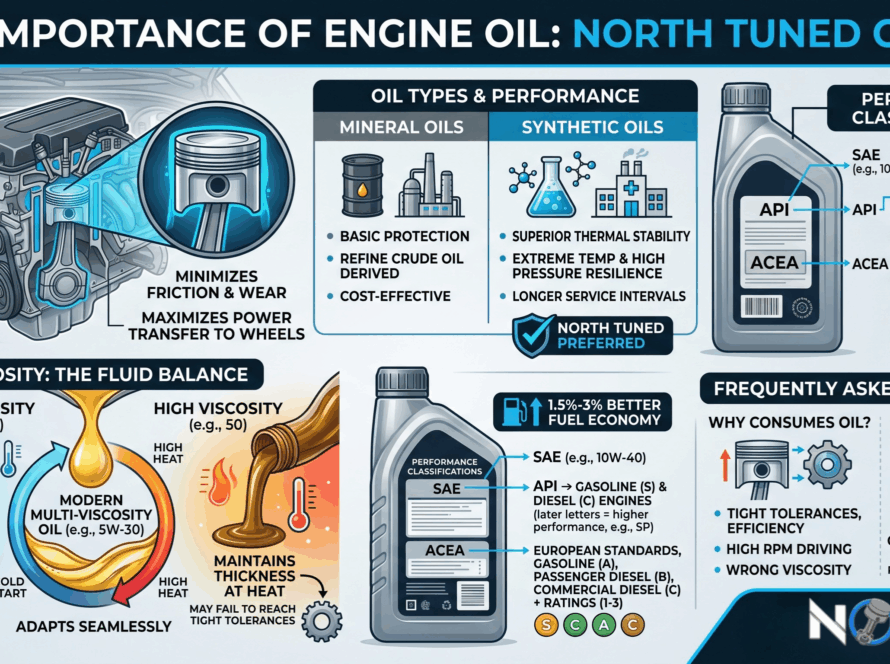
Engine oil is more than just a lubricant; it is a protective shield within your vehicle’s engine. By forming a microscopic film over moving components, it minimizes friction and wear. At North Tuned, we emphasize that selecting the premium oil reduces friction-induced power loss, allowing more effective power transfer to the wheels.

Oil Types and Performance Variations
Mineral Oils: Derived from refined crude oil. While cost-effective, they typically provide only basic protection for modern, high-performance engines.

Synthetic Oils: Engineered in laboratory environments using advanced chemical processes. Within North Tuned performance standards, synthetic oils are preferred for their superior thermal stability and resilience under extreme temperatures or high pressure. They offer longer service intervals and maximum engine longevity.

Viscosity: The Fluid Balance
Viscosity measures an oil’s resistance to flow.

Low Viscosity (e.g., 0W): Flows quickly in cold temperatures, ensuring protection during cold starts.

High Viscosity (e.g., 50): Maintains thickness at high heat but may fail to reach tight engine tolerances if too thick.

North Tuned Note: Modern multi-viscosity oils (like 5W-30) adapt seamlessly to changing climates. These oils provide 1.5% to 3% better fuel economy compared to single-grade oils.

Performance Classifications (SAE, API, ACEA)
The codes on the back of the bottle are vital for your engine’s health:

SAE: Defines the flow grade (e.g., 10W-40).

API: Indicates suitability for Gasoline (S) or Diesel (C) engines. Later letters in the alphabet (e.g., SP) signify higher performance levels.

ACEA: European standards categorizing oils for Gasoline (A), Passenger Diesel (B), and Commercial Diesel (C), followed by performance ratings (1-3).

Frequently Asked Questions
Why does my engine consume oil? Modern engines use tight metal-to-metal tolerances for efficiency, which can lead to slight consumption. Excessive loss is often due to high RPM driving, incorrect oil viscosity, or mechanical wear.

Can I mix different brands? In emergencies, you can top up with the same viscosity and API class. However, mixing mineral and synthetic oils compromises the chemical structure. North Tuned recommends a full oil change as soon as possible after mixing.

read more