
Tag: car tuning

How to Protect Your Engine: Critical Tuning Mistakes and Prevention

How to Protect Your Engine: Critical Tuning Mistakes and Prevention

Performance tuning is a craft that balances art and engineering. At North Tuned, we believe that true performance isn’t just about the peak numbers on a dyno sheet—it’s about how long that engine can sustain those numbers.

1. Tuning Without Pre-Inspection
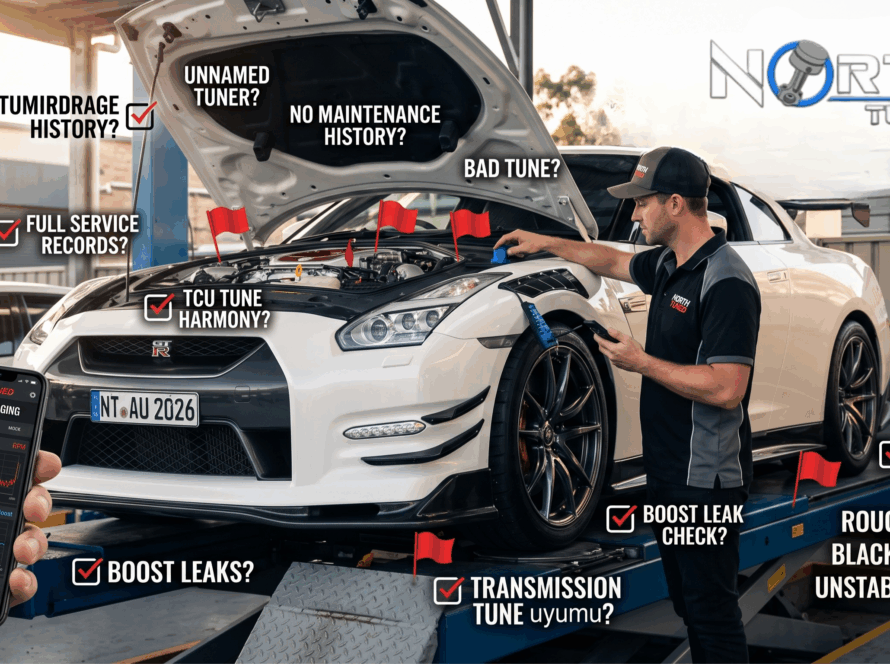
Tuning an engine with existing mechanical issues is like building a skyscraper on a swamp.

The Mistake: Installing a performance map on a car with old spark plugs, a tired fuel pump, or vacuum leaks.

The Outcome: The added stress of increased boost or timing will inevitably cause the weakest link to fail.

North Tuned Pro-Tip: Always perform a diagnostic scan and check for boost leaks before modifying the ECU.

2. Neglecting Thermal Management
Power is a byproduct of combustion, and combustion generates heat. If you increase the energy, you must increase the cooling.

The Mistake: Pushing high boost levels on a stock intercooler.

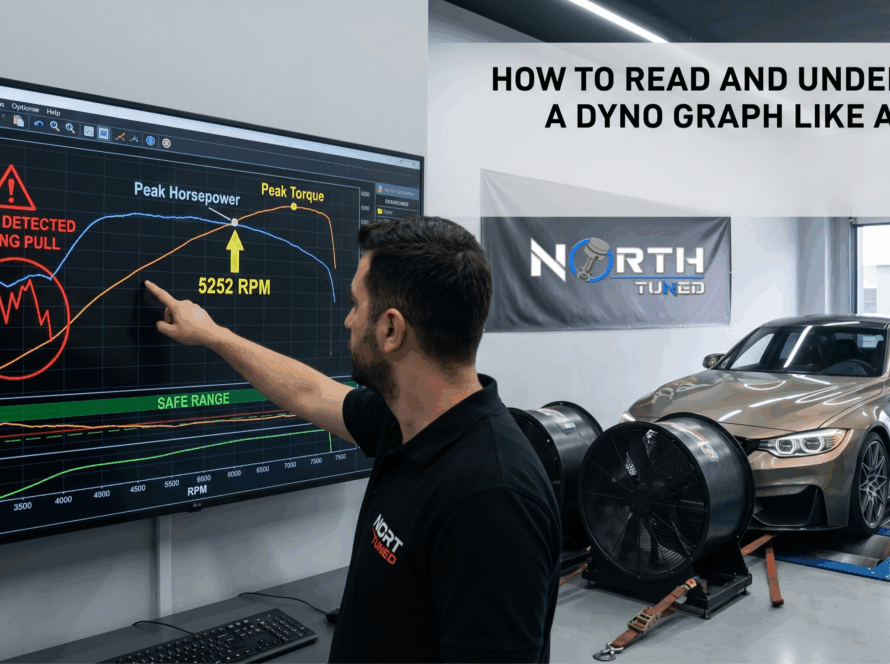
The Outcome: High Intake Air Temperatures (IATs) lead to ignition timing pull and potential engine knock (detonation).

Solution: For Stage 2+ builds, upgrading the cooling system is not optional; it is a necessity for engine longevity.

3. Chasing Boost Instead of Efficiency
A common misconception is that “More Boost = More Power.”

The Mistake: Overworking a small turbocharger beyond its efficiency map.

The Technical Side: When a turbo is pushed too hard, it simply blows hot, turbulent air. This increases backpressure and heat without adding significant oxygen.

Solution: Focus on optimizing the Air-Fuel Ratio (AFR) and ignition timing. Sometimes, less boost with better timing yields more reliable power.

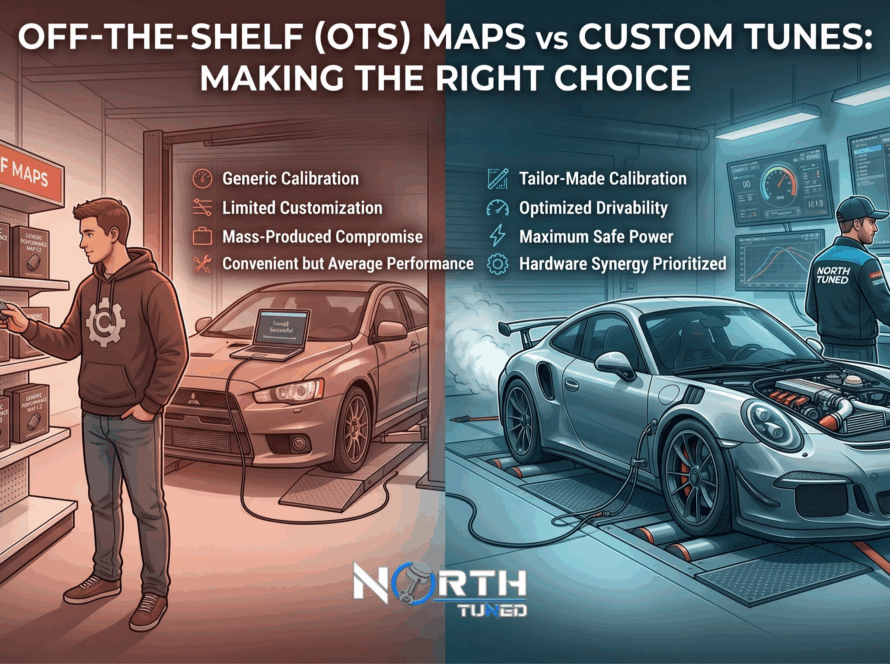
4. The Danger of “Generic” Off-the-Shelf Tunes
Every car lives a different life. A car in a high-altitude region needs different parameters than one at sea level.

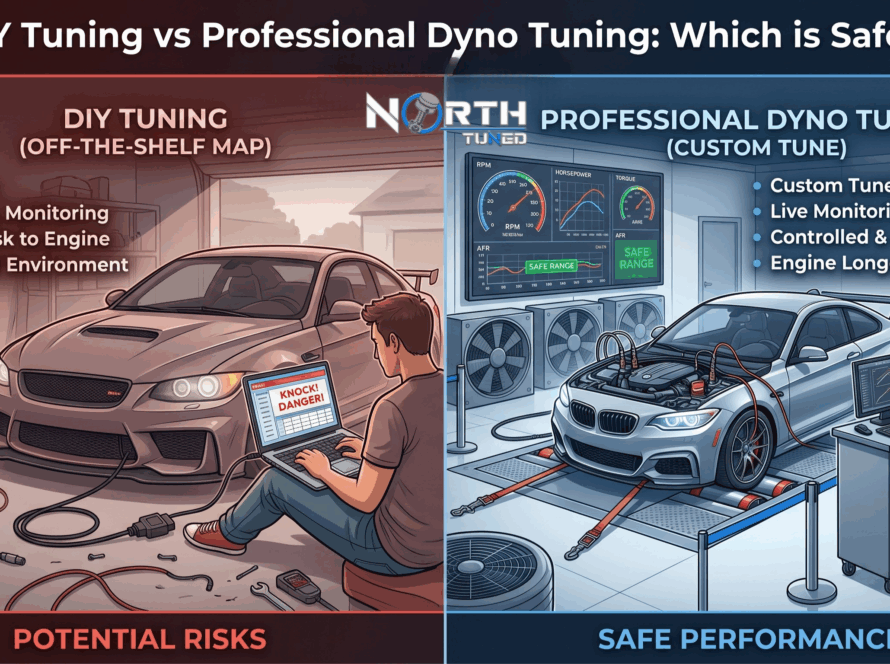
The Mistake: Using cheap, non-adjustable files that don’t account for fuel quality or hardware health.

The Outcome: Poor drivability and a high risk of catastrophic failure under load.

The North Tuned Approach: We prioritize Data Logging. By analyzing how your specific engine reacts in real-time, we fine-tune the software to ensure maximum safety margins.

5. Forgetting the Drivetrain
An engine is only as good as the wheels it turns.

The Mistake: Increasing torque significantly without recalibrating the Transmission Control Unit (TCU).

The Outcome: Slipped clutches in DSG/ZF gearboxes or snapped axles.

Solution: Match your ECU tune with a TCU tune to increase clutch clamping pressure and optimize shift points.

read more
Camshaft and Performance (High-Cam) Camshaft Guide: With North Tuned Expertise

Camshaft and Performance (High-Cam) Camshaft Guide: With North Tuned Expertise

At the heart of every engine lies the master of synchronization: the Camshaft. At North Tuned, we understand that efficiency and pure power are hidden within the precise calibration of this vital component.

What is a Camshaft and How Does It Work?
The camshaft is a critical auxiliary shaft that receives its motion from the crankshaft to manage engine valves. In a standard four-stroke engine, while the crankshaft completes two full rotations (720°), the camshaft completes one (360°).

Its primary duty is to dictate exactly when the intake and exhaust valves open and how long they remain open with millimetric precision. Usually manufactured from high-quality carbon steel through casting or forging, the camshaft features journals, drive gears, and the “cams” that physically actuate the valves.

Power Transmission and Risk Factors
The method of driving the camshaft varies by engine architecture:

Timing Belt/Chain: Used in inline engines where the distance between shafts is significant. At North Tuned, we warn that a snapped or slipped timing belt causes valves to collide with pistons, leading to catastrophic engine failure.

Gear-to-Gear: Common in some V-type configurations where the shafts are close, offering the most durable and efficient transfer.

Signs of Wear and Performance Loss
Even slight wear on the cam lobes results in reduced valve lift or incorrect timing. This restricts the engine’s “breathing,” leading to power loss, poor combustion, and increased fuel consumption.

The Key to Performance: High-Duration (Performance) Camshafts
For those seeking to unlock the true potential of their engine, the first stop is the Performance Camshaft. With North Tuned solutions, we bypass the restrictive profiles of OEM shafts to redefine your engine’s character.

How Does It Generate Power?
High-performance camshafts increase the “duration” (time open) and “lift” (depth of opening) of the valves. Allowing more air-fuel mixture into the combustion chamber per cycle results in a more powerful explosion, leading to power gains of up to 35%.

Technical Terminology & North Tuned Analysis
LIFT: Indicates how far the camshaft pushes the valve open. Higher lift means a larger “curtain area” for airflow.

DURATION: The measurement of how long the valve stays off its seat, measured in degrees of crankshaft rotation.

OVERLAP: The critical window where both intake and exhaust valves are open simultaneously. This scavenges exhaust gases and pulls in fresh charge at high RPMs.

POWER BAND: The RPM range where the camshaft profile is most efficient. At North Tuned, we optimize this band based on your needs, whether for the track or the street.

Vital Note: A performance camshaft is not a standalone miracle. To achieve maximum reliability and output, this modification should be supported by reinforced valve springs, adjustable cam gears, and most importantly, a custom North Tuned ECU Remap.

read more
Optimizing Your Car for Track Days via Tuning Software: The Ultimate North Tuned Guide

Optimizing Your Car for Track Days via Tuning Software: The Ultimate North Tuned Guide

For automotive enthusiasts, a “Track Day” is more than a hobby; it’s a test of engineering and skill. Those few hours spent pushing your car to its absolute limits require a perfect symphony between mechanical hardware and digital software. While most focus on brakes and tires, the true potential of a modern vehicle lies within its ECU (Engine Control Unit).

At North Tuned, we specialize in unlocking that potential, transforming a street-legal car into a consistent, high-performance track weapon through precision software calibration.

1. Power Delivery and Predictability
On the street, software is designed for fuel economy. On the track, the goal is “predictability.”

Linear Power Delivery: Factory turbo maps often have sudden spikes in boost. In the middle of a high-speed corner, this can cause an upset in the chassis. North Tuned reshapes the boost curve to ensure that power builds progressively, giving you total control over traction.

Torque Management: By optimizing torque delivery in lower gears, we reduce unnecessary wheel spin, ensuring that every bit of power is converted into forward momentum as you exit the apex.

2. Advanced Thermal Management
Heat is the silent killer on the track. A 20-minute session subjects the engine to thermal stresses that a street car rarely sees.

Component Protection (EGT): Our calibrations include sophisticated safety maps. If Exhaust Gas Temperatures reach critical levels, the ECU automatically adjusts fueling to cool the internal components, preventing catastrophic failure.

Cooling System Optimization: We recalibrate fan duty cycles and water pump flow to trigger earlier. This ensures the engine remains in its optimal operating window even during the final laps of a hot summer session.

3. TCU Tuning: The Transmission Connection
For owners of DSG, PDK, or ZF8 gearboxes, the transmission software is just as vital as the engine map.

Shift Speed & Force: We decrease shift times to near-instantaneous levels, ensuring there is zero “dead time” during acceleration.

Kickdown Deactivation: Nothing is more frustrating than a car downshifting automatically when you are holding a gear for balance. Our TCU tunes give you 100% manual control, preventing unwanted gear changes at the limit.

4. Track-Specific Calibration Features
Left Foot Braking: Factory logic often cuts the throttle if the brake is pressed simultaneously. We remove this restriction, allowing advanced drivers to use the brake to tuck the nose into a corner while maintaining boost.

Dynamic Throttle Mapping: We sharpen the throttle response to eliminate lag, creating a telepathic connection between your right foot and the engine’s output.

read more
The Environmental Impact of DPF and EGR Deletes: Performance vs. Planet

The Environmental Impact of DPF and EGR Deletes: Performance vs. Planet

In the world of diesel tuning, the debate over DPF (Diesel Particulate Filter) and EGR (Exhaust Gas Recirculation) deletes is often framed as a choice between reliability and bureaucratic regulations. However, at North Tuned, we believe it is crucial to understand the scientific and environmental weight of these modifications. While deleting these components might offer a slight boost in horsepower, the ecological footprint left behind is massive.

The Science Behind the Shield
To appreciate why these systems are vital, we must look at what they prevent:

EGR Systems: By recirculating a portion of exhaust gas, the oxygen concentration in the combustion chamber is lowered, which in turn reduces the peak combustion temperature. This is critical because Nitrogen Oxides ($NO_x$)—one of the most dangerous pollutants—are only formed at extreme temperatures.

DPF Systems: This is a sophisticated honeycomb structure that captures up to 99% of particulate matter (soot). Without it, these particles are released directly into the air we breathe.

The Real-World Consequences of “Deleting”

When a vehicle undergoes a DPF or EGR delete, it ceases to be a modern, clean machine and becomes a significant source of pollution.

1. The Nitrogen Oxide Crisis
Removing the EGR valve leads to a massive spike in $NO_x$ emissions. These gases are precursors to ground-level ozone, which causes severe respiratory distress in humans and contributes to the formation of “smog” that blankets major cities. On a global scale, $NO_x$ is a significant driver of the greenhouse effect, being far more potent than $CO_2$.

2. Invisible Killers: Particulate Matter
A DPF-deleted truck or car releases PM2.5—fine particles smaller than 2.5 micrometers. These particles are small enough to bypass the body’s natural filters, settling deep in the lungs and even entering the bloodstream. Scientific studies have linked this exposure to heart attacks, aggravated asthma, and decreased lung function in children.

3. Environmental Degradation
The environmental impact extends beyond human health. High levels of $NO_x$ contribute to the acidification of oceans and soil. This affects biodiversity, kills sensitive plant species, and disrupts the nitrogen cycle in our forests.

The North Tuned Philosophy: Engineering a Greener Future

At North Tuned, we don’t believe you should have to choose between a fast car and a clean planet. Our approach to tuning is rooted in optimization, not destruction.

Smart Tuning: We use advanced software to optimize fuel maps and timing, improving throttle response and fuel economy while keeping the DPF and EGR fully functional.

Professional Maintenance: We advocate for specialized cleaning services that restore these components to factory efficiency, saving you money on replacements without hurting the environment.

Ethical Performance: True engineering excellence lies in making a system work better within its intended design.

By choosing responsible tuning, you ensure that your vehicle performs at its peak while respecting the air we all share. At North Tuned, we lead the way in sustainable performance.

read more
Best Cars for Stage 3 Tuning in Australia: A Complete Guide

Best Cars for Stage 3 Tuning in Australia: A Complete Guide

If you are looking to build a true power monster on Australian streets or tracks, “Stage 1” and “Stage 2” are merely the appetizers. Stage 3 is where the rules of the game truly change. This level involves turbo upgrades, fuel system overhauls, and internal engine reinforcements, turning a standard daily driver into a “supercar killer.”

At North Tuned, we have selected the best platforms for Stage 3 tuning, keeping in mind Australia’s unique climate conditions and fuel quality.

What is Stage 3?
Stage 3 is the phase where we go beyond just software (ECU remapping) and push the physical limits of the hardware. It typically includes:

Upgraded Hybrid or Big Turbo kits.

High-pressure fuel pumps (HPFP) and larger injectors.

Advanced intercoolers and cooling systems.

Transmission (TCU) tuning and clutch upgrades.

Top Stage 3 Candidates in the Australian Market
1. Volkswagen Golf R (Mk7 / Mk7.5 / Mk8)
VAG group vehicles are the gold standard for Stage 3 tuning. The EA888 engine block can easily reach 500+ hp with just a turbo swap and a precision North Tuned map.

Why? Massive aftermarket support and the 4Motion AWD system that puts the power down effectively.

2. BMW M3/M4 (S55 & S58 Engines)
Bavarian engineering takes on a whole new identity at Stage 3. The new S58 engine, in particular, is so robust that pushing past the 700hp mark with “bolt-on” turbo kits is becoming a common sight at Australian drag strips.

3. Nissan Patrol (Y61 & Y62) – Australia’s Heavyweight
Australia is synonymous with off-roading. Adding a supercharger or a twin-turbo setup to the Y62’s V8 transforms this massive SUV into a desert-conquering rocket.

4. Audi RS3 (DAZA / DNWA)
The legendary 5-cylinder engine is a masterpiece. A Stage 3 RS3 is perhaps the most efficient way to achieve 0-100 km/h times in the 2-second range. With a TTE or Garrett turbo upgrade, the sound and speed are unmatched.

Why Choose North Tuned?
Stage 3 tuning leaves no room for error. An incorrect air-fuel ratio or excessive boost can lead to catastrophic engine failure. At North Tuned, we specialize in Custom Dyno Tuning tailored to your specific hardware, ensuring that your quest for more power doesn’t compromise reliability.

read more
Performance Mods That Pair Perfectly With ECU Tuning

Performance Mods That Pair Perfectly With ECU Tuning

When it comes to unlocking a vehicle’s true potential, ECU Tuning is often the first step. However, at North Tuned, we believe that software is like a conductor; for it to produce the best symphony, the instruments beneath it must be up to the task.

Here are the top performance modifications that complement your tune and help your engine “breathe” better.

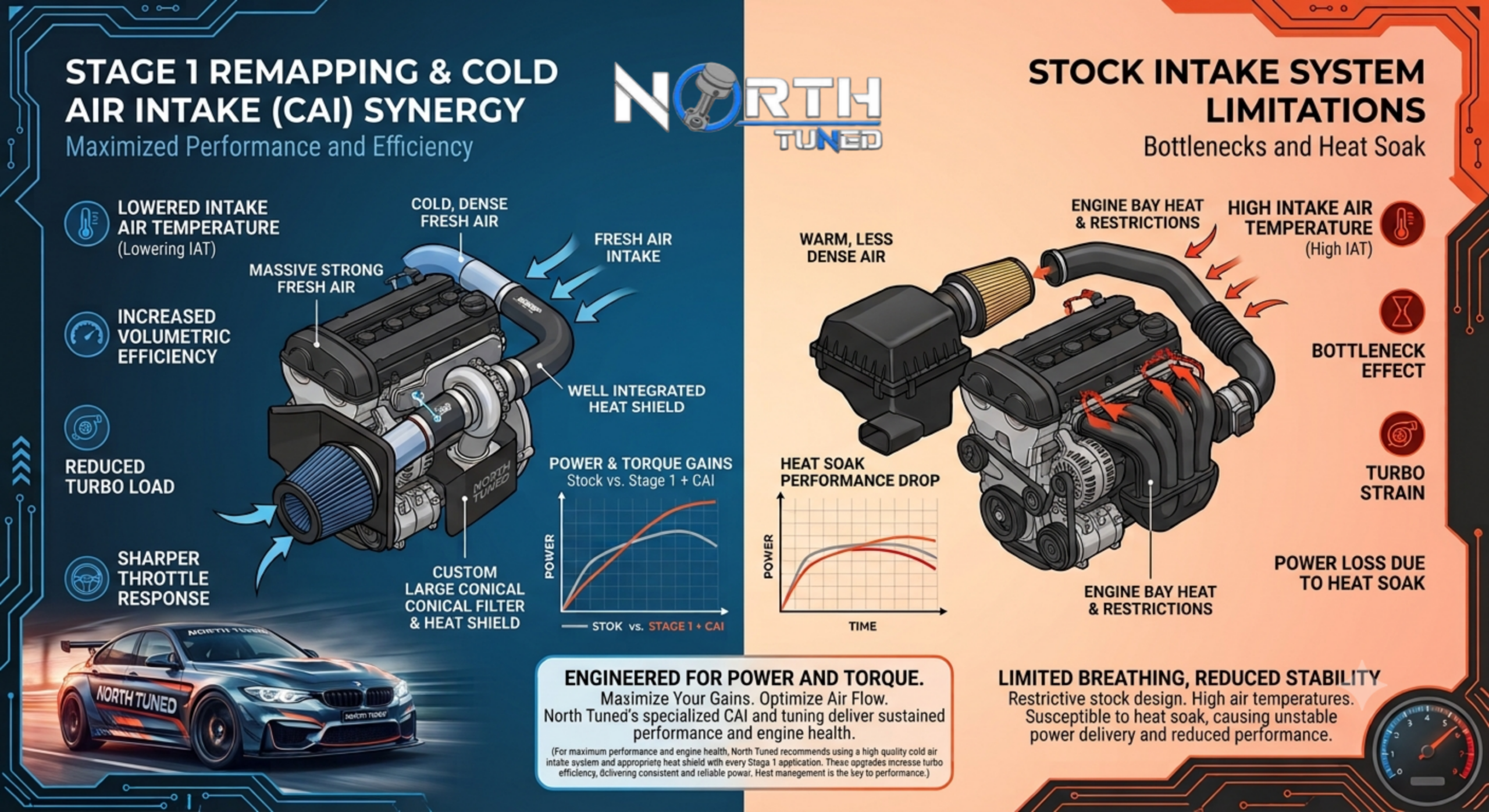
1. High-Flow Air Filters & Cold Air Intakes
A tuned engine demands more fuel, which in turn requires more oxygen. Stock paper filters often create a bottleneck.

Benefit: Increases airflow volume and sharpens throttle response.

2. Downpipe and Exhaust Upgrades
In turbocharged engines, getting exhaust gases out quickly is crucial. Standard catalytic converters can create backpressure and trap heat during high-performance driving.

Benefit: Lowers Exhaust Gas Temperatures (EGT) and allows the turbo to spool up faster.

3. Upgraded Intercooler
More boost equals more heat. When intake air gets too hot, it loses density, leading to “heat soak” and power loss.

Benefit: Keeps intake temperatures low, ensuring consistent power delivery even under hard driving.

4. Ignition System (Spark Plugs & Coils)
Under increased boost and cylinder pressure, stock spark plugs might struggle to ignite the mixture, leading to misfires.

Benefit: A stronger spark ensures complete combustion and a smoother power band.

North Tuned Insight: To get the most out of these hardware changes, your ECU map should be calibrated to recognize the improved airflow and cooling. Efficiency and longevity go hand in hand.

read more

How to Measure Your Car’s Performance After a Tune

Getting a professional tune (remapping) is the most exciting way to unlock your vehicle’s hidden potential. However, simply saying “it feels faster” isn’t enough. To truly understand the gains, you need empirical data. Here is how we at North Tuned recommend verifying your performance increase:

1. Dyno (Dynamometer) Testing
This is the gold standard. A dyno measures the horsepower (HP) and torque (Nm) delivered to the wheels.

Before/After: Performing a run right before and right after the tune provides a clear picture of the changes in the power band.

Health Check: It allows technicians to monitor Air-Fuel Ratios (AFR) to ensure the tune is running safely under load.

2. GPS-Based Performance Meters (Dragy or VBOX)
Devices like Dragy are the best way to turn feelings into facts. These use high-frequency GPS (10Hz or higher) to track acceleration with extreme precision.

0-100 km/h & 100-200 km/h: These are the industry standards for measuring real-world acceleration.

Slope Correction: These devices account for road incline, giving you a “valid” and honest result regardless of the terrain.

3. OBDII Data Logging
Speed is only one part of the story; how the engine achieves that speed matters for longevity. Use an OBDII scanner to log:

Boost Levels: Is the turbo hitting the requested targets?

Ignition Timing: Is the engine running efficiently without “pulling” timing due to knock?

Intake Air Temperatures (IAT): Is your cooling system handling the extra power effectively?

4. In-Gear Acceleration (Flexibility)
This is the most relevant metric for daily driving. For example, measure the time it takes to go from 80 km/h to 120 km/h in 4th gear. The reduction in this timeframe is the best indicator of your car’s increased “punch” and torque delivery.

read more
What is NOS (Nitrous Oxide System)? The Chemistry of Performance

What is NOS (Nitrous Oxide System)? The Chemistry of Performance

For speed enthusiasts and performance seekers, NOS (Nitrous Oxide System) remains one of the most intriguing and effective ways to achieve instantaneous power gains in internal combustion engines. But how exactly does this system work, and what happens at the heart of your vehicle? As North Tuned, we take a closer look at this adrenaline-pumping technology.

How Does NOS Work? The Formula of Power
The power generated by an internal combustion engine depends on how violently the oxygen taken in can be detonated with the injected fuel. In standard engine tuning, the goal is to increase the air-fuel mixture entering the engine. NOS takes this process to a much more radical level.

Oxygen Enrichment: When Nitrous Oxide gas enters the combustion chamber, it breaks down due to heat, releasing pure oxygen. This represents a much higher concentration of oxygen compared to regular atmospheric air.

Cooling Effect: The cooling effect created as the gas exits the cylinder increases the density of the intake air. Cooler air is denser, allowing significantly more oxygen to fill the combustion chamber than normal.

Powerful Combustion: With the increased oxygen, more fuel is delivered to the system. The result is a much more powerful explosion, leading to a massive increase in horsepower delivered to the wheels.

Why Choose NOS?
Factory-spec cars are manufactured with performance values below their true potential to ensure fuel economy and durability under all road conditions. A NOS kit, applied with North Tuned expertise, awakens the “sleeping giant” within your vehicle’s DNA—only when you need it.

The biggest advantage of the system is that it is “on-demand.” While providing a standard driving experience for daily city use, you can transform your car into a high-performance machine with a single touch whenever extra power is required.

Does NOS Damage the Engine?
Let’s provide a clear answer to the most frequently asked question: Not with the right setup and correct limits.

The key to preventing engine damage is selecting the appropriate horsepower gain. As long as you do not exceed the load capacity that your engine components (pistons, rods, bearings) can tolerate, no additional wear occurs.

Safe Power Gains with North Tuned:

Precise Calibration: For high-level horsepower increases, we meticulously perform critical adjustments such as spark plug selection and ignition timing retardation.

Fuel Optimization: We ensure the fuel system and octane levels are correctly tuned to support the increased power.

Controlled Power: By activating the system only when performance is needed, you preserve the overall longevity of your engine.

Push the Limits with North Tuned
If you want to discover your vehicle’s true potential and achieve safe performance gains, you are in the right place. To get detailed information about NOS applications and our other performance solutions, and to determine the most suitable kit for your vehicle, feel free to contact us.

read more
Stage 2 Tuning for Daily Drivers: Is It Worth the Investment?

Stage 2 Tuning for Daily Drivers: Is It Worth the Investment?

For many enthusiasts, a car is more than just a tool for commuting; it’s a passion project. When the factory power feels insufficient, Stage 2 tuning is often the next logical step. But is it practical for a vehicle you drive every single day?

What is Stage 2?
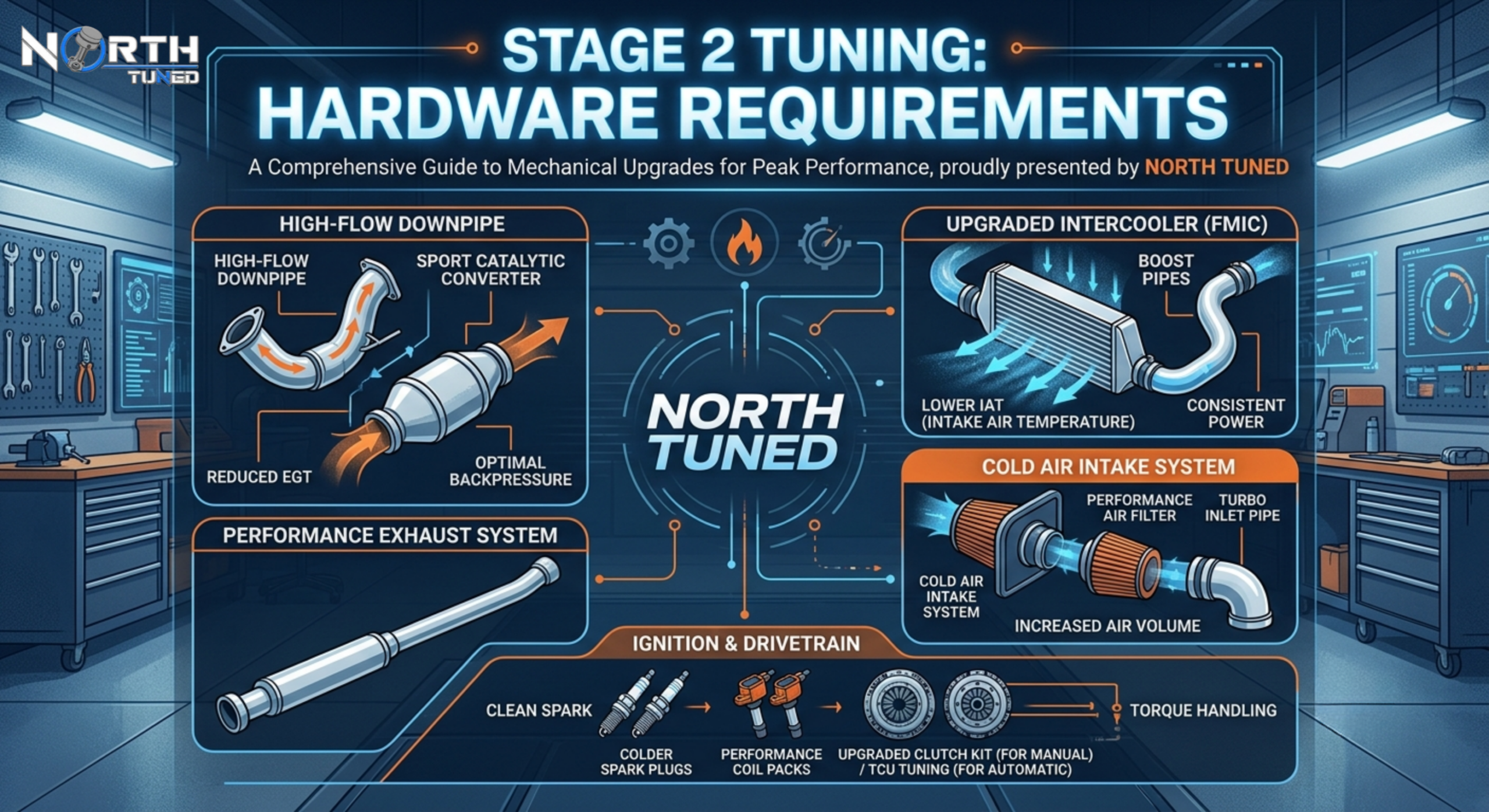
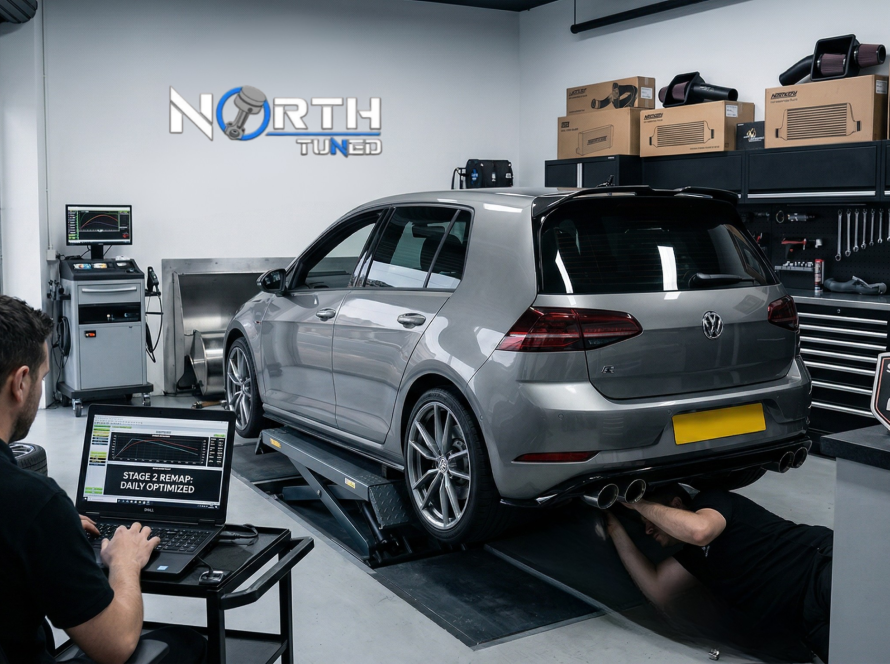
Unlike Stage 1, which is primarily a software-only upgrade, Stage 2 requires hardware modifications to help the engine “breathe” better. Typical upgrades include:

Downpipe: For faster exhaust gas evacuation.

Upgraded Intercooler: To ensure cooler, denser air intake.

High-Flow Air Intake: To reduce intake restriction.

Custom Remap: ECU calibration optimized for these specific hardware changes.

Pros and Cons for the Daily Drive
A Stage 2 vehicle offers a much broader torque curve and more aggressive acceleration compared to Stage 1. However, there are trade-offs to consider:

Performance: Significant gains in overtaking power and highway merging.

Fuel Economy: While efficiency can improve during cruising, spirited driving will see a noticeable jump in fuel consumption.

NVH (Noise, Vibration, Harshness): An aftermarket downpipe will increase exhaust volume. This might be thrilling for some but tiring for others in heavy traffic.

Reliability: Since you are pushing the engine further, high-quality maintenance becomes non-negotiable.

The Verdict: Is it worth it?
If you view driving as an experience rather than a chore and are willing to invest in the supporting hardware, Stage 2 is absolutely worth it. It transforms the character of the car without sacrificing total usability. At North Tuned, we believe the key is balance—achieving maximum performance while staying within the safe mechanical limits of your engine.

read more
What Are Stage 1, 2, and 3 Tunes?

What Are Stage 1, 2, and 3 Tunes?

In the car modification world, the concept of a tuning “Stage” is something we hear frequently, yet even experienced car enthusiasts sometimes struggle to define their exact boundaries. Let’s summarize what kind of modifications are done at each level to improve your car’s performance, using a clear and straightforward approach:

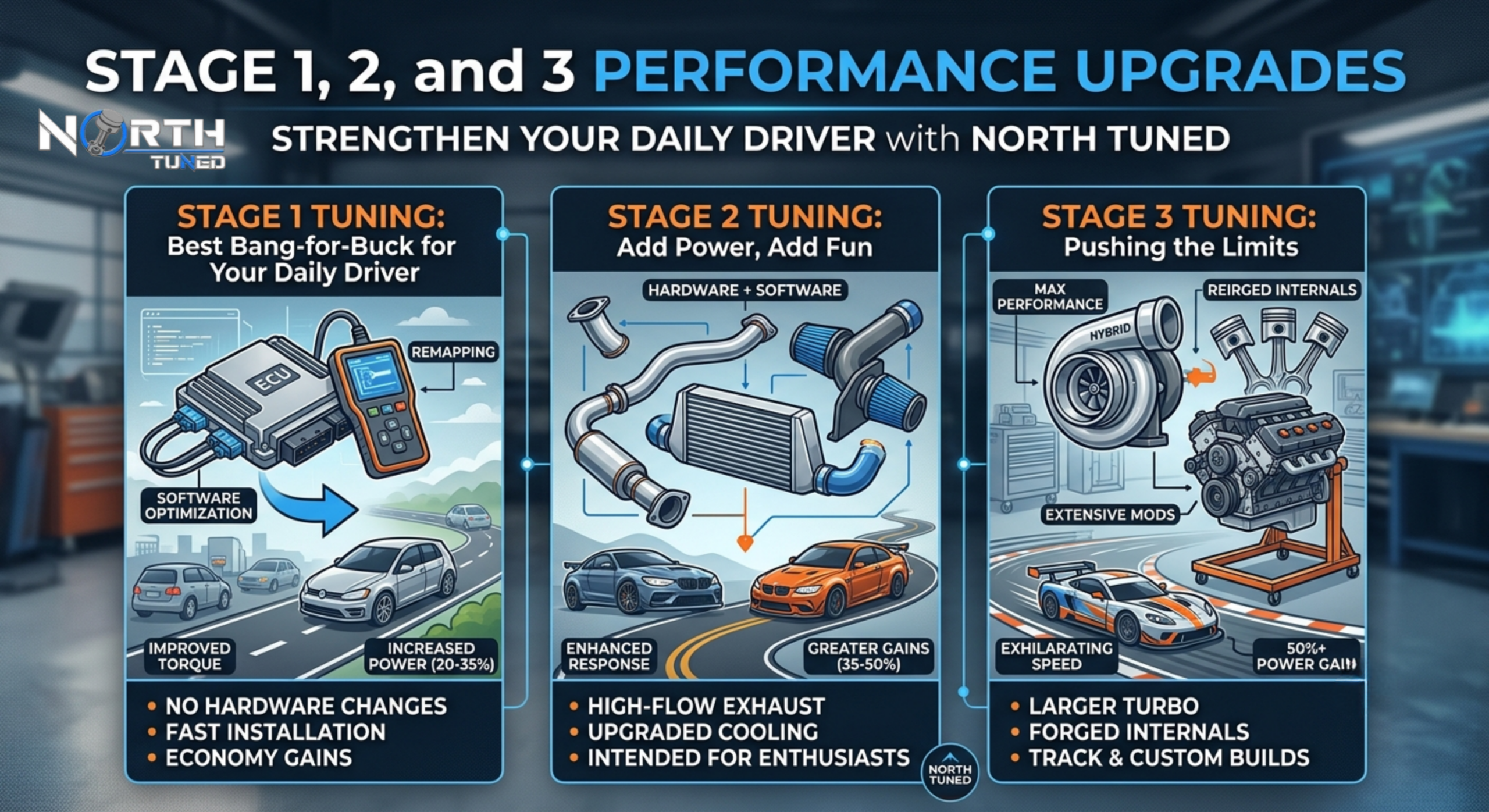
Stage 1: The Beginner and Foundation Phase
This is the most practical modification step, achieved without altering the car’s original mechanical structure, opening the engine block, or engaging in heavy fabrication. It mostly utilizes “plug-and-play” parts. While being the most cost-effective stage, it allows the car to breathe better and builds a solid foundation for future, larger power upgrades.

Key Upgrades Include:

Cold Air Intake kits

Sports exhaust systems and Downpipes (catalytic converter removal/decats)

Colder performance spark plugs and ignition coils

Blow Off / Dump Valves for turbocharged cars

Mild performance software that doesn’t stress the engine internals (Soft Chip Tuning / Remap)

Ignition timing optimization

Stage 2: The Intermediate Level and Mechanical Enhancement
This is the stage you move to when the power gained from Stage 1 simply isn’t enough, marking the beginning of significant hardware changes to the engine. Although it doesn’t require a heavy internal engine rebuild, professional labor and a custom software update are mandatory to ensure the new, larger parts work together in harmony.

Key Upgrades Include:

Enlarging the existing turbo (Hybrid turbo upgrades)

Installing a larger capacity Intercooler to better cool the compressed air

Fuel injector and high-pressure fuel pump upgrades to supply more fuel

Street-profile upgraded camshafts

Upgraded Stage 2 clutch to transmit the increased power to the transmission without slipping

Custom-made, large-volume intake or exhaust manifolds

Supercharger or larger turbo conversions

Stage 3: The Advanced Level and Track-Focused Phase
This is the most aggressive stage where the car almost completely breaks away from comfortable, daily street use and transforms into a purebred race car. You literally dive into the heart of the engine (opening the engine block), and the internal moving parts are replaced with heavy-duty materials designed to withstand extreme pressure.

Key Upgrades Include:

High-pressure resistant Forged pistons and connecting rods (Forged internals)

Upgraded engine valves, heavy-duty valve springs, and titanium retainers

Race-spec (highly aggressive) camshafts that noticeably alter the engine’s idle

Heavy-duty Stage 3 bronze/puck clutch kits

Drivetrain upgrades (heavy-duty driveshafts, axles) to prevent snapping under load

Massive Big Brake Kits (BBK) to tame the dangerous speeds the car can now reach

A completely Custom Engine Tune (Remap) built from scratch specifically for this extensive hardware list

A Quick Summary:
A Stage 3 setup is absolutely not recommended for a daily driver that you use to commute to work or go grocery shopping. Vehicles pushed to their absolute mechanical limits like this require a much more expensive, frequent, and highly meticulous maintenance routine compared to standard cars.

read more