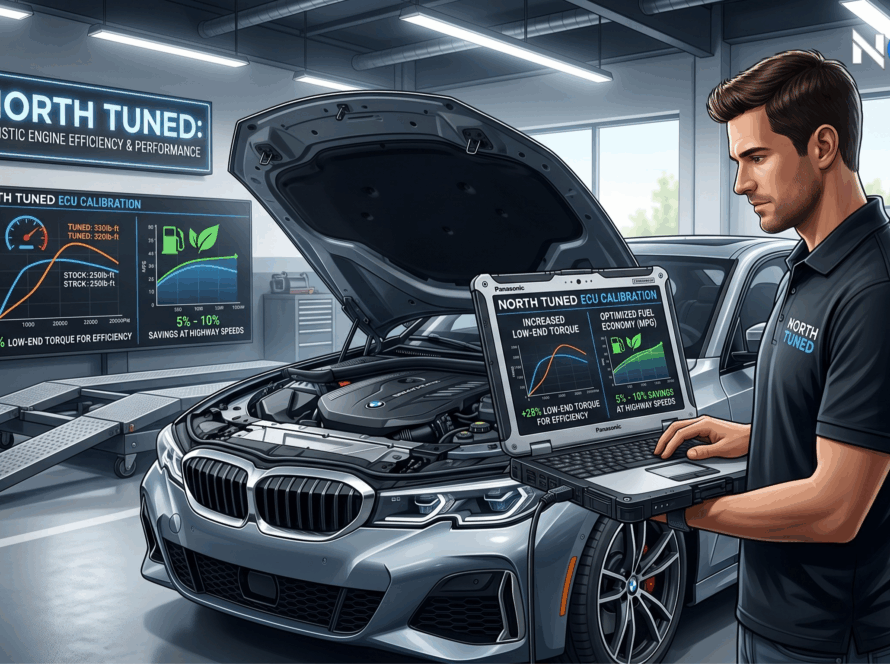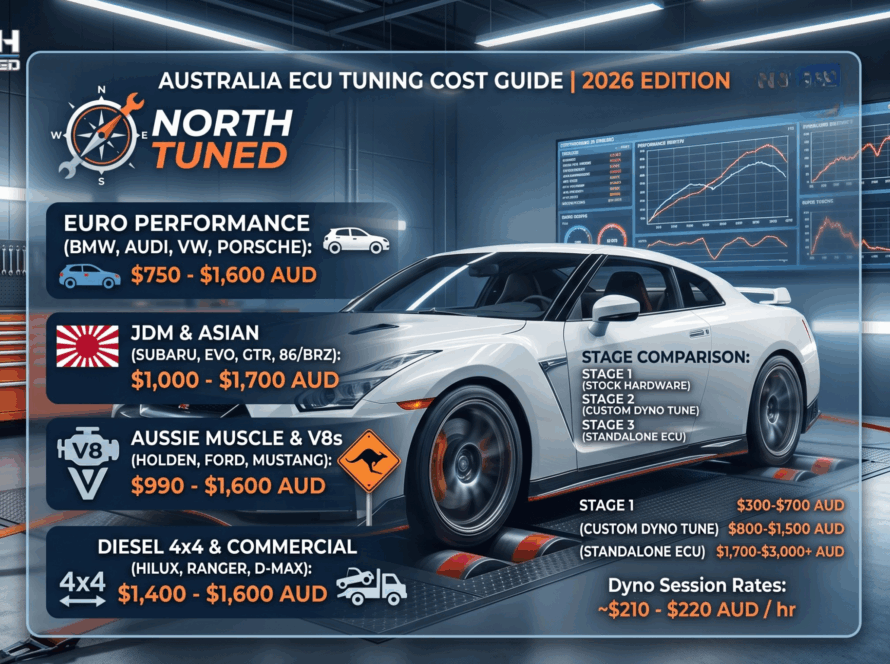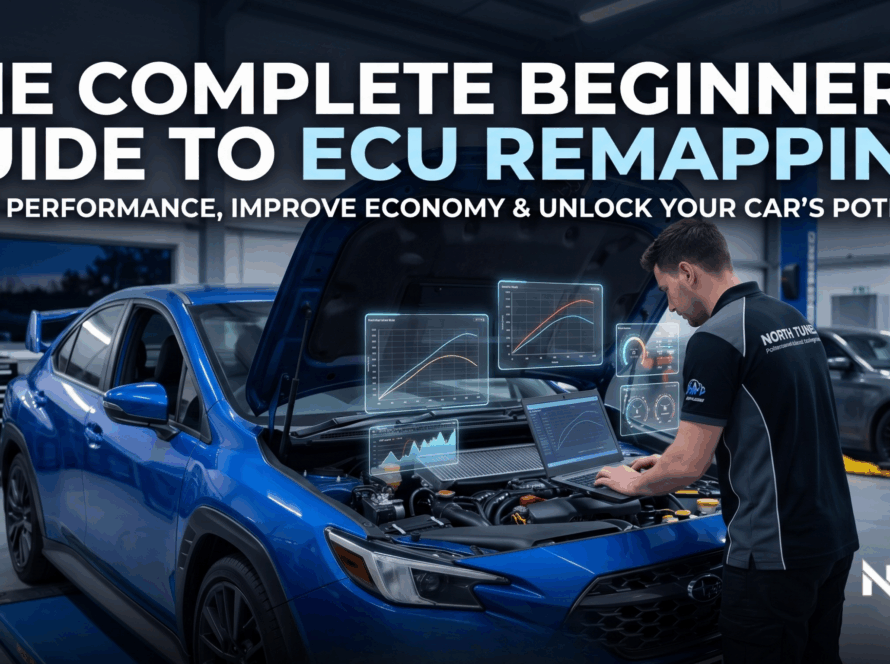

Performance tuning is a craft that balances art and engineering. At North Tuned, we believe that true performance isn’t just about the peak numbers on a dyno sheet—it’s about how long that engine can sustain those numbers.
1. Tuning Without Pre-Inspection
Tuning an engine with existing mechanical issues is like building a skyscraper on a swamp.
The Mistake: Installing a performance map on a car with old spark plugs, a tired fuel pump, or vacuum leaks.
The Outcome: The added stress of increased boost or timing will inevitably cause the weakest link to fail.
North Tuned Pro-Tip: Always perform a diagnostic scan and check for boost leaks before modifying the ECU.
2. Neglecting Thermal Management
Power is a byproduct of combustion, and combustion generates heat. If you increase the energy, you must increase the cooling.
The Mistake: Pushing high boost levels on a stock intercooler.
The Outcome: High Intake Air Temperatures (IATs) lead to ignition timing pull and potential engine knock (detonation).
Solution: For Stage 2+ builds, upgrading the cooling system is not optional; it is a necessity for engine longevity.
3. Chasing Boost Instead of Efficiency
A common misconception is that “More Boost = More Power.”
The Mistake: Overworking a small turbocharger beyond its efficiency map.
The Technical Side: When a turbo is pushed too hard, it simply blows hot, turbulent air. This increases backpressure and heat without adding significant oxygen.
Solution: Focus on optimizing the Air-Fuel Ratio (AFR) and ignition timing. Sometimes, less boost with better timing yields more reliable power.
4. The Danger of “Generic” Off-the-Shelf Tunes
Every car lives a different life. A car in a high-altitude region needs different parameters than one at sea level.
The Mistake: Using cheap, non-adjustable files that don’t account for fuel quality or hardware health.
The Outcome: Poor drivability and a high risk of catastrophic failure under load.
The North Tuned Approach: We prioritize Data Logging. By analyzing how your specific engine reacts in real-time, we fine-tune the software to ensure maximum safety margins.
5. Forgetting the Drivetrain
An engine is only as good as the wheels it turns.
The Mistake: Increasing torque significantly without recalibrating the Transmission Control Unit (TCU).
The Outcome: Slipped clutches in DSG/ZF gearboxes or snapped axles.
Solution: Match your ECU tune with a TCU tune to increase clutch clamping pressure and optimize shift points.
For performance enthusiasts, there are two primary ways to unlock a vehicle’s hidden potential: ECU Remapping and Plug-and-Play (PnP) Tuning Modules. At North Tuned, we’ve analyzed both methods to help you make the best decision for your ride.
1. What is ECU Remapping?
ECU Remapping involves rewriting the original software within your vehicle’s Electronic Control Unit. By removing factory-set restrictions, parameters such as fuel mapping, ignition timing, and boost pressure are fully optimized.
Pros:
Total Control: Every parameter of the engine can be adjusted.
Linear Power Delivery: Power is spread across the entire RPM range for a smoother feel.
Custom Tailored: If you have hardware upgrades (like an intake or exhaust), the map can be customized specifically for those parts.
Speed Limiter Removal: Most remaps allow for the removal of factory speed governors.
Cons:
Reversibility: Requires a professional to flash the car back to stock.
Warranty Concerns: Deep diagnostic scans at dealerships can often detect software changes.
2. What are Plug-and-Play Chips?
PnP modules are external boxes that sit between the engine sensors and the ECU. They function by intercepting and modifying sensor signals to “trick” the ECU into producing more power.
Pros:
Easy Installation: Usually a “DIY” job that takes about 15-20 minutes.
Instant Removal: You can unplug the device before a service visit or when selling the car, leaving no physical trace.
Transferability: Can often be moved to another vehicle with the same engine type.
Cons:
Limited Scope: It can only manipulate a few signals (mostly boost and fuel pressure) rather than managing the entire engine logic.
Less Refined: May not feel as smooth as a remap and can sometimes cause “jerky” power delivery in lower gears.
Feature,ECU Remapping,Plug-and-Play Chip
Power Gains,Maximum & Optimized,Moderate / Standardized
Driveability,Smooth & Natural,Aggressive but can be inconsistent
Installation,Professional Required,DIY Possible
Traceability,Software-visible,Physically removable
North Tuned Verdict
If you are looking for the most efficient, healthy, and bespoke performance increase, ECU Remapping is the superior choice. However, if your car is under a strict warranty or you want a temporary boost that you can remove at any time, a high-quality Plug-and-Play Module is a solid alternative.
For automotive enthusiasts, a “Track Day” is more than a hobby; it’s a test of engineering and skill. Those few hours spent pushing your car to its absolute limits require a perfect symphony between mechanical hardware and digital software. While most focus on brakes and tires, the true potential of a modern vehicle lies within its ECU (Engine Control Unit).
At North Tuned, we specialize in unlocking that potential, transforming a street-legal car into a consistent, high-performance track weapon through precision software calibration.
1. Power Delivery and Predictability
On the street, software is designed for fuel economy. On the track, the goal is “predictability.”
Linear Power Delivery: Factory turbo maps often have sudden spikes in boost. In the middle of a high-speed corner, this can cause an upset in the chassis. North Tuned reshapes the boost curve to ensure that power builds progressively, giving you total control over traction.
Torque Management: By optimizing torque delivery in lower gears, we reduce unnecessary wheel spin, ensuring that every bit of power is converted into forward momentum as you exit the apex.
2. Advanced Thermal Management
Heat is the silent killer on the track. A 20-minute session subjects the engine to thermal stresses that a street car rarely sees.
Component Protection (EGT): Our calibrations include sophisticated safety maps. If Exhaust Gas Temperatures reach critical levels, the ECU automatically adjusts fueling to cool the internal components, preventing catastrophic failure.
Cooling System Optimization: We recalibrate fan duty cycles and water pump flow to trigger earlier. This ensures the engine remains in its optimal operating window even during the final laps of a hot summer session.
3. TCU Tuning: The Transmission Connection
For owners of DSG, PDK, or ZF8 gearboxes, the transmission software is just as vital as the engine map.
Shift Speed & Force: We decrease shift times to near-instantaneous levels, ensuring there is zero “dead time” during acceleration.
Kickdown Deactivation: Nothing is more frustrating than a car downshifting automatically when you are holding a gear for balance. Our TCU tunes give you 100% manual control, preventing unwanted gear changes at the limit.
4. Track-Specific Calibration Features
Left Foot Braking: Factory logic often cuts the throttle if the brake is pressed simultaneously. We remove this restriction, allowing advanced drivers to use the brake to tuck the nose into a corner while maintaining boost.
Dynamic Throttle Mapping: We sharpen the throttle response to eliminate lag, creating a telepathic connection between your right foot and the engine’s output.
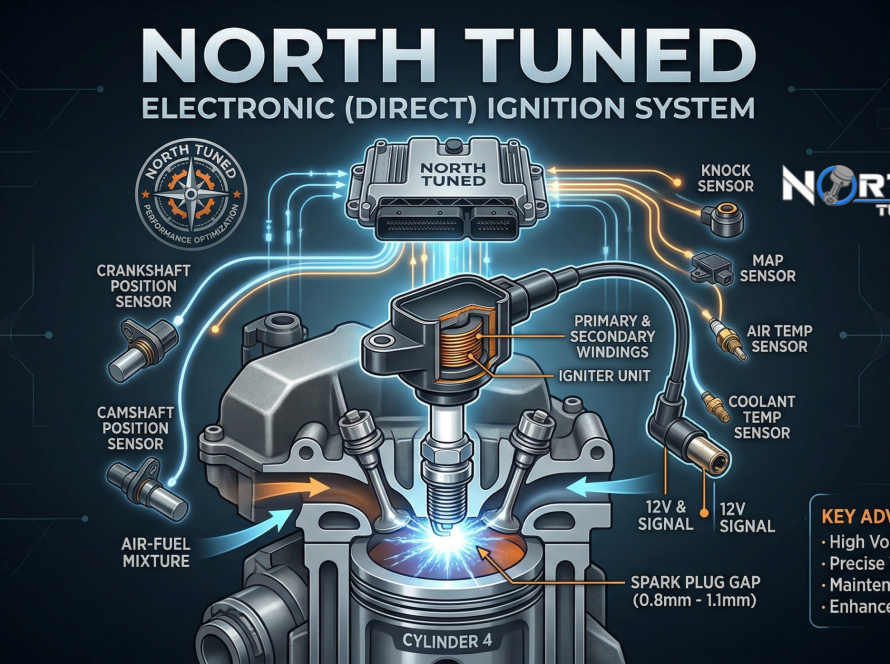
The primary function of a standalone electronic ignition system is to ignite the air-fuel mixture in the combustion chamber at the most optimal moment, providing the necessary ignition advance for peak engine performance. At North Tuned, we prioritize millisecond precision in ignition timing to ensure a superior high-performance driving experience.

Operating Principle
In this system, an independent ignition coil is utilized for each cylinder. These coils integrate the igniter unit, primary, and secondary windings, connecting directly to the spark plug. Unlike traditional systems, there are no spark plug wires; the coils are powered by a 12V supply and controlled via signal currents directly from the ECU.
As we emphasize in North Tuned software optimization processes, the Engine Control Unit (ECU) processes real-time data from crankshaft and camshaft sensors. By controlling the primary circuit of each cylinder’s coil, it generates high voltage at the exact required moment to trigger flawless combustion.
Key Sensors and Their Roles
The ECU manages the ignition map based on data from several critical sensors:
Crankshaft & TDC Sensor: Determines engine RPM and piston position.
Camshaft (Phase) Sensor: Verifies the timing of the cylinders.
Knock Sensor: Monitors pre-ignition to ensure engine safety.
MAP/MAF Sensor: Measures intake manifold pressure and air mass flow.
Temperature Sensors: Optimizes advance based on coolant and intake air temperatures.
Advantages of the System with North Tuned
High Voltage Power: Produces up to 40,000 Volts for a stronger spark and complete combustion.
Precise Advance Management: Electronic control delivers maximum performance and optimized fuel efficiency.
Mechanical Reliability: No moving or friction-based parts, leading to lower failure rates and zero maintenance.
Wide Spark Plug Gap: A gap of 0.8 mm – 1.1 mm allows for a larger flame kernel and significant power gains.
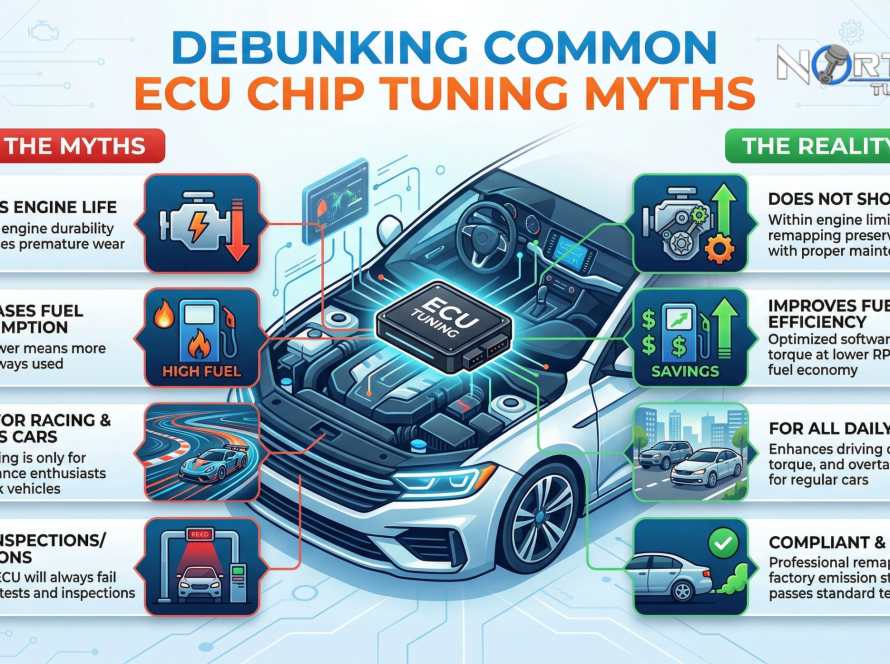
In the automotive world, the most effective way to increase performance is ECU (Engine Control Unit) Chip Tuning. As this technology evolves, it unfortunately brings along various misconceptions. At Nort Tuned, we are debunking these industry myths with engineering facts.
1. Myth: “Why Didn’t the Manufacturer Do It? It Must Be Harmful”
The Reality: Manufacturers (OEMs) design cars for global markets. They must account for extreme temperatures, poor fuel quality in developing countries, and neglected maintenance cycles. Consequently, engines are released with significantly restricted power (often 30-40% below capacity).
Nort Tuned Approach: We don’t remove safety margins; we recalibrate them based on your local fuel quality and driving conditions. A professional remap doesn’t strain the engine; it optimizes combustion efficiency, making the engine run smoother.
2. Myth: “More Power Always Equals Higher Fuel Consumption”
The Reality: While power requires energy, efficiency is the key. After a remap, the torque curve is shifted to lower RPMs.
The Logic: Your car delivers the power it used to give at 2000 RPM now at 1600 RPM.
The Saving: You can upshift earlier and use less throttle to maintain speed. On highway cruises, it is common to see a 10% to 18% improvement in fuel economy.
3. Myth: “Tuned Cars Will Fail Emission Tests or Inspections”
The Reality: This is a total misconception. ECU optimization doesn’t alter the physical hardware. When done correctly, emission levels stay within factory limits. Your vehicle will pass standard inspections and exhaust emission tests without any issues.
4. Myth: “Tuning Boxes are the Same as Remapping”
The Reality: “Plug-and-play” tuning boxes merely “trick” the sensors into sending false data to the ECU. This is a crude method that can lead to uncontrolled fuel delivery.
Nort Tuned Difference: We perform Custom Mapping. We analyze the vehicle’s mileage, turbo health, and injector status to create a tailored software solution. We never use “copy-paste” files that could endanger your engine.
5. Myth: “Chip Tuning is Only for Turbocharged Cars”
The Reality: While turbo engines see the most dramatic gains (20-35%), atmospheric (N/A) engines also benefit significantly. Remapping improves throttle response, removes “flat spots” in the power band, and provides a much more spirited driving experience.
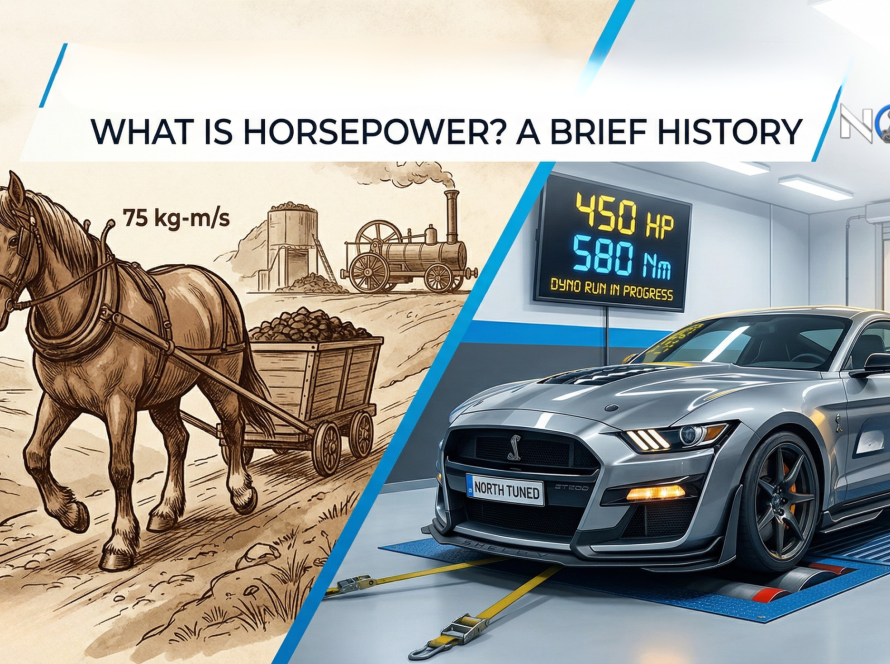
The term Horsepower (HP) is undoubtedly one of the most frequently used terms by car enthusiasts. Although it is the first criterion we look at when measuring a vehicle’s performance, it is not exactly equal to “the power of a single horse,” contrary to popular belief. So, how did this unit, which we at North Tuned place at the center of performance, come about?
James Watt and Marketing Genius
The term was first coined in 1782 by James Watt, a successful Scottish engineer and inventor who improved steam engines. To explain the capability of his engines to the public, Watt chose horses—the most common “engine” of that era—as a point of comparison.
How Was 1 Horsepower Calculated?
Watt observed horses working in coal mines. He calculated that, on average, a horse could pull 45 kg of coal 1.1 meters in one second. This mathematically equated to approximately 50 kg-m/s of work. However, to make his engines seem even more reliable and impressive, Watt increased this figure by 50%, rounding it up to 75 kg-m/s, and defined this as 1 Horsepower (HP).
In short, the modern definition is:
1 Horsepower (HP) is the amount of power required to lift a 75 kg load 1 meter vertically in 1 second.
Today, at North Tuned, we take James Watt’s fundamental legacy and optimize it with modern software and engineering solutions, efficiently awakening the “sleeping” horses within your vehicle.
When it comes to unlocking a vehicle’s true potential, ECU Tuning is often the first step. However, at North Tuned, we believe that software is like a conductor; for it to produce the best symphony, the instruments beneath it must be up to the task.
Here are the top performance modifications that complement your tune and help your engine “breathe” better.
1. High-Flow Air Filters & Cold Air Intakes
A tuned engine demands more fuel, which in turn requires more oxygen. Stock paper filters often create a bottleneck.
Benefit: Increases airflow volume and sharpens throttle response.
2. Downpipe and Exhaust Upgrades
In turbocharged engines, getting exhaust gases out quickly is crucial. Standard catalytic converters can create backpressure and trap heat during high-performance driving.
Benefit: Lowers Exhaust Gas Temperatures (EGT) and allows the turbo to spool up faster.
3. Upgraded Intercooler
More boost equals more heat. When intake air gets too hot, it loses density, leading to “heat soak” and power loss.
Benefit: Keeps intake temperatures low, ensuring consistent power delivery even under hard driving.
4. Ignition System (Spark Plugs & Coils)
Under increased boost and cylinder pressure, stock spark plugs might struggle to ignite the mixture, leading to misfires.
Benefit: A stronger spark ensures complete combustion and a smoother power band.
North Tuned Insight: To get the most out of these hardware changes, your ECU map should be calibrated to recognize the improved airflow and cooling. Efficiency and longevity go hand in hand.
Getting a professional tune (remapping) is the most exciting way to unlock your vehicle’s hidden potential. However, simply saying “it feels faster” isn’t enough. To truly understand the gains, you need empirical data. Here is how we at North Tuned recommend verifying your performance increase:
1. Dyno (Dynamometer) Testing
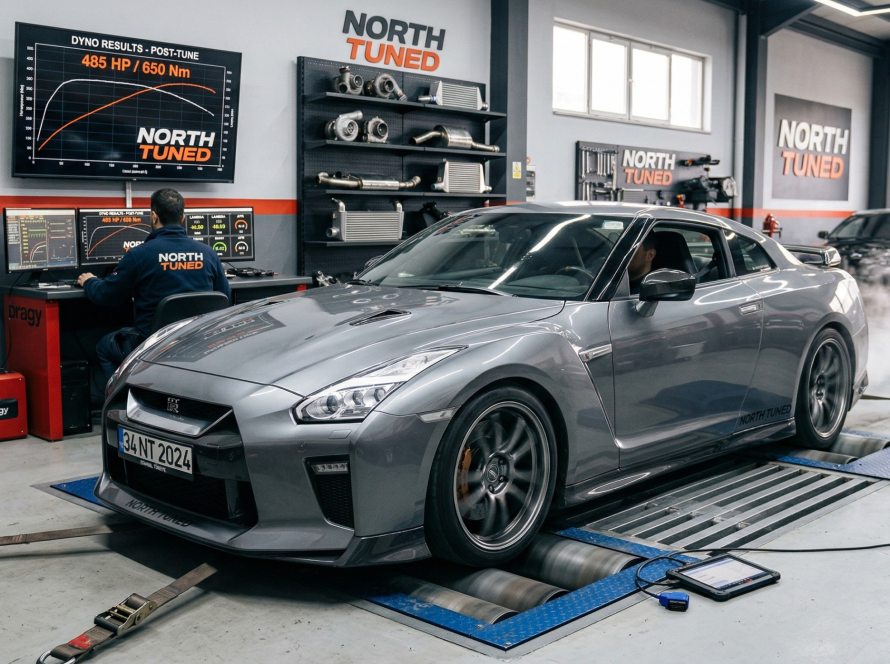
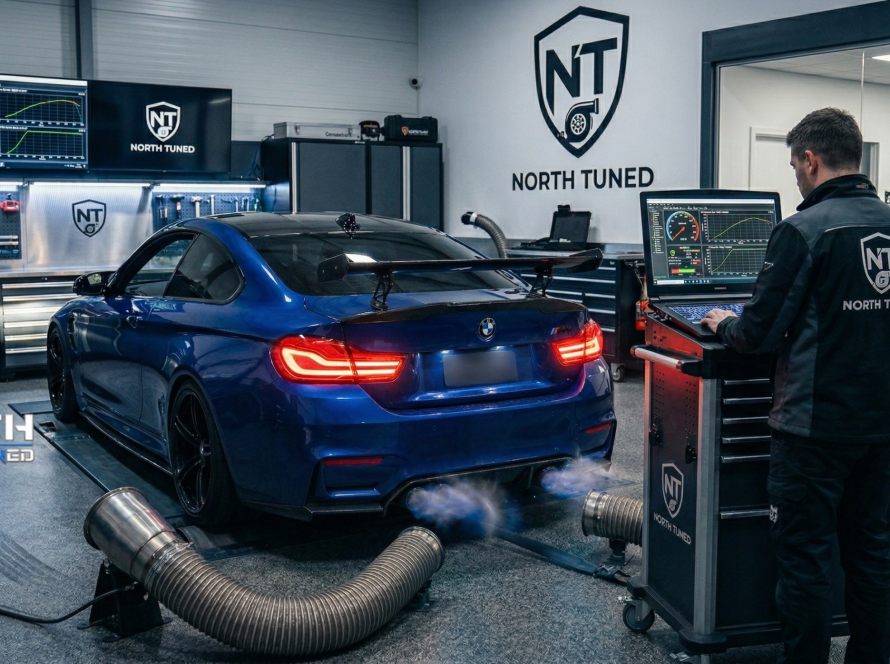
This is the gold standard. A dyno measures the horsepower (HP) and torque (Nm) delivered to the wheels.
Before/After: Performing a run right before and right after the tune provides a clear picture of the changes in the power band.
Health Check: It allows technicians to monitor Air-Fuel Ratios (AFR) to ensure the tune is running safely under load.
2. GPS-Based Performance Meters (Dragy or VBOX)
Devices like Dragy are the best way to turn feelings into facts. These use high-frequency GPS (10Hz or higher) to track acceleration with extreme precision.
0-100 km/h & 100-200 km/h: These are the industry standards for measuring real-world acceleration.
Slope Correction: These devices account for road incline, giving you a “valid” and honest result regardless of the terrain.
3. OBDII Data Logging
Speed is only one part of the story; how the engine achieves that speed matters for longevity. Use an OBDII scanner to log:
Boost Levels: Is the turbo hitting the requested targets?
Ignition Timing: Is the engine running efficiently without “pulling” timing due to knock?
Intake Air Temperatures (IAT): Is your cooling system handling the extra power effectively?
4. In-Gear Acceleration (Flexibility)
This is the most relevant metric for daily driving. For example, measure the time it takes to go from 80 km/h to 120 km/h in 4th gear. The reduction in this timeframe is the best indicator of your car’s increased “punch” and torque delivery.
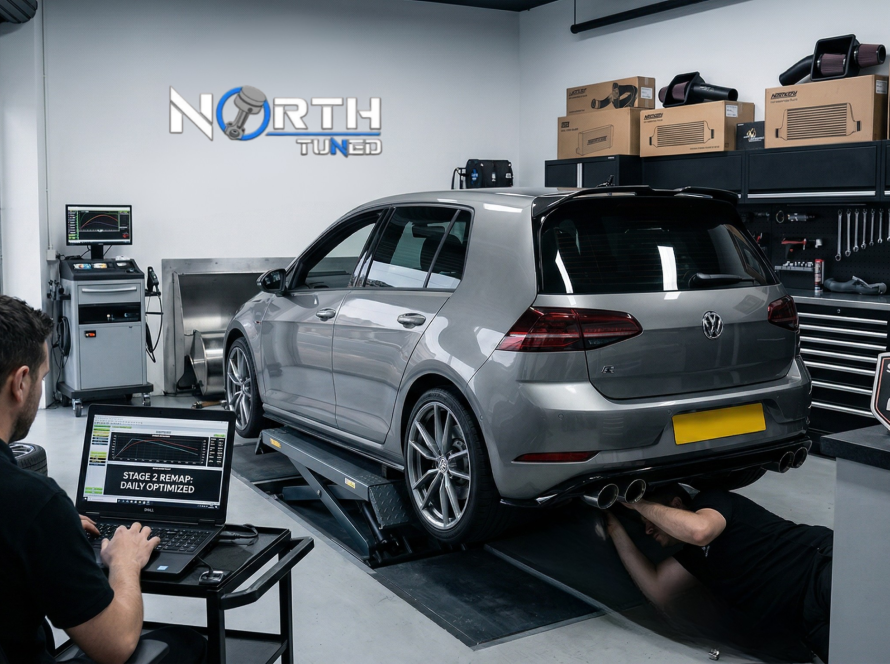
For many enthusiasts, a car is more than just a tool for commuting; it’s a passion project. When the factory power feels insufficient, Stage 2 tuning is often the next logical step. But is it practical for a vehicle you drive every single day?
What is Stage 2?
Unlike Stage 1, which is primarily a software-only upgrade, Stage 2 requires hardware modifications to help the engine “breathe” better. Typical upgrades include:
Downpipe: For faster exhaust gas evacuation.
Upgraded Intercooler: To ensure cooler, denser air intake.
High-Flow Air Intake: To reduce intake restriction.
Custom Remap: ECU calibration optimized for these specific hardware changes.
Pros and Cons for the Daily Drive
A Stage 2 vehicle offers a much broader torque curve and more aggressive acceleration compared to Stage 1. However, there are trade-offs to consider:
Performance: Significant gains in overtaking power and highway merging.
Fuel Economy: While efficiency can improve during cruising, spirited driving will see a noticeable jump in fuel consumption.
NVH (Noise, Vibration, Harshness): An aftermarket downpipe will increase exhaust volume. This might be thrilling for some but tiring for others in heavy traffic.
Reliability: Since you are pushing the engine further, high-quality maintenance becomes non-negotiable.
The Verdict: Is it worth it?
If you view driving as an experience rather than a chore and are willing to invest in the supporting hardware, Stage 2 is absolutely worth it. It transforms the character of the car without sacrificing total usability. At North Tuned, we believe the key is balance—achieving maximum performance while staying within the safe mechanical limits of your engine.
Your car is capable of much more than what the factory settings allow. Manufacturers often “detune” engines to account for global variables like low-grade fuel or extreme environmental conditions. If you are a driving enthusiast, these restrictions are holding you back.
Here are the top 5 signs it’s time to visit North Tuned for a professional remap:
1. Significant Throttle Lag
Does your car feel “disconnected” when you hit the accelerator? This delay is often due to restrictive factory throttle mapping. A professional ECU remap sharpens the communication between your foot and the engine, providing instant power delivery.
2. Poor Fuel Economy Relative to Output
A performance tune isn’t just about speed; it’s about efficiency. By optimizing the air-fuel ratio and increasing low-end torque, the engine works less to maintain cruising speeds. If you’re visiting the gas station more often than you’d like, a specialized tune can actually improve your MPG.
3. Lack of Power During Overtaking
Overtaking requires a burst of confidence. If you find yourself hesitating because the car lacks that “punch” in the mid-range RPM, you are missing out on essential torque. Tuning expands the power band, making highway merges and overtaking maneuvers safer and more exhilarating.
4. Inefficient Gear Hunting
If you drive an automatic or dual-clutch vehicle, you might notice the car “hunts” for gears or stays in a high gear for too long during an incline. A North Tuned performance map harmonizes the engine’s output with the gearbox logic, ensuring you are always in the optimal power range.
5. The “Safety Margin” Is Too Wide
Standard cars are built for the “average” driver. If you maintain your vehicle well and use high-quality fuel, you don’t need the massive safety buffers set by the factory. Unleashing that dormant 20-30% of horsepower and torque is the most cost-effective way to transform your driving experience without mechanical modifications.
Why Choose North Tuned?
At North Tuned, we don’t just “plug and play.” We provide custom-tailored software solutions that respect your engine’s longevity while maximizing its output. Whether you are looking for a Stage 1 remap, DPF/EGR solutions, or Eco-Tuning, our expert team ensures your vehicle performs at its peak.