
Tag: ignition timing

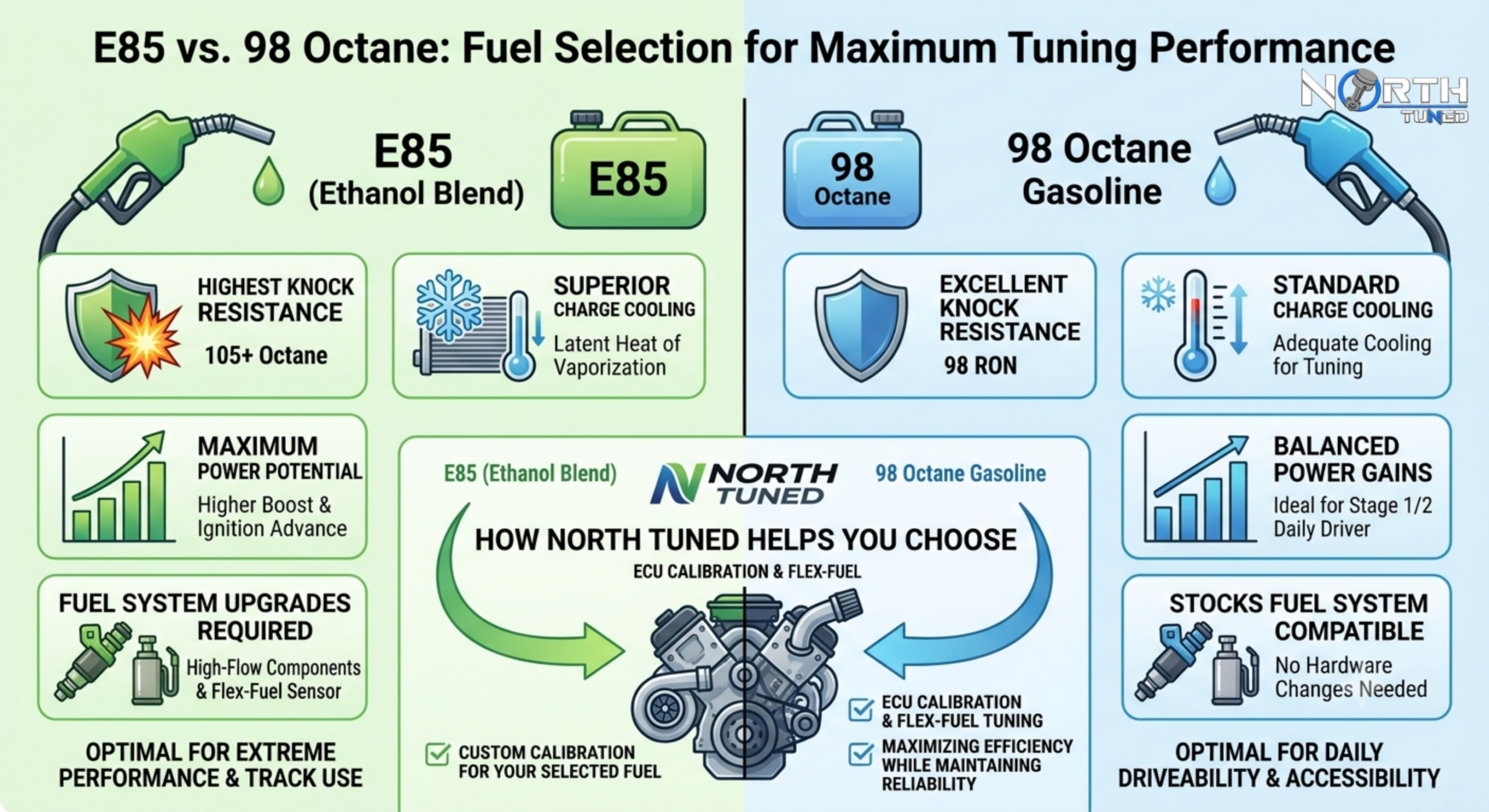
Ethanol Fuel and Performance: The Secret Weapon for High Horsepower

Ethanol Fuel and Performance: The Secret Weapon for High Horsepower

In the world of automotive tuning, fuel is just as critical as the hardware itself. When you push the limits of standard pump gas, you eventually hit a wall called “knock” or “detonation.” This is where Ethanol (Ethyl Alcohol) becomes a game-changer. At North Tuned, we frequently utilize ethanol blends to unlock the true potential of turbocharged and high-compression engines.

Here is an in-depth technical look at why ethanol is the preferred choice for high-performance applications and what you need to know about the transition.

What is Ethanol Fuel?
Ethanol is a renewable fuel source produced by fermenting sugars from agricultural feedstocks like corn, sugar cane, and wheat. While it can be used in its pure form, it is most commonly mixed with gasoline in varying ratios:

E10: 10% Ethanol / 90% Gasoline (Commonly found at standard gas stations).

E85: 85% Ethanol / 15% Gasoline (The “Gold Standard” for performance tuning).

Why Ethanol Wins: The Technical Advantages
The reason ethanol is so highly regarded in the motorsport and tuning industry boils down to two main factors: Octane Rating and Latent Heat of Vaporization.

1. Massive Octane Boost
Standard premium gasoline usually sits between 91 and 93 AKI (95-98 RON). Pure ethanol, however, boasts an octane rating of approximately 116 AKI / 129 RON. Even at an E85 blend, the effective octane rating is usually 105+.

The Benefit: High octane means the fuel is incredibly resistant to pre-ignition. This allows tuners to advance ignition timing and increase boost pressure significantly without the risk of engine damage.

2. Superior Cooling Effect
Ethanol has a much higher latent heat of vaporization than gasoline. This means that as ethanol is injected and evaporates, it absorbs a significant amount of heat from the intake air and the combustion chamber.

Turbo Longevity: By lowering Exhaust Gas Temperatures (EGT), ethanol protects the turbocharger turbine and internal engine components from thermal stress. It essentially acts as a chemical intercooler.

The “Ethanol Ready” Conversion: What Changes?
Ethanol contains about 34% less energy by volume than gasoline. This means that to maintain the correct Air/Fuel Ratio (AFR), the engine must spray more fuel. For E85, you typically need 30% to 35% more fuel flow compared to gasoline.

To make a vehicle compatible, North Tuned focuses on these essential upgrades:

High-Flow Fuel Pumps & Injectors: Since the volume requirement increases, upgraded pumps and larger injectors are mandatory to prevent the engine from running lean.

Flex Fuel Sensors: We install sensors that detect the exact ethanol content in the tank. This allows the ECU to automatically adjust the tune in real-time, whether you are running 10% or 85% ethanol.

Material Compatibility: While most modern cars (post-2000s) have fuel systems resistant to alcohol, older projects may require replacing rubber lines with PTFE (Teflon) lines to prevent corrosion.

Daily Driving and Environmental Impact
While ethanol is a “cleaner” burning fuel in terms of carbon emissions, it does have some quirks:

Cold Starts: Ethanol does not vaporize well at temperatures below 13°C (55°F). Specialized tuning is required to ensure the car starts smoothly on cold mornings.

Fuel Economy: Because more fuel is required to produce the same energy, you will notice a roughly 25-30% drop in MPG when running E85.

Ethanol is not just a fuel; it’s a performance tool. It allows us to reach power levels that were previously only possible with expensive, leaded racing fuels. If you are looking to maximize the efficiency and output of your turbocharged engine while keeping engine temperatures in check, an ethanol conversion is the most effective path forward.

read more
Electronic (Direct) Ignition System: North Tuned Technology

Electronic (Direct) Ignition System: North Tuned Technology

The primary function of a standalone electronic ignition system is to ignite the air-fuel mixture in the combustion chamber at the most optimal moment, providing the necessary ignition advance for peak engine performance. At North Tuned, we prioritize millisecond precision in ignition timing to ensure a superior high-performance driving experience.

North Tuned
North Tuned

Operating Principle
In this system, an independent ignition coil is utilized for each cylinder. These coils integrate the igniter unit, primary, and secondary windings, connecting directly to the spark plug. Unlike traditional systems, there are no spark plug wires; the coils are powered by a 12V supply and controlled via signal currents directly from the ECU.

As we emphasize in North Tuned software optimization processes, the Engine Control Unit (ECU) processes real-time data from crankshaft and camshaft sensors. By controlling the primary circuit of each cylinder’s coil, it generates high voltage at the exact required moment to trigger flawless combustion.

Key Sensors and Their Roles
The ECU manages the ignition map based on data from several critical sensors:

Crankshaft & TDC Sensor: Determines engine RPM and piston position.

Camshaft (Phase) Sensor: Verifies the timing of the cylinders.

Knock Sensor: Monitors pre-ignition to ensure engine safety.

MAP/MAF Sensor: Measures intake manifold pressure and air mass flow.

Temperature Sensors: Optimizes advance based on coolant and intake air temperatures.

Advantages of the System with North Tuned
High Voltage Power: Produces up to 40,000 Volts for a stronger spark and complete combustion.

Precise Advance Management: Electronic control delivers maximum performance and optimized fuel efficiency.

Mechanical Reliability: No moving or friction-based parts, leading to lower failure rates and zero maintenance.

Wide Spark Plug Gap: A gap of 0.8 mm – 1.1 mm allows for a larger flame kernel and significant power gains.

read more
What is NOS (Nitrous Oxide System)? The Chemistry of Performance

What is NOS (Nitrous Oxide System)? The Chemistry of Performance

For speed enthusiasts and performance seekers, NOS (Nitrous Oxide System) remains one of the most intriguing and effective ways to achieve instantaneous power gains in internal combustion engines. But how exactly does this system work, and what happens at the heart of your vehicle? As North Tuned, we take a closer look at this adrenaline-pumping technology.

How Does NOS Work? The Formula of Power
The power generated by an internal combustion engine depends on how violently the oxygen taken in can be detonated with the injected fuel. In standard engine tuning, the goal is to increase the air-fuel mixture entering the engine. NOS takes this process to a much more radical level.

Oxygen Enrichment: When Nitrous Oxide gas enters the combustion chamber, it breaks down due to heat, releasing pure oxygen. This represents a much higher concentration of oxygen compared to regular atmospheric air.

Cooling Effect: The cooling effect created as the gas exits the cylinder increases the density of the intake air. Cooler air is denser, allowing significantly more oxygen to fill the combustion chamber than normal.

Powerful Combustion: With the increased oxygen, more fuel is delivered to the system. The result is a much more powerful explosion, leading to a massive increase in horsepower delivered to the wheels.

Why Choose NOS?
Factory-spec cars are manufactured with performance values below their true potential to ensure fuel economy and durability under all road conditions. A NOS kit, applied with North Tuned expertise, awakens the “sleeping giant” within your vehicle’s DNA—only when you need it.

The biggest advantage of the system is that it is “on-demand.” While providing a standard driving experience for daily city use, you can transform your car into a high-performance machine with a single touch whenever extra power is required.

Does NOS Damage the Engine?
Let’s provide a clear answer to the most frequently asked question: Not with the right setup and correct limits.

The key to preventing engine damage is selecting the appropriate horsepower gain. As long as you do not exceed the load capacity that your engine components (pistons, rods, bearings) can tolerate, no additional wear occurs.

Safe Power Gains with North Tuned:

Precise Calibration: For high-level horsepower increases, we meticulously perform critical adjustments such as spark plug selection and ignition timing retardation.

Fuel Optimization: We ensure the fuel system and octane levels are correctly tuned to support the increased power.

Controlled Power: By activating the system only when performance is needed, you preserve the overall longevity of your engine.

Push the Limits with North Tuned
If you want to discover your vehicle’s true potential and achieve safe performance gains, you are in the right place. To get detailed information about NOS applications and our other performance solutions, and to determine the most suitable kit for your vehicle, feel free to contact us.

read more