
Tag: Intercooler Upgrade

How to Protect Your Engine: Critical Tuning Mistakes and Prevention

How to Protect Your Engine: Critical Tuning Mistakes and Prevention

Performance tuning is a craft that balances art and engineering. At North Tuned, we believe that true performance isn’t just about the peak numbers on a dyno sheet—it’s about how long that engine can sustain those numbers.

1. Tuning Without Pre-Inspection
Tuning an engine with existing mechanical issues is like building a skyscraper on a swamp.

The Mistake: Installing a performance map on a car with old spark plugs, a tired fuel pump, or vacuum leaks.

The Outcome: The added stress of increased boost or timing will inevitably cause the weakest link to fail.

North Tuned Pro-Tip: Always perform a diagnostic scan and check for boost leaks before modifying the ECU.

2. Neglecting Thermal Management
Power is a byproduct of combustion, and combustion generates heat. If you increase the energy, you must increase the cooling.

The Mistake: Pushing high boost levels on a stock intercooler.

The Outcome: High Intake Air Temperatures (IATs) lead to ignition timing pull and potential engine knock (detonation).

Solution: For Stage 2+ builds, upgrading the cooling system is not optional; it is a necessity for engine longevity.

3. Chasing Boost Instead of Efficiency
A common misconception is that “More Boost = More Power.”

The Mistake: Overworking a small turbocharger beyond its efficiency map.

The Technical Side: When a turbo is pushed too hard, it simply blows hot, turbulent air. This increases backpressure and heat without adding significant oxygen.

Solution: Focus on optimizing the Air-Fuel Ratio (AFR) and ignition timing. Sometimes, less boost with better timing yields more reliable power.

4. The Danger of “Generic” Off-the-Shelf Tunes
Every car lives a different life. A car in a high-altitude region needs different parameters than one at sea level.

The Mistake: Using cheap, non-adjustable files that don’t account for fuel quality or hardware health.

The Outcome: Poor drivability and a high risk of catastrophic failure under load.

The North Tuned Approach: We prioritize Data Logging. By analyzing how your specific engine reacts in real-time, we fine-tune the software to ensure maximum safety margins.

5. Forgetting the Drivetrain
An engine is only as good as the wheels it turns.

The Mistake: Increasing torque significantly without recalibrating the Transmission Control Unit (TCU).

The Outcome: Slipped clutches in DSG/ZF gearboxes or snapped axles.

Solution: Match your ECU tune with a TCU tune to increase clutch clamping pressure and optimize shift points.

read more
Performance Mods That Pair Perfectly With ECU Tuning

Performance Mods That Pair Perfectly With ECU Tuning

When it comes to unlocking a vehicle’s true potential, ECU Tuning is often the first step. However, at North Tuned, we believe that software is like a conductor; for it to produce the best symphony, the instruments beneath it must be up to the task.

Here are the top performance modifications that complement your tune and help your engine “breathe” better.

1. High-Flow Air Filters & Cold Air Intakes
A tuned engine demands more fuel, which in turn requires more oxygen. Stock paper filters often create a bottleneck.

Benefit: Increases airflow volume and sharpens throttle response.

2. Downpipe and Exhaust Upgrades
In turbocharged engines, getting exhaust gases out quickly is crucial. Standard catalytic converters can create backpressure and trap heat during high-performance driving.

Benefit: Lowers Exhaust Gas Temperatures (EGT) and allows the turbo to spool up faster.

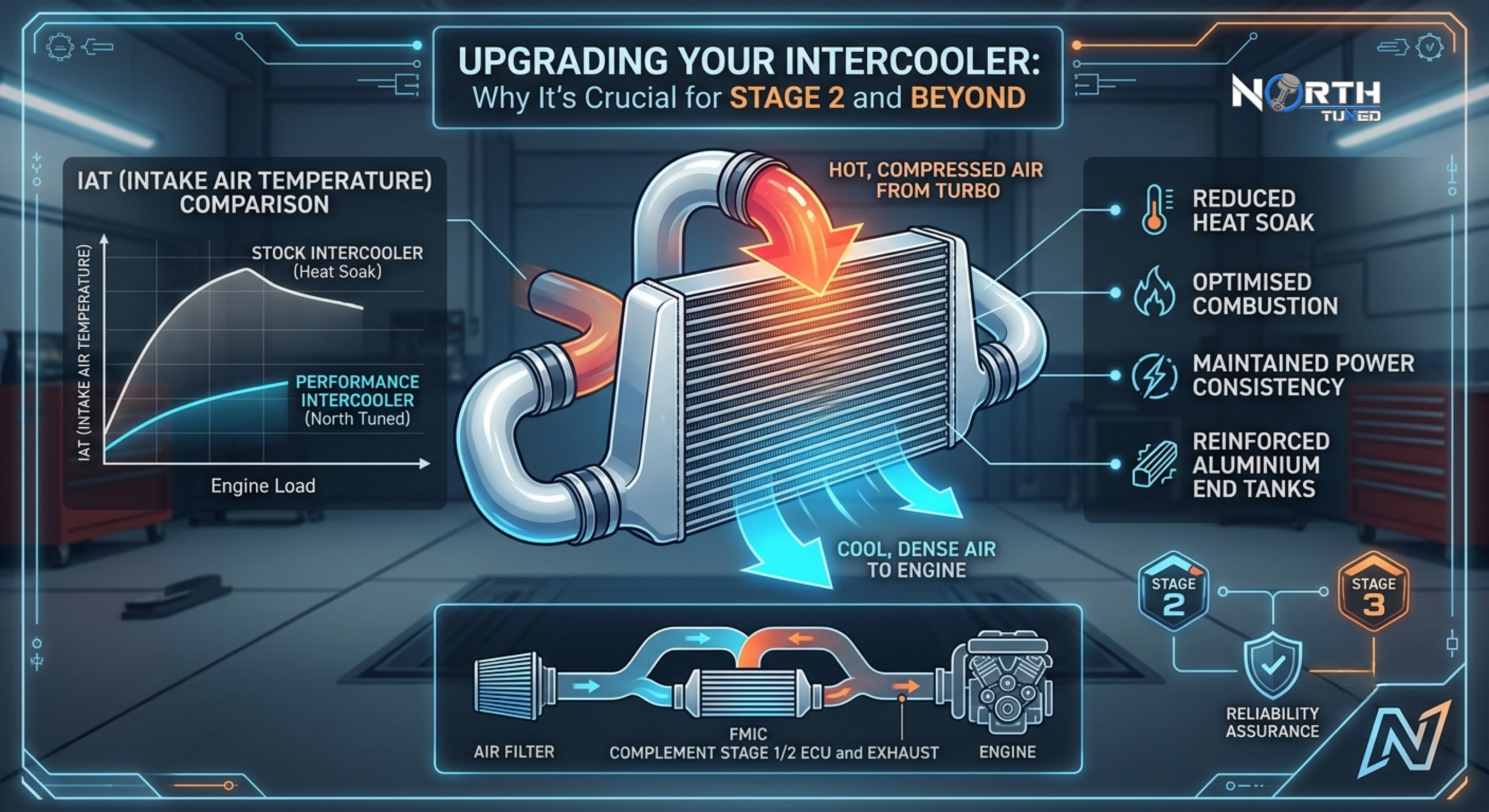
3. Upgraded Intercooler
More boost equals more heat. When intake air gets too hot, it loses density, leading to “heat soak” and power loss.

Benefit: Keeps intake temperatures low, ensuring consistent power delivery even under hard driving.

4. Ignition System (Spark Plugs & Coils)
Under increased boost and cylinder pressure, stock spark plugs might struggle to ignite the mixture, leading to misfires.

Benefit: A stronger spark ensures complete combustion and a smoother power band.

North Tuned Insight: To get the most out of these hardware changes, your ECU map should be calibrated to recognize the improved airflow and cooling. Efficiency and longevity go hand in hand.

read more
How to Safely Upgrade Your Turbocharged Engine in Australia

How to Safely Upgrade Your Turbocharged Engine in Australia

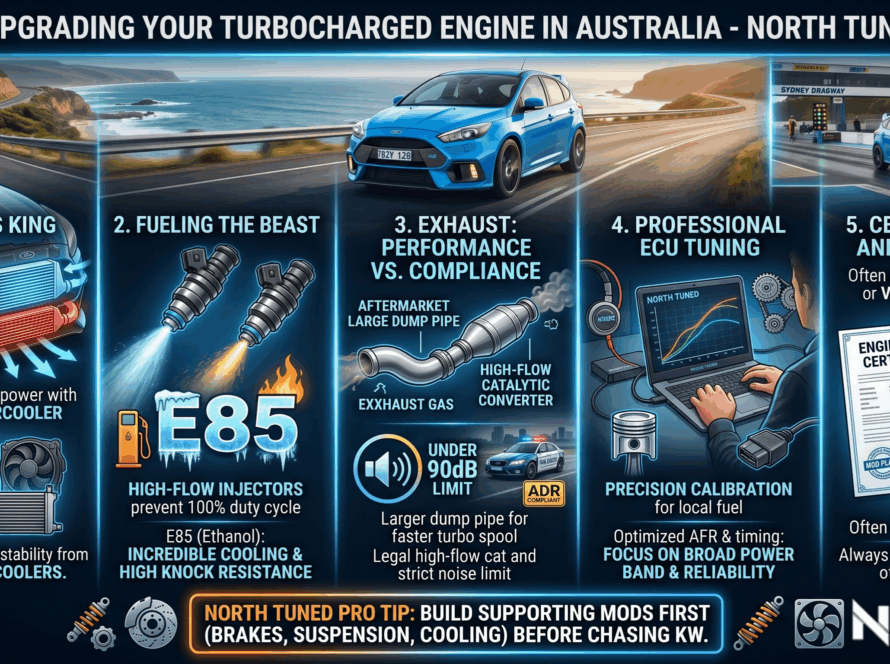
Upgrading a turbocharged car in Australia is a balancing act between chasing “kw” at the wheels and staying on the right side of the law. Whether you’re cruising the Great Ocean Road or hitting Sydney Dragway, here is how to do it right with North Tuned.

1. Cooling is King
Australia’s heat is brutal on forced induction engines. High intake temperatures lead to power loss and engine-killing detonation.

Intercooler Upgrades: A high-quality intercooler is the most effective way to maintain consistent power.

Radiator & Oil Coolers: Don’t ignore the fluids. Keeping oil and coolant temps stable is vital for engine longevity.

2. Fueling the Beast
To make power safely, your fuel system must keep up with the increased airflow.

High-Flow Injectors: Ensure your injectors aren’t running at a 100% duty cycle.

The E85 Advantage: Many Australian tuners prefer E85 (Ethanol) because of its incredible cooling properties and high knock resistance, allowing for more aggressive timing.

3. Exhaust: Performance vs. Compliance
While we all love a deep rumble, the ADR (Australian Design Rules) are strict.

Dump Pipes: A larger dump pipe reduces backpressure, allowing the turbo to spool faster.

Keep it Legal: Ensure you have a high-flow catalytic converter and stay under the 90dB limit to avoid unwanted attention from the authorities.

4. Professional ECU Tuning
This is where the magic happens. A subpar tune can melt pistons in seconds.

Precision Calibration: At North Tuned, we focus on a broad power band rather than just peak numbers. We prioritize reliability, ensuring your Air-Fuel Ratios (AFR) and ignition timing are optimized for local fuel quality.

5. Certification and Insurance
In Australia, significant modifications like turbo upgrades or fuel system changes often require an Engineering Certificate (such as a Mod Plate in QLD or VSCCS in NSW). Always inform your insurance provider about your mods to ensure you are covered in the event of an accident.

North Tuned Pro Tip: Always build your engine’s “supporting mods” (brakes, suspension, and cooling) before chasing big horsepower. A fast car is only good if it can stop and turn!

read more