
Tag: power upgrade

Why ECU Tuning Is Safer Than You Think

Why ECU Tuning Is Safer Than You Think

In today’s automotive world, performance and efficiency enthusiasts consider engine modifications a major point of interest. Among these modifications, ECU (Engine Control Unit) tuning stands out as the most prominent. However, some vehicle owners hesitate, worrying that pushing the engine’s limits might carry long-term risks.

In reality, thanks to professional engineering approaches offered by North Tuned, ECU software and calibration provide an unexpected standard of safety. In this article, we will detail why ECU tuning is a highly secure, predictable, and advantageous process, contrary to popular belief.

1. The Meaning of Factory Safety Tolerances
The software on a vehicle when it leaves the factory is designed to handle the worst conditions and the most careless user profiles worldwide. Manufacturers leave a large “safety margin” by taking into account low-quality fuel, extreme climate conditions, and users who neglect periodic maintenance.

Utilizing Safety Margins: North Tuned stays well within the mechanical and thermal limits of the engine rather than blindly pushing the limits.

Unlocking Potential: The process releases the engine’s hidden potential while ensuring the durability levels designed by factory engineers are never compromised.

2. Personalized Calibration Over Generic Software
Cheap and generic maps available on the market apply the same changes to every vehicle, which can conflict with the engine’s physical structure. The main differentiator of North Tuned is the application of custom-tailored calibrations:

Hardware and Software Harmony: Parameters are rewritten by taking the vehicle’s mileage, current condition, and existing components into account.

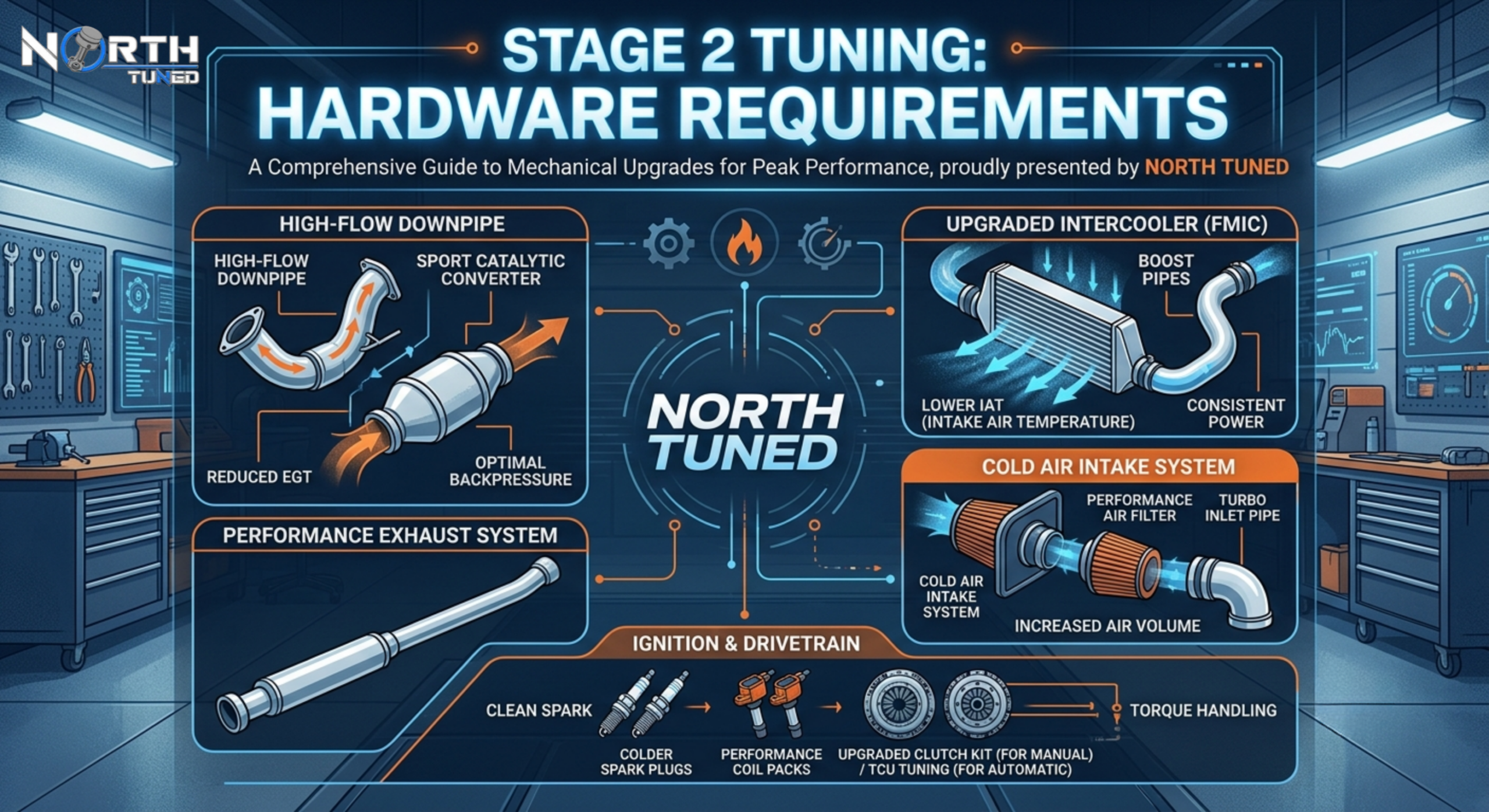
Exhaust and Transmission Integration: During Stage 1 or Stage 2 upgrades, transmission torque limiters and exhaust system temperature thresholds are maintained, preventing excessive strain.

3. Proper Air-Fuel Ratios and Thermal Management
One of the biggest concerns is whether tuning will cause the engine to overheat. A proper tuning process does not overheat the engine; instead, it increases thermal efficiency:

Preventing Lean Mixture Danger: Amateur interventions can cause the engine to run in a lean mixture (too much air, not enough fuel), which raises combustion chamber temperatures.

Optimal Boost and Fuel Maps: North Tuned keeps the Air-Fuel Ratio (AFR) at ideal levels, keeping in-cylinder temperatures well under control.

4. Reversibility and Complete Control
One of the most reassuring features of ECU tuning is its flexible and non-destructive nature:

Preserving the Original Backup: The vehicle’s original factory software is safely backed up. You can revert your vehicle back to its stock factory settings at any time without leaving any traces.

Data Reading and Diagnostics: During the process, sensor data is analyzed in detail, ensuring the system can fall back to its original protective modes if necessary.

What North Tuned Offers
Providing the power and flexibility your vehicle deserves without risking engine health, North Tuned offers the following key services:

Stage 1 & Stage 2 Upgrades: High torque and power output without putting engine and transmission safety at risk.

Emission Management: Healthy software solutions to prevent issues with systems like DPF, EGR, and AdBlue.

Fuel Efficiency: Optimization in fuel consumption, particularly during long highway drives and city commutes, through precise calibration.

Explore your vehicle’s true potential safely with North Tuned.

read more
ECU Remapping vs. Plug-and-Play Chips: Which One is Right for You?

ECU Remapping vs. Plug-and-Play Chips: Which One is Right for You?

For performance enthusiasts, there are two primary ways to unlock a vehicle’s hidden potential: ECU Remapping and Plug-and-Play (PnP) Tuning Modules. At North Tuned, we’ve analyzed both methods to help you make the best decision for your ride.

1. What is ECU Remapping?

ECU Remapping involves rewriting the original software within your vehicle’s Electronic Control Unit. By removing factory-set restrictions, parameters such as fuel mapping, ignition timing, and boost pressure are fully optimized.

Pros:

Total Control: Every parameter of the engine can be adjusted.

Linear Power Delivery: Power is spread across the entire RPM range for a smoother feel.

Custom Tailored: If you have hardware upgrades (like an intake or exhaust), the map can be customized specifically for those parts.

Speed Limiter Removal: Most remaps allow for the removal of factory speed governors.

Cons:
Reversibility: Requires a professional to flash the car back to stock.

Warranty Concerns: Deep diagnostic scans at dealerships can often detect software changes.

2. What are Plug-and-Play Chips?
PnP modules are external boxes that sit between the engine sensors and the ECU. They function by intercepting and modifying sensor signals to “trick” the ECU into producing more power.

Pros:
Easy Installation: Usually a “DIY” job that takes about 15-20 minutes.

Instant Removal: You can unplug the device before a service visit or when selling the car, leaving no physical trace.

Transferability: Can often be moved to another vehicle with the same engine type.

Cons:
Limited Scope: It can only manipulate a few signals (mostly boost and fuel pressure) rather than managing the entire engine logic.

Less Refined: May not feel as smooth as a remap and can sometimes cause “jerky” power delivery in lower gears.

Feature,ECU Remapping,Plug-and-Play Chip
Power Gains,Maximum & Optimized,Moderate / Standardized
Driveability,Smooth & Natural,Aggressive but can be inconsistent
Installation,Professional Required,DIY Possible
Traceability,Software-visible,Physically removable

North Tuned Verdict
If you are looking for the most efficient, healthy, and bespoke performance increase, ECU Remapping is the superior choice. However, if your car is under a strict warranty or you want a temporary boost that you can remove at any time, a high-quality Plug-and-Play Module is a solid alternative.

read more