
Tag: stage 1 tuning

Comprehensive Guide to Stage 1 Tuning for Petrol vs. Diesel Engines

Comprehensive Guide to Stage 1 Tuning for Petrol vs. Diesel Engines

For automotive enthusiasts, Stage 1 Tuning is the most effective way to personalize a vehicle and surpass factory limitations. While many drivers wonder why manufacturers don’t deliver maximum power from the factory, the truth is that Stage 1 is an engineering optimization. In this guide, North Tuned explores the reactions, advantages, and technical nuances of petrol and diesel engines in the most profound detail.

What is Stage 1? Behind the Software
Stage 1 involves recalibrating the software on the ECU (Engine Control Unit) without changing any physical mechanical parts. Car manufacturers release vehicles with “de-tuned” engines (often at 70-80% efficiency) to ensure they can handle poor fuel quality, extreme climates, and different tax brackets worldwide. Stage 1 awakens this “sleeping” potential within safe margins.

1. Stage 1 in Diesel Engines: The Power of Torque
Diesel engines, with their high compression ratios and turbochargers, are the most “eager” units to respond to software tuning. Even though they are often built for economy, their character changes completely after Stage 1.

Torque Increase and Driving Dynamics
In diesels, the biggest gain is in Torque (Nm) rather than just horsepower. The massive pulling power felt at low RPMs (1500-2500 RPM) after tuning carries the car’s mid-range acceleration to an incredible level. Especially for heavy SUVs or loaded commercial vehicles, Stage 1 is almost a necessity for driving comfort.

Economy and Efficiency
One of the primary motivations for tuning a diesel is fuel economy. The increased torque allows the engine to maintain the same speed at lower RPMs. This translates back to you as up to 10% fuel savings in urban stop-and-go traffic and long-distance cruising.

Critical Components: DPF and EGR
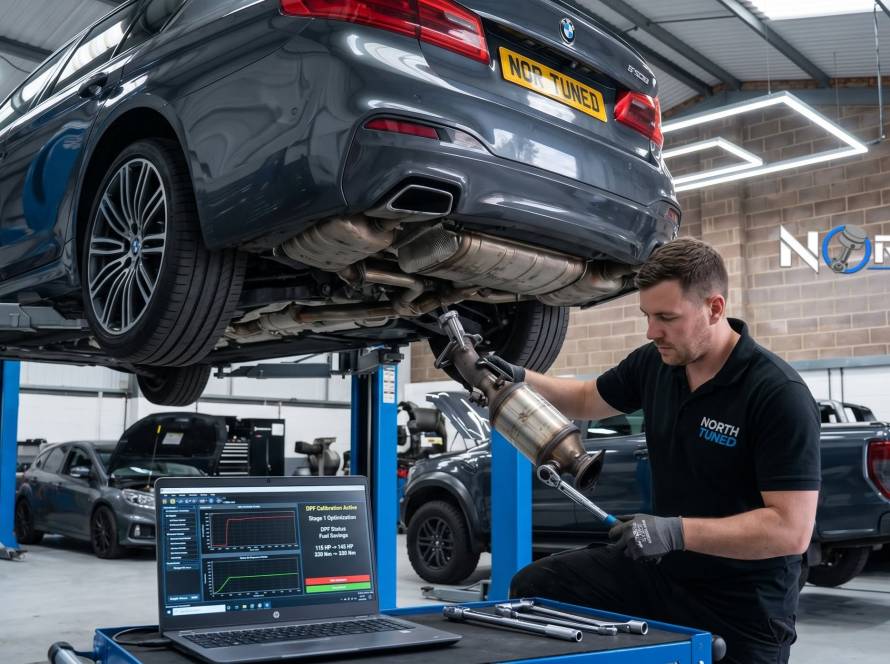
Diesel owners often worry about emission systems. North Tuned’s professional software optimizes combustion efficiency without disrupting the working principles of the Diesel Particulate Filter (DPF) and EGR systems. Unlike low-quality “smoky” tunes, your engine performs a cleaner combustion process.

2. Stage 1 in Petrol Engines: The Joy of the Rev Range
A Stage 1 application in petrol engines offers two different scenarios depending on the intake type (Turbocharged or Naturally Aspirated).

Turbocharged Petrol Units (TSI, T-GDI, EcoBoost)
Modern turbo-petrol engines receive a magical touch with Stage 1. Precise recalibration of turbo boost and ignition timing provides a much more dramatic increase in horsepower compared to diesels. Power is delivered continuously until the end of the rev range, meaning the car continues to accelerate even at high speeds.

Naturally Aspirated Engines: Throttle Response and Fluidity
While HP gains in non-turbo engines usually stay within the 5-10% range, the real impact of Stage 1 is felt in throttle sensitivity. The sluggish factory response is eliminated; the car becomes more vivid and “fluid,” responding instantly to the driver’s commands.

Technical Comparison: Gains and Characteristics
Power Character: While power in diesels comes with a sudden torque burst, turbo petrol vehicles exhibit a more linear and aggressive acceleration curve.

Mechanical Tolerance: Diesel engine blocks are generally more robust, making them resistant to high torque. In petrol vehicles, the health of the cooling and ignition systems is the priority.

Longevity: In both engine types, Stage 1 does not shorten engine life as long as regular maintenance is performed. In fact, a more efficient engine provides the same performance with less effort.

Why Choose North Tuned?
While many places use “generic maps,” at North Tuned, we treat every vehicle as an engineering project.

Individual Calibration: We analyze your vehicle’s current mileage, turbo condition, and injector health to write a software specifically for you.

Transmission Harmony: While increasing engine power, we meticulously protect transmission torque limits, especially in automatic (DSG, ZF, EDC) vehicles.

Safe Limits: Our priority is not “maximum power” but “safest performance.” We never push your engine’s mechanical boundaries.

Stage 1 Tuning is a technical art that reveals the soul of your vehicle. Are you ready to discover your car’s true potential with North Tuned?

read more
ECU Remapping vs. Plug-and-Play Chips: Which One is Right for You?

ECU Remapping vs. Plug-and-Play Chips: Which One is Right for You?

For performance enthusiasts, there are two primary ways to unlock a vehicle’s hidden potential: ECU Remapping and Plug-and-Play (PnP) Tuning Modules. At North Tuned, we’ve analyzed both methods to help you make the best decision for your ride.

1. What is ECU Remapping?

ECU Remapping involves rewriting the original software within your vehicle’s Electronic Control Unit. By removing factory-set restrictions, parameters such as fuel mapping, ignition timing, and boost pressure are fully optimized.

Pros:

Total Control: Every parameter of the engine can be adjusted.

Linear Power Delivery: Power is spread across the entire RPM range for a smoother feel.

Custom Tailored: If you have hardware upgrades (like an intake or exhaust), the map can be customized specifically for those parts.

Speed Limiter Removal: Most remaps allow for the removal of factory speed governors.

Cons:
Reversibility: Requires a professional to flash the car back to stock.

Warranty Concerns: Deep diagnostic scans at dealerships can often detect software changes.

2. What are Plug-and-Play Chips?
PnP modules are external boxes that sit between the engine sensors and the ECU. They function by intercepting and modifying sensor signals to “trick” the ECU into producing more power.

Pros:
Easy Installation: Usually a “DIY” job that takes about 15-20 minutes.

Instant Removal: You can unplug the device before a service visit or when selling the car, leaving no physical trace.

Transferability: Can often be moved to another vehicle with the same engine type.

Cons:
Limited Scope: It can only manipulate a few signals (mostly boost and fuel pressure) rather than managing the entire engine logic.

Less Refined: May not feel as smooth as a remap and can sometimes cause “jerky” power delivery in lower gears.

Feature,ECU Remapping,Plug-and-Play Chip
Power Gains,Maximum & Optimized,Moderate / Standardized
Driveability,Smooth & Natural,Aggressive but can be inconsistent
Installation,Professional Required,DIY Possible
Traceability,Software-visible,Physically removable

North Tuned Verdict
If you are looking for the most efficient, healthy, and bespoke performance increase, ECU Remapping is the superior choice. However, if your car is under a strict warranty or you want a temporary boost that you can remove at any time, a high-quality Plug-and-Play Module is a solid alternative.

read more
Optimizing Your Car for Track Days via Tuning Software: The Ultimate North Tuned Guide

Optimizing Your Car for Track Days via Tuning Software: The Ultimate North Tuned Guide

For automotive enthusiasts, a “Track Day” is more than a hobby; it’s a test of engineering and skill. Those few hours spent pushing your car to its absolute limits require a perfect symphony between mechanical hardware and digital software. While most focus on brakes and tires, the true potential of a modern vehicle lies within its ECU (Engine Control Unit).

At North Tuned, we specialize in unlocking that potential, transforming a street-legal car into a consistent, high-performance track weapon through precision software calibration.

1. Power Delivery and Predictability
On the street, software is designed for fuel economy. On the track, the goal is “predictability.”

Linear Power Delivery: Factory turbo maps often have sudden spikes in boost. In the middle of a high-speed corner, this can cause an upset in the chassis. North Tuned reshapes the boost curve to ensure that power builds progressively, giving you total control over traction.

Torque Management: By optimizing torque delivery in lower gears, we reduce unnecessary wheel spin, ensuring that every bit of power is converted into forward momentum as you exit the apex.

2. Advanced Thermal Management
Heat is the silent killer on the track. A 20-minute session subjects the engine to thermal stresses that a street car rarely sees.

Component Protection (EGT): Our calibrations include sophisticated safety maps. If Exhaust Gas Temperatures reach critical levels, the ECU automatically adjusts fueling to cool the internal components, preventing catastrophic failure.

Cooling System Optimization: We recalibrate fan duty cycles and water pump flow to trigger earlier. This ensures the engine remains in its optimal operating window even during the final laps of a hot summer session.

3. TCU Tuning: The Transmission Connection
For owners of DSG, PDK, or ZF8 gearboxes, the transmission software is just as vital as the engine map.

Shift Speed & Force: We decrease shift times to near-instantaneous levels, ensuring there is zero “dead time” during acceleration.

Kickdown Deactivation: Nothing is more frustrating than a car downshifting automatically when you are holding a gear for balance. Our TCU tunes give you 100% manual control, preventing unwanted gear changes at the limit.

4. Track-Specific Calibration Features
Left Foot Braking: Factory logic often cuts the throttle if the brake is pressed simultaneously. We remove this restriction, allowing advanced drivers to use the brake to tuck the nose into a corner while maintaining boost.

Dynamic Throttle Mapping: We sharpen the throttle response to eliminate lag, creating a telepathic connection between your right foot and the engine’s output.

read more
Common Myths vs. Realities of ECU Chip Tuning: Unlocking the Hidden Potential

Common Myths vs. Realities of ECU Chip Tuning: Unlocking the Hidden Potential

In the automotive world, the most effective way to increase performance is ECU (Engine Control Unit) Chip Tuning. As this technology evolves, it unfortunately brings along various misconceptions. At Nort Tuned, we are debunking these industry myths with engineering facts.

1. Myth: “Why Didn’t the Manufacturer Do It? It Must Be Harmful”
The Reality: Manufacturers (OEMs) design cars for global markets. They must account for extreme temperatures, poor fuel quality in developing countries, and neglected maintenance cycles. Consequently, engines are released with significantly restricted power (often 30-40% below capacity).

Nort Tuned Approach: We don’t remove safety margins; we recalibrate them based on your local fuel quality and driving conditions. A professional remap doesn’t strain the engine; it optimizes combustion efficiency, making the engine run smoother.

2. Myth: “More Power Always Equals Higher Fuel Consumption”
The Reality: While power requires energy, efficiency is the key. After a remap, the torque curve is shifted to lower RPMs.

The Logic: Your car delivers the power it used to give at 2000 RPM now at 1600 RPM.

The Saving: You can upshift earlier and use less throttle to maintain speed. On highway cruises, it is common to see a 10% to 18% improvement in fuel economy.

3. Myth: “Tuned Cars Will Fail Emission Tests or Inspections”
The Reality: This is a total misconception. ECU optimization doesn’t alter the physical hardware. When done correctly, emission levels stay within factory limits. Your vehicle will pass standard inspections and exhaust emission tests without any issues.

4. Myth: “Tuning Boxes are the Same as Remapping”
The Reality: “Plug-and-play” tuning boxes merely “trick” the sensors into sending false data to the ECU. This is a crude method that can lead to uncontrolled fuel delivery.
Nort Tuned Difference: We perform Custom Mapping. We analyze the vehicle’s mileage, turbo health, and injector status to create a tailored software solution. We never use “copy-paste” files that could endanger your engine.

5. Myth: “Chip Tuning is Only for Turbocharged Cars”
The Reality: While turbo engines see the most dramatic gains (20-35%), atmospheric (N/A) engines also benefit significantly. Remapping improves throttle response, removes “flat spots” in the power band, and provides a much more spirited driving experience.

read more
EGR Problems in Modern Cars and How Tuning Can Solve Them

EGR Problems in Modern Cars and How Tuning Can Solve Them

In the modern automotive industry, there is a constant battle between performance and environmental regulations. One of the primary components of this struggle is the EGR (Exhaust Gas Recirculation) system. While designed with good intentions, it has become a notorious source of headaches for diesel and gasoline engine owners alike.

Understanding the EGR System
The EGR system’s job is to redirect a portion of the exhaust gases back into the combustion chamber. By doing this, it lowers the combustion temperature and reduces Nitrogen Oxide ($NO_x$) emissions. However, introducing “dirty” air into the intake system is counter-intuitive for engine longevity and performance.

Why Does It Fail?
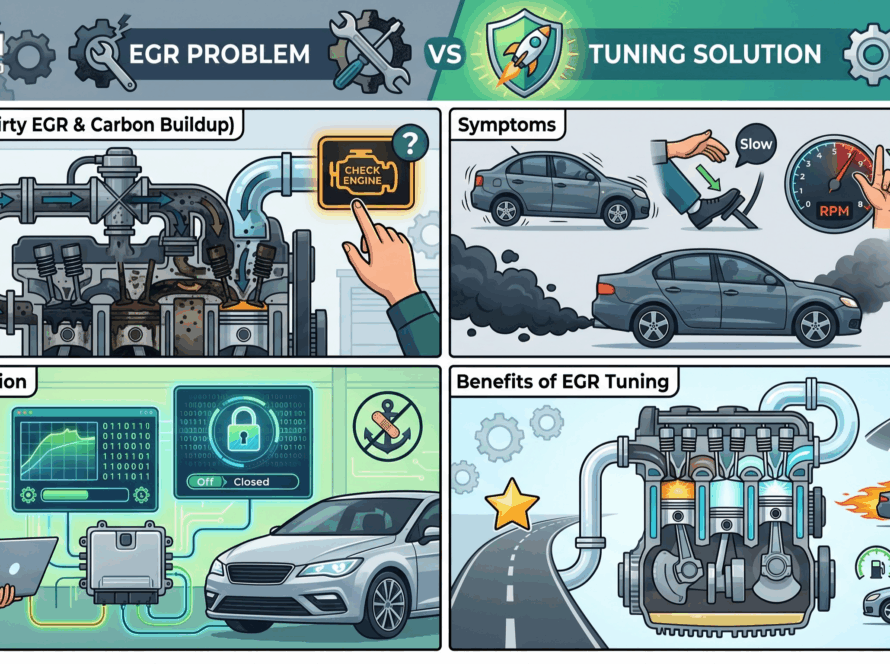
The primary enemy of the EGR valve is carbon buildup. Exhaust gases contain soot, and when mixed with oil vapors in the intake, they form a thick, tar-like substance. This sludge eventually causes the valve to stick or completely clogs the intake manifold.

Symptoms of a Faulty EGR Valve
If you experience any of the following, your EGR system is likely failing:

Loss of Power: Especially noticeable during acceleration.

Increased Fuel Consumption: The ECU struggles to find the correct air-fuel ratio.

Rough Idling: The car shakes or vibrates when stopped.

Limp Mode: The vehicle limits its RPM to prevent engine damage.

Excessive Smoke: Dark smoke from the exhaust due to poor combustion.

The Tuning Solution: Why EGR Delete?
At North Tuned, we believe in long-term reliability. Replacing a faulty EGR valve is often a “band-aid” fix, as the new part will inevitably clog again. Our EGR Software Optimization offers a permanent solution.

Benefits of EGR Tuning & Deletion:
Enhanced Engine Longevity: By preventing soot from entering the engine, you extend the life of your internal components.

Improved Throttle Response: With only fresh, oxygen-rich air entering the cylinders, the engine responds much faster to your inputs.

Cost-Effective: Software adjustment is often cheaper than buying a brand-new mechanical valve and paying for labor multiple times.

Better Fuel Economy: A cleaner burn means every drop of fuel is used more efficiently.

Professional Calibration at North Tuned
When we perform an EGR delete, we modify the Engine Control Unit (ECU) maps. We don’t just “turn off the light”; we recalibrate the air mass flow and fuel injection parameters to ensure the engine operates perfectly without the EGR cycle. This results in a smoother drive and total peace of mind.

read more
Chip Tuning: Unlock Your Vehicle’s Hidden Potential with North Tuned

Chip Tuning: Unlock Your Vehicle’s Hidden Potential with North Tuned

In the modern automotive world, technology is no longer just about mechanical parts. With the advancement of emission standards and the necessity for engine longevity, every vehicle is now managed by an Electronic Control Unit (ECU)—the digital brain of your car. However, most vehicles leave the factory with their true performance capabilities restricted by conservative software settings.

If you are unsatisfied with your vehicle’s current performance or feel that it lacks the “punch” it should have, North Tuned offers professional Chip Tuning services designed specifically for your needs.

What is Chip Tuning?
Chip Tuning is the process of reprogramming the software within the Engine Control Unit (ECU) while staying within the mechanical tolerances of the engine. Whether your vehicle is naturally aspirated or forced induction (turbocharger/supercharger), and whether it runs on petrol or diesel, North Tuned executes this transformation in three professional steps:

Read & Backup: Your vehicle’s original factory software is securely read and a backup is created for safety.

Optimization: Based on your performance expectations and driving habits, our expert engineers recalibrate the software maps.

Uploading: The perfected, custom-tailored program is flashed back into the ECU, completing the process.

Why Do Manufacturers Limit Engine Power?

When a car leaves the factory, it is designed to operate in extreme conditions—from polar freezes to desert heat—and with varying fuel qualities or different taxation policies across the globe. To maintain this wide safety margin, manufacturers intentionally “detune” the engine.

At North Tuned, we optimize your vehicle’s software for your specific climate and driving style, reaching the “sweet spot” of efficiency. When handled by experts and kept within recommended power limits, tuning provides significant benefits without harming your engine.

How the Process Works
During Chip Tuning, no physical parts are added or removed from the vehicle. The software is accessed in two primary ways:

OBD Port (On-Board Diagnostics): A digital connection is established through the vehicle’s diagnostic socket.

Bench Tuning: On certain models, the ECU is removed and programmed directly using specialized hardware.

By making precision adjustments to maps such as Air-Fuel Ratio (AFR) and Torque Limiters, we achieve a more responsive and refined driving experience.

Not Just Power, But Efficiency!

Chip tuning isn’t just about speed. A correctly calibrated software allows the engine to produce more torque at lower RPMs. This means your car becomes “meatier” in the lower rev range, requiring less throttle input to maintain speed. The result? Significant fuel savings depending on your driving style.

Are you ready to unleash the true power of your vehicle and take your driving pleasure to the next level? Contact the North Tuned expert team today.

Chip Tuning: Unlock Your Vehicle’s Hidden Potential with North Tuned

read more
Engine Tuning Guide

Engine Tuning Guide

The performance of the car you’ve driven fondly for years might start to feel inadequate over time; you may want to recapture that day-one excitement and push the limits a little further. We will provide you with practical information in this article about essential engine modifications that will boost your vehicle’s power and take your driving dynamics to a whole new level.

Sports Air Filter Upgrade

Sports Air Filter Upgrade

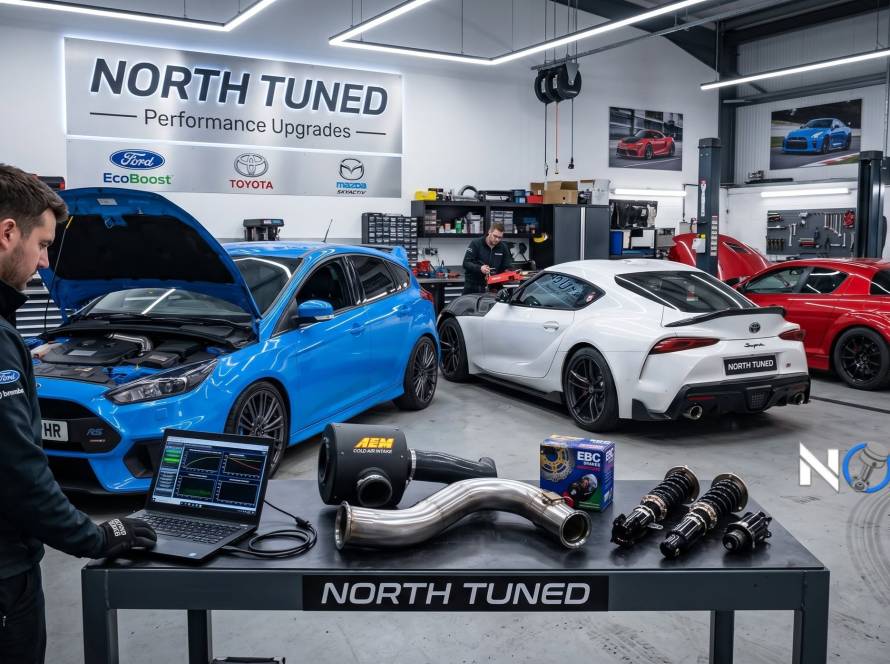
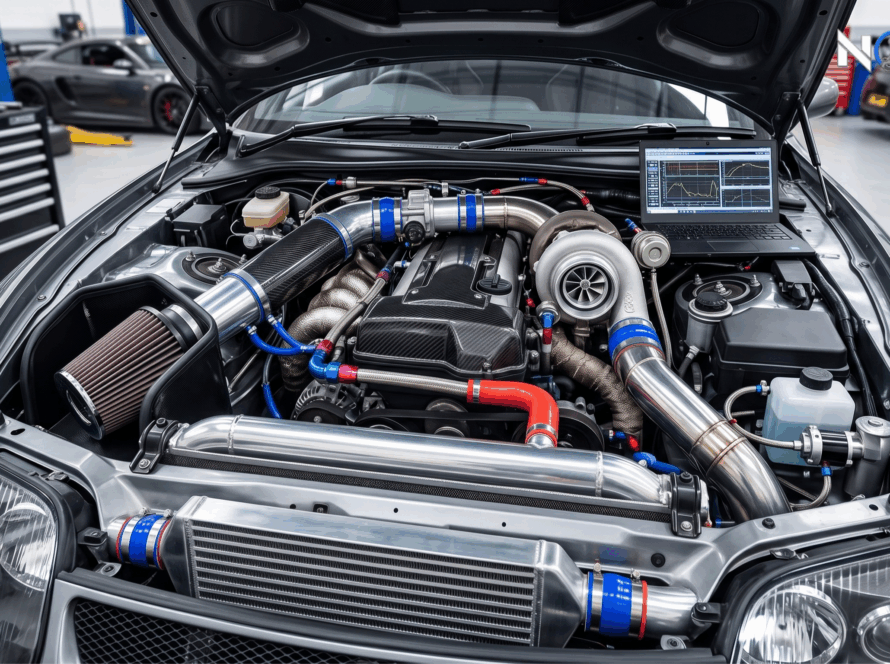
Car manufacturers often use restrictive air intake systems to keep mass-production costs down and comply with standard noise regulations. Aftermarket sports air filters, commonly known as Cold Air Intake Kits, eliminate this factory-induced shortness of breath. These performance-oriented kits maximize the air mass entering the engine per unit of time by channeling much cooler, denser oxygen directly into the combustion chambers. More oxygen means a more powerful combustion. As a result, your vehicle not only gains a noticeable performance boost with improved throttle response but also unleashes that deep, sporty intake growl we all love when you step on the gas.

Sports Exhaust Upgrades

Sports Exhaust Upgrades

Whether you own a naturally aspirated or a forced induction (turbocharged or supercharged) engine, this upgrade is a must-have for car enthusiasts looking to personalize their vehicle and push its performance limits. It stands out as one of the most popular modification steps taken to help the exhaust gases flow more freely, boost horsepower, and achieve that highly desired, deep, and aggressive sound.

Chip Tuning (ECU Remapping)
Thanks to giant leaps in automotive technology, modern vehicles roll out of the factory equipped with highly durable, efficient, and high-potential engines. This robust and tolerant foundation makes today’s cars perfect canvases for performance upgrades. Chip Tuning unlocks your vehicle’s hidden true capacity by professionally optimizing the original parameters and maps within the Engine Control Unit (ECU). Through this fine-tuning of the engine’s brain, it is possible to achieve significant increases in horsepower and torque without having to replace a single mechanical part. For a deeper dive into the technical details and specific gains for your car, feel free to check out our comprehensive Chip Tuning guide.

Turbocharger Upgrades

Turbocharger Upgrades

Strict modern emission standards and high taxation policies have driven automakers to extract maximum power from smaller displacement engines. The undisputed hero of this “downsizing” trend is the turbocharger. A turbo’s primary job is to force pressurized air into the combustion chambers, cramming a significantly higher volume of oxygen into the cylinders. The rule of thumb is simple: A larger turbo equates to massive power potential. However, blindly choosing an oversized turbo without considering the vehicle’s dynamics leads to “uncontrolled power” and frustrating turbo lag at lower RPMs.

To safely harness and regulate this increased boost pressure without stressing the engine, upgrades to the wastegate system are absolutely essential. Furthermore, when upgrading a turbo, the intercooler capacity must be re-evaluated and upsized if necessary to combat the extra heat generated by the higher boost levels. The intercooler’s job is to cool down the compressed air, thereby increasing its density; cooler, denser air results in a more violent, efficient combustion and yields extra horsepower. But there is a delicate balance to strike here: Installing an unnecessarily large intercooler will cause pressure drops in the charge piping, severely dulling your throttle response and ruining the sporty driving experience.

Methanol Injection (Water-Meth) Systems

Methanol Injection (Water-Meth) Systems

Commonly utilized in high-performance builds, this system safely pushes an engine’s performance boundaries. Methyl alcohol, one of the most effective alcohols for internal combustion engines, is integrated into the system by being sprayed directly into the air intake tract.

Key Advantages:

Thermal Management: It rapidly lowers combustion chamber temperatures, preventing engine overheating.

High Octane Support: Due to its high octane rating, it allows tuners to aggressively adjust ignition timing during the remapping process.

Combustion Quality: It maximizes fuel burn quality, resulting in a cleaner and more efficient explosion.

Performance Gains: The synergy of these effects delivers significant increases in both horsepower and torque.

Potential Disadvantages:

High Consumption Rate: Since it evaporates much more easily than gasoline, the consumption rate is notably higher.

Corrosion Risk: By its chemical nature, prolonged use can lead to wear and corrosion within fuel system components.

Cold Start Issues: When used as a primary fuel source, it fails to atomize correctly in cold weather, making the engine difficult to start.

read more