
In the automotive world, the ability to harness speed is just as vital as achieving it. At North Tuned, we don’t just accelerate your driving experience; we secure it with world-class stopping power. Unlike standard components, performance-oriented braking systems provide a high and consistent friction coefficient under demanding conditions, granting the driver total command over the vehicle.
Why Upgrade to High-Performance Brakes?
Large-scale performance discs utilize their increased surface area to convert kinetic energy into heat and dissipate it rapidly. This effectively eliminates “brake fade”—the dangerous phenomenon where overheated brakes lose their effectiveness. Optimized through North Tuned expertise, these systems shorten stopping distances and maintain consistent bite even after repeated, high-speed decelerations.
Carbon Ceramic Technology: The Pinnacle of Braking
Considered the gold standard of braking technology, carbon ceramic discs first proved their worth in extreme environments like Formula 1. Commercialized by Porsche in 1999 under the PCCB (Porsche Ceramic Composite Brake) moniker, this technology is now the benchmark for luxury and supercar performance.
Key Features of High-Performance Brakes by North Tuned:
Extreme Thermal Stability: Engineered to withstand blistering temperatures ranging from 1000°C to 1600°C.
Lightweight Agility: Ceramic discs are significantly lighter than traditional cast-iron discs. This reduction in “unsprung weight” enhances suspension geometry, handling, and steering precision.
All-Weather Reliability: Ceramic pads do not absorb moisture. This ensures immediate braking response on wet roads without the typical delay found in standard systems.
Acoustic Comfort and Aesthetics: These systems are designed to minimize brake squeal. Furthermore, they produce minimal, light-colored dust that doesn’t adhere to your wheels, keeping your rims pristine.
Superior Durability: Under optimal conditions, ceramic components offer a much longer service life compared to conventional braking materials.
Whether on the track or the open road, North Tuned ensures that your vehicle’s stopping power is always a step ahead of its speed.
For speed enthusiasts and performance seekers, NOS (Nitrous Oxide System) remains one of the most intriguing and effective ways to achieve instantaneous power gains in internal combustion engines. But how exactly does this system work, and what happens at the heart of your vehicle? As North Tuned, we take a closer look at this adrenaline-pumping technology.
How Does NOS Work? The Formula of Power
The power generated by an internal combustion engine depends on how violently the oxygen taken in can be detonated with the injected fuel. In standard engine tuning, the goal is to increase the air-fuel mixture entering the engine. NOS takes this process to a much more radical level.
Oxygen Enrichment: When Nitrous Oxide gas enters the combustion chamber, it breaks down due to heat, releasing pure oxygen. This represents a much higher concentration of oxygen compared to regular atmospheric air.
Cooling Effect: The cooling effect created as the gas exits the cylinder increases the density of the intake air. Cooler air is denser, allowing significantly more oxygen to fill the combustion chamber than normal.
Powerful Combustion: With the increased oxygen, more fuel is delivered to the system. The result is a much more powerful explosion, leading to a massive increase in horsepower delivered to the wheels.
Why Choose NOS?
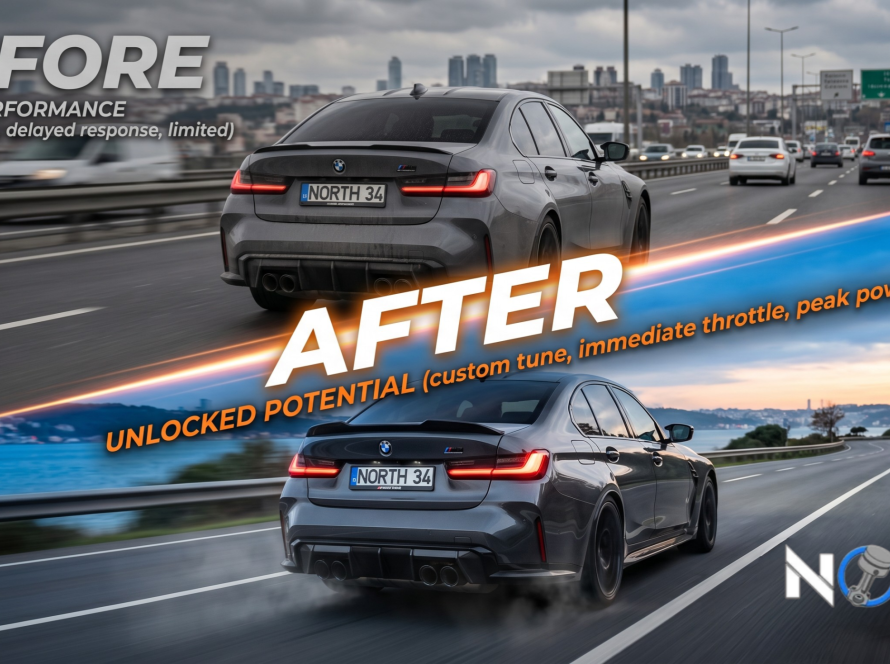
Factory-spec cars are manufactured with performance values below their true potential to ensure fuel economy and durability under all road conditions. A NOS kit, applied with North Tuned expertise, awakens the “sleeping giant” within your vehicle’s DNA—only when you need it.
The biggest advantage of the system is that it is “on-demand.” While providing a standard driving experience for daily city use, you can transform your car into a high-performance machine with a single touch whenever extra power is required.
Does NOS Damage the Engine?
Let’s provide a clear answer to the most frequently asked question: Not with the right setup and correct limits.
The key to preventing engine damage is selecting the appropriate horsepower gain. As long as you do not exceed the load capacity that your engine components (pistons, rods, bearings) can tolerate, no additional wear occurs.
Safe Power Gains with North Tuned:
Precise Calibration: For high-level horsepower increases, we meticulously perform critical adjustments such as spark plug selection and ignition timing retardation.
Fuel Optimization: We ensure the fuel system and octane levels are correctly tuned to support the increased power.
Controlled Power: By activating the system only when performance is needed, you preserve the overall longevity of your engine.
Push the Limits with North Tuned
If you want to discover your vehicle’s true potential and achieve safe performance gains, you are in the right place. To get detailed information about NOS applications and our other performance solutions, and to determine the most suitable kit for your vehicle, feel free to contact us.
For many enthusiasts, a car is more than just a tool for commuting; it’s a passion project. When the factory power feels insufficient, Stage 2 tuning is often the next logical step. But is it practical for a vehicle you drive every single day?
What is Stage 2?
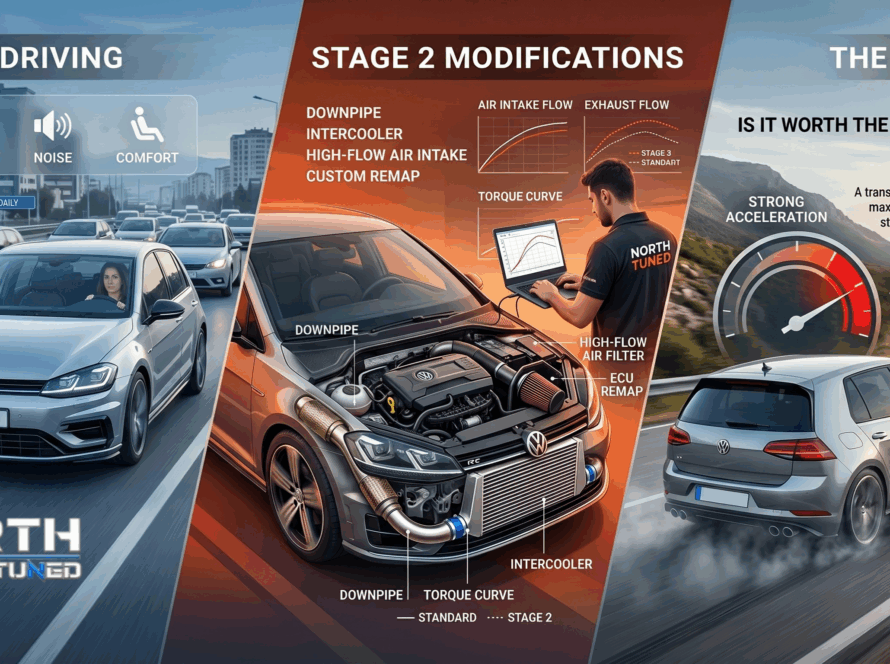
Unlike Stage 1, which is primarily a software-only upgrade, Stage 2 requires hardware modifications to help the engine “breathe” better. Typical upgrades include:
Downpipe: For faster exhaust gas evacuation.
Upgraded Intercooler: To ensure cooler, denser air intake.
High-Flow Air Intake: To reduce intake restriction.
Custom Remap: ECU calibration optimized for these specific hardware changes.
Pros and Cons for the Daily Drive
A Stage 2 vehicle offers a much broader torque curve and more aggressive acceleration compared to Stage 1. However, there are trade-offs to consider:
Performance: Significant gains in overtaking power and highway merging.
Fuel Economy: While efficiency can improve during cruising, spirited driving will see a noticeable jump in fuel consumption.
NVH (Noise, Vibration, Harshness): An aftermarket downpipe will increase exhaust volume. This might be thrilling for some but tiring for others in heavy traffic.
Reliability: Since you are pushing the engine further, high-quality maintenance becomes non-negotiable.
The Verdict: Is it worth it?
If you view driving as an experience rather than a chore and are willing to invest in the supporting hardware, Stage 2 is absolutely worth it. It transforms the character of the car without sacrificing total usability. At North Tuned, we believe the key is balance—achieving maximum performance while staying within the safe mechanical limits of your engine.