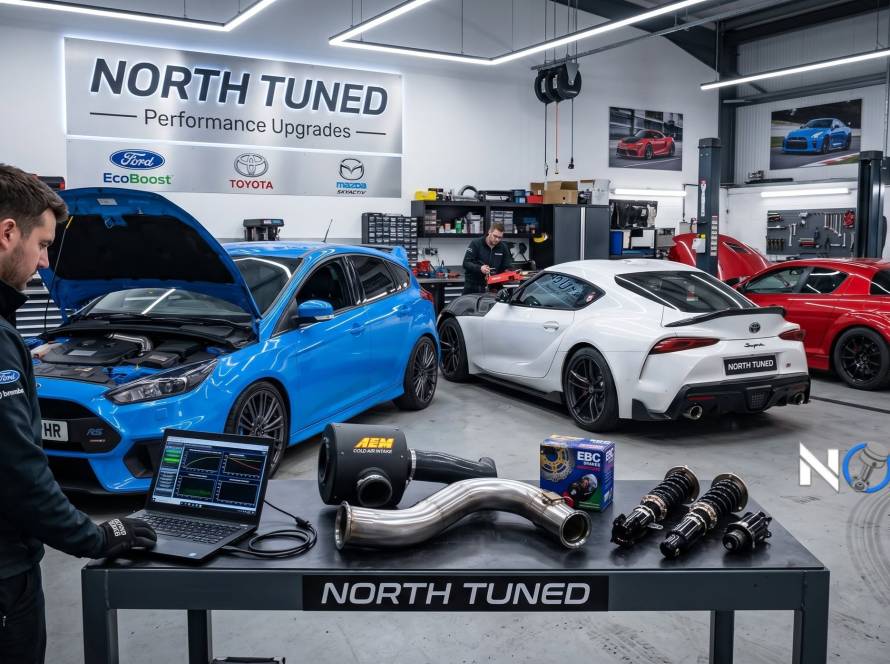

In the automotive world, Downpipe is one of the first modifications that come to mind for enthusiasts. It is a critical exhaust component, especially for turbocharged vehicles, designed to unleash the engine’s true potential. Technically, a downpipe connects the turbocharger outlet to the rest of the exhaust system.
Limitations of Factory Systems
Today, car manufacturers must minimize costs and meet stringent emission standards during mass production. Consequently, factory exhaust systems are often designed with narrow diameters and numerous restrictive bends. Specifically, the high-density catalytic converters within these systems create significant “backpressure,” hindering the turbocharger’s efficiency and slowing down the evacuation of exhaust gases.
Why Choose North Tuned Downpipe?
At North Tuned, our downpipe solutions are engineered to remove these factory restrictions. By utilizing larger diameters and smooth-walled piping, we allow your engine to “breathe” far more effectively than with stock components.
Key Benefits of Downpipe Upgrades:
Faster Turbo Spool: Since exhaust gases encounter minimal resistance, the turbocharger reaches its optimum RPM much quicker, eliminating turbo lag.
Increased Horsepower and Torque: Improved gas flow leads to better engine volumetric efficiency, resulting in measurable gains in both HP and torque.
Thermal Management: Efficiently moving hot gases away from the turbo reduces operating temperatures, protecting the longevity of your turbocharger.
Perfect Synergy with Chiptuning: For Stage 2 and higher performance software, a North Tuned downpipe is essential to handle increased boost levels and maximize power delivery.
Enhanced Sound: It provides a deeper, more aggressive, and sportier exhaust note that reflects the power under the hood.
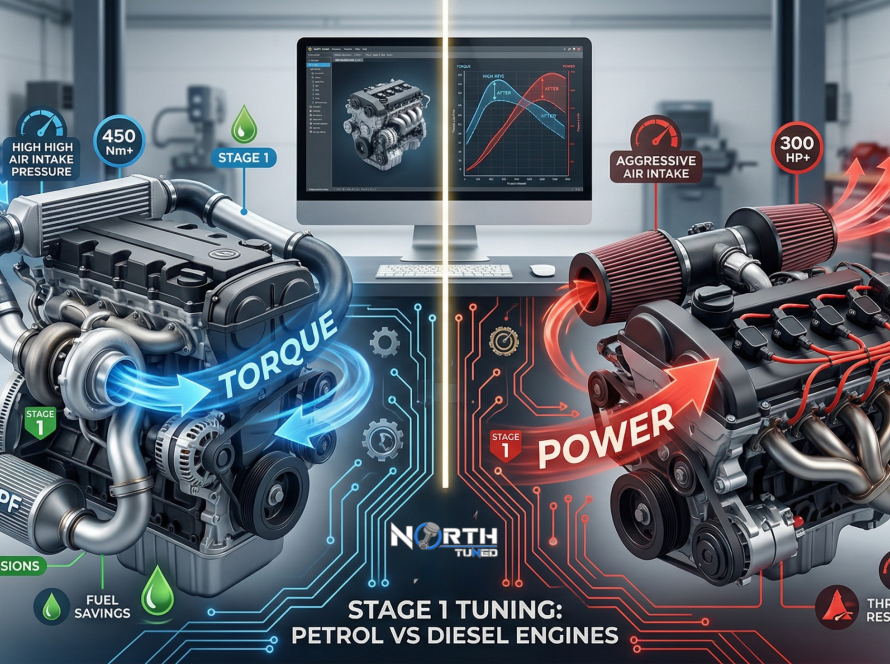
For automotive enthusiasts, Stage 1 Tuning is the most effective way to personalize a vehicle and surpass factory limitations. While many drivers wonder why manufacturers don’t deliver maximum power from the factory, the truth is that Stage 1 is an engineering optimization. In this guide, North Tuned explores the reactions, advantages, and technical nuances of petrol and diesel engines in the most profound detail.
What is Stage 1? Behind the Software
Stage 1 involves recalibrating the software on the ECU (Engine Control Unit) without changing any physical mechanical parts. Car manufacturers release vehicles with “de-tuned” engines (often at 70-80% efficiency) to ensure they can handle poor fuel quality, extreme climates, and different tax brackets worldwide. Stage 1 awakens this “sleeping” potential within safe margins.
1. Stage 1 in Diesel Engines: The Power of Torque
Diesel engines, with their high compression ratios and turbochargers, are the most “eager” units to respond to software tuning. Even though they are often built for economy, their character changes completely after Stage 1.
Torque Increase and Driving Dynamics
In diesels, the biggest gain is in Torque (Nm) rather than just horsepower. The massive pulling power felt at low RPMs (1500-2500 RPM) after tuning carries the car’s mid-range acceleration to an incredible level. Especially for heavy SUVs or loaded commercial vehicles, Stage 1 is almost a necessity for driving comfort.
Economy and Efficiency
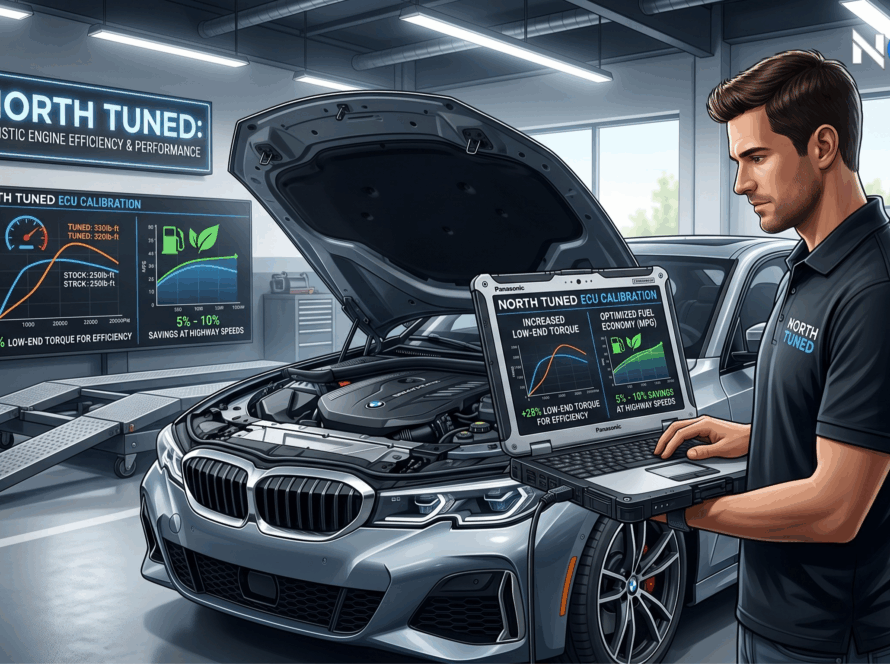
One of the primary motivations for tuning a diesel is fuel economy. The increased torque allows the engine to maintain the same speed at lower RPMs. This translates back to you as up to 10% fuel savings in urban stop-and-go traffic and long-distance cruising.
Critical Components: DPF and EGR
Diesel owners often worry about emission systems. North Tuned’s professional software optimizes combustion efficiency without disrupting the working principles of the Diesel Particulate Filter (DPF) and EGR systems. Unlike low-quality “smoky” tunes, your engine performs a cleaner combustion process.
2. Stage 1 in Petrol Engines: The Joy of the Rev Range
A Stage 1 application in petrol engines offers two different scenarios depending on the intake type (Turbocharged or Naturally Aspirated).
Turbocharged Petrol Units (TSI, T-GDI, EcoBoost)
Modern turbo-petrol engines receive a magical touch with Stage 1. Precise recalibration of turbo boost and ignition timing provides a much more dramatic increase in horsepower compared to diesels. Power is delivered continuously until the end of the rev range, meaning the car continues to accelerate even at high speeds.
Naturally Aspirated Engines: Throttle Response and Fluidity
While HP gains in non-turbo engines usually stay within the 5-10% range, the real impact of Stage 1 is felt in throttle sensitivity. The sluggish factory response is eliminated; the car becomes more vivid and “fluid,” responding instantly to the driver’s commands.
Technical Comparison: Gains and Characteristics
Power Character: While power in diesels comes with a sudden torque burst, turbo petrol vehicles exhibit a more linear and aggressive acceleration curve.
Mechanical Tolerance: Diesel engine blocks are generally more robust, making them resistant to high torque. In petrol vehicles, the health of the cooling and ignition systems is the priority.
Longevity: In both engine types, Stage 1 does not shorten engine life as long as regular maintenance is performed. In fact, a more efficient engine provides the same performance with less effort.
Why Choose North Tuned?
While many places use “generic maps,” at North Tuned, we treat every vehicle as an engineering project.
Individual Calibration: We analyze your vehicle’s current mileage, turbo condition, and injector health to write a software specifically for you.
Transmission Harmony: While increasing engine power, we meticulously protect transmission torque limits, especially in automatic (DSG, ZF, EDC) vehicles.
Safe Limits: Our priority is not “maximum power” but “safest performance.” We never push your engine’s mechanical boundaries.
Stage 1 Tuning is a technical art that reveals the soul of your vehicle. Are you ready to discover your car’s true potential with North Tuned?
At the heart of every engine lies the master of synchronization: the Camshaft. At North Tuned, we understand that efficiency and pure power are hidden within the precise calibration of this vital component.
What is a Camshaft and How Does It Work?
The camshaft is a critical auxiliary shaft that receives its motion from the crankshaft to manage engine valves. In a standard four-stroke engine, while the crankshaft completes two full rotations (720°), the camshaft completes one (360°).
Its primary duty is to dictate exactly when the intake and exhaust valves open and how long they remain open with millimetric precision. Usually manufactured from high-quality carbon steel through casting or forging, the camshaft features journals, drive gears, and the “cams” that physically actuate the valves.
Power Transmission and Risk Factors
The method of driving the camshaft varies by engine architecture:
Timing Belt/Chain: Used in inline engines where the distance between shafts is significant. At North Tuned, we warn that a snapped or slipped timing belt causes valves to collide with pistons, leading to catastrophic engine failure.
Gear-to-Gear: Common in some V-type configurations where the shafts are close, offering the most durable and efficient transfer.
Signs of Wear and Performance Loss
Even slight wear on the cam lobes results in reduced valve lift or incorrect timing. This restricts the engine’s “breathing,” leading to power loss, poor combustion, and increased fuel consumption.
The Key to Performance: High-Duration (Performance) Camshafts
For those seeking to unlock the true potential of their engine, the first stop is the Performance Camshaft. With North Tuned solutions, we bypass the restrictive profiles of OEM shafts to redefine your engine’s character.
How Does It Generate Power?
High-performance camshafts increase the “duration” (time open) and “lift” (depth of opening) of the valves. Allowing more air-fuel mixture into the combustion chamber per cycle results in a more powerful explosion, leading to power gains of up to 35%.
Technical Terminology & North Tuned Analysis
LIFT: Indicates how far the camshaft pushes the valve open. Higher lift means a larger “curtain area” for airflow.
DURATION: The measurement of how long the valve stays off its seat, measured in degrees of crankshaft rotation.
OVERLAP: The critical window where both intake and exhaust valves are open simultaneously. This scavenges exhaust gases and pulls in fresh charge at high RPMs.
POWER BAND: The RPM range where the camshaft profile is most efficient. At North Tuned, we optimize this band based on your needs, whether for the track or the street.
Vital Note: A performance camshaft is not a standalone miracle. To achieve maximum reliability and output, this modification should be supported by reinforced valve springs, adjustable cam gears, and most importantly, a custom North Tuned ECU Remap.
For performance enthusiasts, there are two primary ways to unlock a vehicle’s hidden potential: ECU Remapping and Plug-and-Play (PnP) Tuning Modules. At North Tuned, we’ve analyzed both methods to help you make the best decision for your ride.
1. What is ECU Remapping?
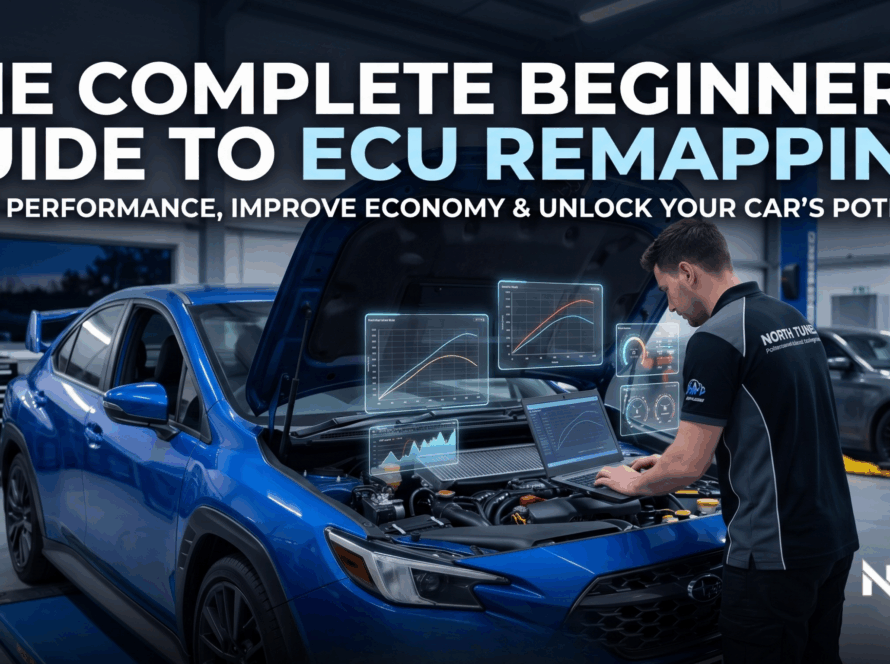
ECU Remapping involves rewriting the original software within your vehicle’s Electronic Control Unit. By removing factory-set restrictions, parameters such as fuel mapping, ignition timing, and boost pressure are fully optimized.
Pros:
Total Control: Every parameter of the engine can be adjusted.
Linear Power Delivery: Power is spread across the entire RPM range for a smoother feel.
Custom Tailored: If you have hardware upgrades (like an intake or exhaust), the map can be customized specifically for those parts.
Speed Limiter Removal: Most remaps allow for the removal of factory speed governors.
Cons:
Reversibility: Requires a professional to flash the car back to stock.
Warranty Concerns: Deep diagnostic scans at dealerships can often detect software changes.
2. What are Plug-and-Play Chips?
PnP modules are external boxes that sit between the engine sensors and the ECU. They function by intercepting and modifying sensor signals to “trick” the ECU into producing more power.
Pros:
Easy Installation: Usually a “DIY” job that takes about 15-20 minutes.
Instant Removal: You can unplug the device before a service visit or when selling the car, leaving no physical trace.
Transferability: Can often be moved to another vehicle with the same engine type.
Cons:
Limited Scope: It can only manipulate a few signals (mostly boost and fuel pressure) rather than managing the entire engine logic.
Less Refined: May not feel as smooth as a remap and can sometimes cause “jerky” power delivery in lower gears.
Feature,ECU Remapping,Plug-and-Play Chip
Power Gains,Maximum & Optimized,Moderate / Standardized
Driveability,Smooth & Natural,Aggressive but can be inconsistent
Installation,Professional Required,DIY Possible
Traceability,Software-visible,Physically removable
North Tuned Verdict
If you are looking for the most efficient, healthy, and bespoke performance increase, ECU Remapping is the superior choice. However, if your car is under a strict warranty or you want a temporary boost that you can remove at any time, a high-quality Plug-and-Play Module is a solid alternative.
In the automotive world, the most effective way to increase performance is ECU (Engine Control Unit) Chip Tuning. As this technology evolves, it unfortunately brings along various misconceptions. At Nort Tuned, we are debunking these industry myths with engineering facts.
1. Myth: “Why Didn’t the Manufacturer Do It? It Must Be Harmful”
The Reality: Manufacturers (OEMs) design cars for global markets. They must account for extreme temperatures, poor fuel quality in developing countries, and neglected maintenance cycles. Consequently, engines are released with significantly restricted power (often 30-40% below capacity).
Nort Tuned Approach: We don’t remove safety margins; we recalibrate them based on your local fuel quality and driving conditions. A professional remap doesn’t strain the engine; it optimizes combustion efficiency, making the engine run smoother.
2. Myth: “More Power Always Equals Higher Fuel Consumption”
The Reality: While power requires energy, efficiency is the key. After a remap, the torque curve is shifted to lower RPMs.
The Logic: Your car delivers the power it used to give at 2000 RPM now at 1600 RPM.
The Saving: You can upshift earlier and use less throttle to maintain speed. On highway cruises, it is common to see a 10% to 18% improvement in fuel economy.
3. Myth: “Tuned Cars Will Fail Emission Tests or Inspections”
The Reality: This is a total misconception. ECU optimization doesn’t alter the physical hardware. When done correctly, emission levels stay within factory limits. Your vehicle will pass standard inspections and exhaust emission tests without any issues.
4. Myth: “Tuning Boxes are the Same as Remapping”
The Reality: “Plug-and-play” tuning boxes merely “trick” the sensors into sending false data to the ECU. This is a crude method that can lead to uncontrolled fuel delivery.
Nort Tuned Difference: We perform Custom Mapping. We analyze the vehicle’s mileage, turbo health, and injector status to create a tailored software solution. We never use “copy-paste” files that could endanger your engine.
5. Myth: “Chip Tuning is Only for Turbocharged Cars”
The Reality: While turbo engines see the most dramatic gains (20-35%), atmospheric (N/A) engines also benefit significantly. Remapping improves throttle response, removes “flat spots” in the power band, and provides a much more spirited driving experience.
When it comes to unlocking a vehicle’s true potential, ECU Tuning is often the first step. However, at North Tuned, we believe that software is like a conductor; for it to produce the best symphony, the instruments beneath it must be up to the task.
Here are the top performance modifications that complement your tune and help your engine “breathe” better.
1. High-Flow Air Filters & Cold Air Intakes
A tuned engine demands more fuel, which in turn requires more oxygen. Stock paper filters often create a bottleneck.
Benefit: Increases airflow volume and sharpens throttle response.
2. Downpipe and Exhaust Upgrades
In turbocharged engines, getting exhaust gases out quickly is crucial. Standard catalytic converters can create backpressure and trap heat during high-performance driving.
Benefit: Lowers Exhaust Gas Temperatures (EGT) and allows the turbo to spool up faster.
3. Upgraded Intercooler
More boost equals more heat. When intake air gets too hot, it loses density, leading to “heat soak” and power loss.
Benefit: Keeps intake temperatures low, ensuring consistent power delivery even under hard driving.
4. Ignition System (Spark Plugs & Coils)
Under increased boost and cylinder pressure, stock spark plugs might struggle to ignite the mixture, leading to misfires.
Benefit: A stronger spark ensures complete combustion and a smoother power band.
North Tuned Insight: To get the most out of these hardware changes, your ECU map should be calibrated to recognize the improved airflow and cooling. Efficiency and longevity go hand in hand.
Getting a professional tune (remapping) is the most exciting way to unlock your vehicle’s hidden potential. However, simply saying “it feels faster” isn’t enough. To truly understand the gains, you need empirical data. Here is how we at North Tuned recommend verifying your performance increase:
1. Dyno (Dynamometer) Testing
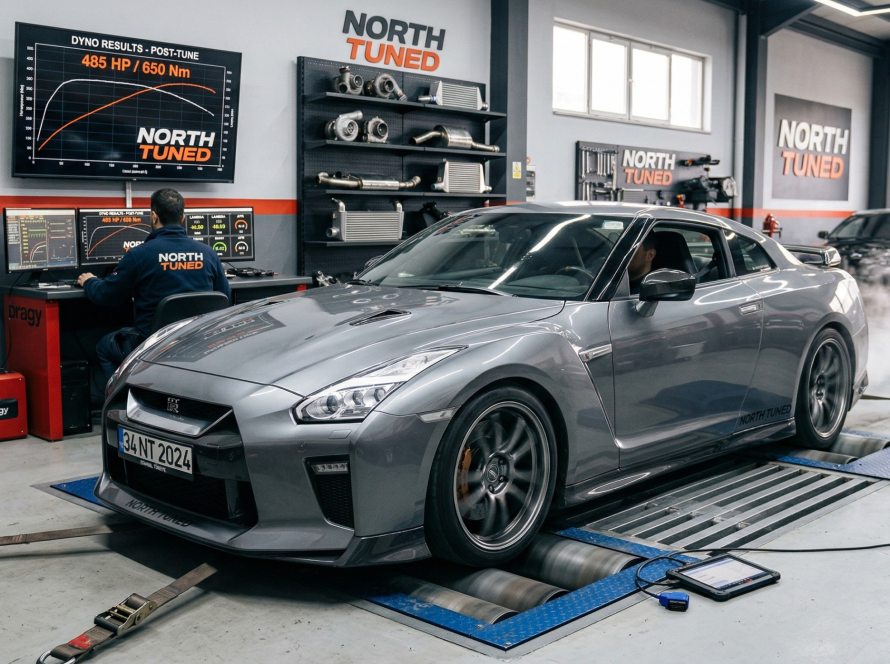
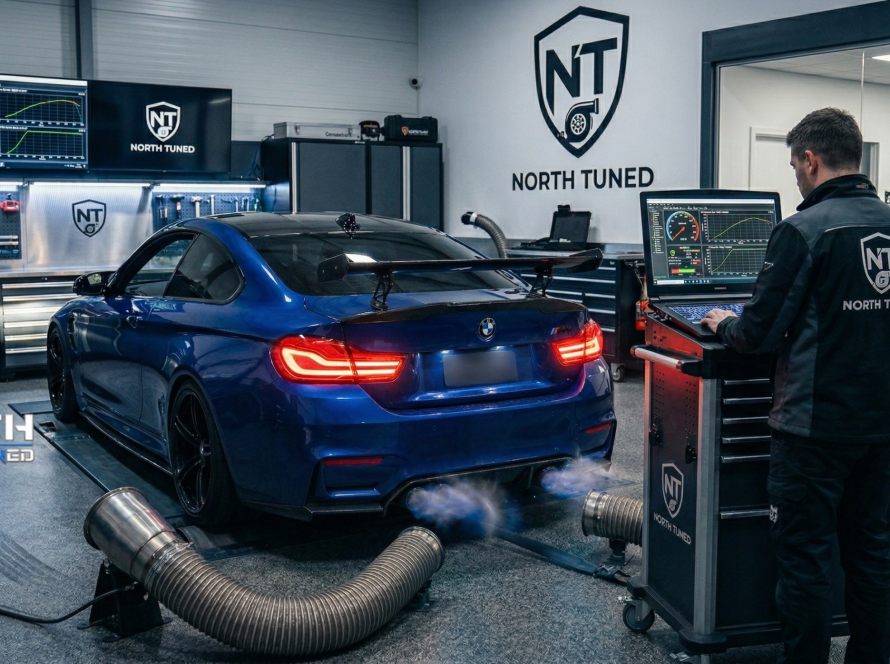
This is the gold standard. A dyno measures the horsepower (HP) and torque (Nm) delivered to the wheels.
Before/After: Performing a run right before and right after the tune provides a clear picture of the changes in the power band.
Health Check: It allows technicians to monitor Air-Fuel Ratios (AFR) to ensure the tune is running safely under load.
2. GPS-Based Performance Meters (Dragy or VBOX)
Devices like Dragy are the best way to turn feelings into facts. These use high-frequency GPS (10Hz or higher) to track acceleration with extreme precision.
0-100 km/h & 100-200 km/h: These are the industry standards for measuring real-world acceleration.
Slope Correction: These devices account for road incline, giving you a “valid” and honest result regardless of the terrain.
3. OBDII Data Logging
Speed is only one part of the story; how the engine achieves that speed matters for longevity. Use an OBDII scanner to log:
Boost Levels: Is the turbo hitting the requested targets?
Ignition Timing: Is the engine running efficiently without “pulling” timing due to knock?
Intake Air Temperatures (IAT): Is your cooling system handling the extra power effectively?
4. In-Gear Acceleration (Flexibility)
This is the most relevant metric for daily driving. For example, measure the time it takes to go from 80 km/h to 120 km/h in 4th gear. The reduction in this timeframe is the best indicator of your car’s increased “punch” and torque delivery.
For many enthusiasts, a car is more than just a tool for commuting; it’s a passion project. When the factory power feels insufficient, Stage 2 tuning is often the next logical step. But is it practical for a vehicle you drive every single day?
What is Stage 2?
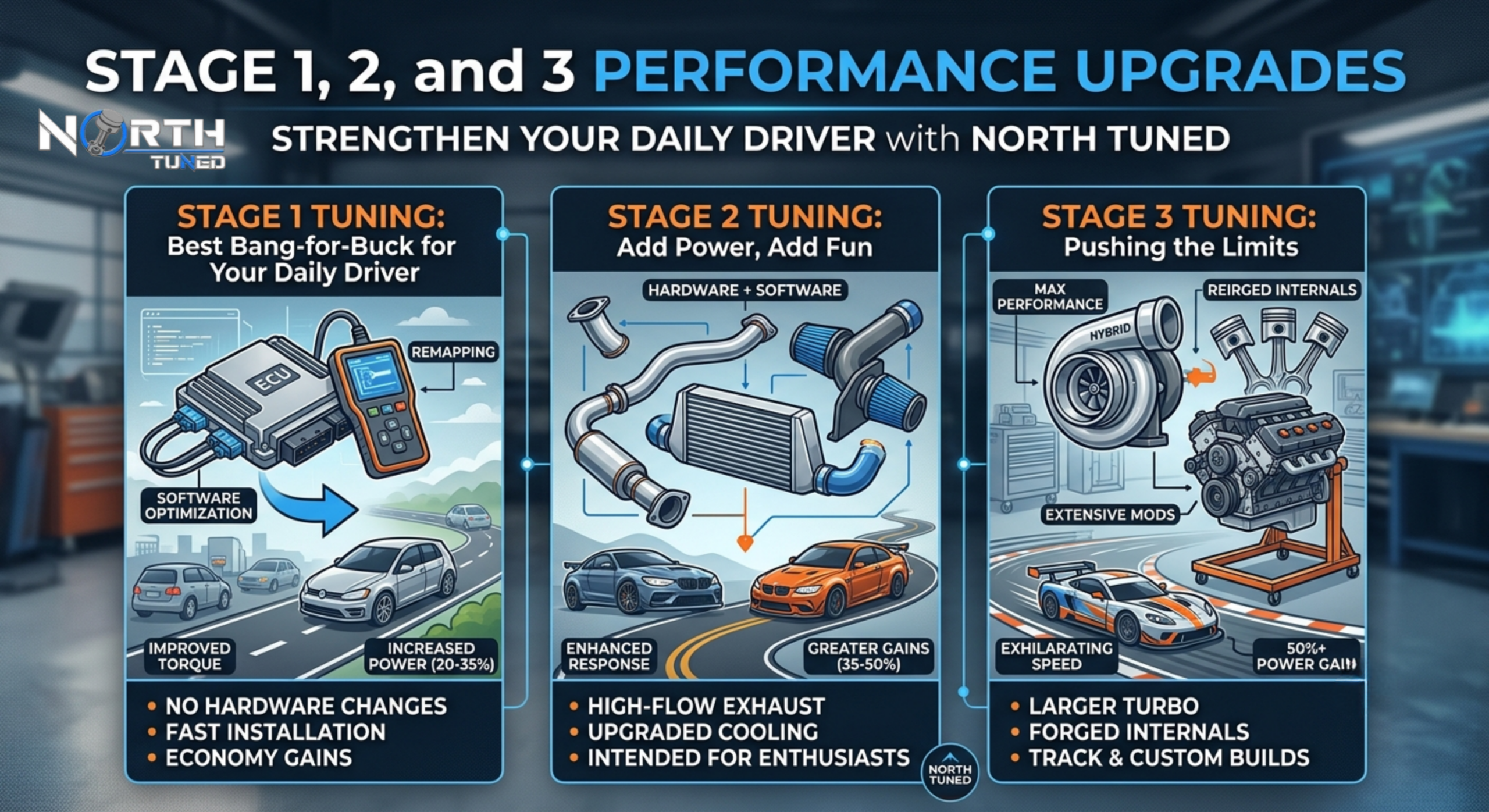
Unlike Stage 1, which is primarily a software-only upgrade, Stage 2 requires hardware modifications to help the engine “breathe” better. Typical upgrades include:
Downpipe: For faster exhaust gas evacuation.
Upgraded Intercooler: To ensure cooler, denser air intake.
High-Flow Air Intake: To reduce intake restriction.
Custom Remap: ECU calibration optimized for these specific hardware changes.
Pros and Cons for the Daily Drive
A Stage 2 vehicle offers a much broader torque curve and more aggressive acceleration compared to Stage 1. However, there are trade-offs to consider:
Performance: Significant gains in overtaking power and highway merging.
Fuel Economy: While efficiency can improve during cruising, spirited driving will see a noticeable jump in fuel consumption.
NVH (Noise, Vibration, Harshness): An aftermarket downpipe will increase exhaust volume. This might be thrilling for some but tiring for others in heavy traffic.
Reliability: Since you are pushing the engine further, high-quality maintenance becomes non-negotiable.
The Verdict: Is it worth it?
If you view driving as an experience rather than a chore and are willing to invest in the supporting hardware, Stage 2 is absolutely worth it. It transforms the character of the car without sacrificing total usability. At North Tuned, we believe the key is balance—achieving maximum performance while staying within the safe mechanical limits of your engine.
In the modern automotive world, technology is no longer just about mechanical parts. With the advancement of emission standards and the necessity for engine longevity, every vehicle is now managed by an Electronic Control Unit (ECU)—the digital brain of your car. However, most vehicles leave the factory with their true performance capabilities restricted by conservative software settings.
If you are unsatisfied with your vehicle’s current performance or feel that it lacks the “punch” it should have, North Tuned offers professional Chip Tuning services designed specifically for your needs.
What is Chip Tuning?
Chip Tuning is the process of reprogramming the software within the Engine Control Unit (ECU) while staying within the mechanical tolerances of the engine. Whether your vehicle is naturally aspirated or forced induction (turbocharger/supercharger), and whether it runs on petrol or diesel, North Tuned executes this transformation in three professional steps:
Read & Backup: Your vehicle’s original factory software is securely read and a backup is created for safety.
Optimization: Based on your performance expectations and driving habits, our expert engineers recalibrate the software maps.
Uploading: The perfected, custom-tailored program is flashed back into the ECU, completing the process.
Why Do Manufacturers Limit Engine Power?
When a car leaves the factory, it is designed to operate in extreme conditions—from polar freezes to desert heat—and with varying fuel qualities or different taxation policies across the globe. To maintain this wide safety margin, manufacturers intentionally “detune” the engine.
At North Tuned, we optimize your vehicle’s software for your specific climate and driving style, reaching the “sweet spot” of efficiency. When handled by experts and kept within recommended power limits, tuning provides significant benefits without harming your engine.
How the Process Works
During Chip Tuning, no physical parts are added or removed from the vehicle. The software is accessed in two primary ways:
OBD Port (On-Board Diagnostics): A digital connection is established through the vehicle’s diagnostic socket.
Bench Tuning: On certain models, the ECU is removed and programmed directly using specialized hardware.
By making precision adjustments to maps such as Air-Fuel Ratio (AFR) and Torque Limiters, we achieve a more responsive and refined driving experience.
Not Just Power, But Efficiency!
Chip tuning isn’t just about speed. A correctly calibrated software allows the engine to produce more torque at lower RPMs. This means your car becomes “meatier” in the lower rev range, requiring less throttle input to maintain speed. The result? Significant fuel savings depending on your driving style.
Are you ready to unleash the true power of your vehicle and take your driving pleasure to the next level? Contact the North Tuned expert team today.