
Tag: Tuning Solutions

Ethanol Fuel and Performance: The Secret Weapon for High Horsepower

Ethanol Fuel and Performance: The Secret Weapon for High Horsepower

In the world of automotive tuning, fuel is just as critical as the hardware itself. When you push the limits of standard pump gas, you eventually hit a wall called “knock” or “detonation.” This is where Ethanol (Ethyl Alcohol) becomes a game-changer. At North Tuned, we frequently utilize ethanol blends to unlock the true potential of turbocharged and high-compression engines.

Here is an in-depth technical look at why ethanol is the preferred choice for high-performance applications and what you need to know about the transition.

What is Ethanol Fuel?
Ethanol is a renewable fuel source produced by fermenting sugars from agricultural feedstocks like corn, sugar cane, and wheat. While it can be used in its pure form, it is most commonly mixed with gasoline in varying ratios:

E10: 10% Ethanol / 90% Gasoline (Commonly found at standard gas stations).

E85: 85% Ethanol / 15% Gasoline (The “Gold Standard” for performance tuning).

Why Ethanol Wins: The Technical Advantages
The reason ethanol is so highly regarded in the motorsport and tuning industry boils down to two main factors: Octane Rating and Latent Heat of Vaporization.

1. Massive Octane Boost
Standard premium gasoline usually sits between 91 and 93 AKI (95-98 RON). Pure ethanol, however, boasts an octane rating of approximately 116 AKI / 129 RON. Even at an E85 blend, the effective octane rating is usually 105+.

The Benefit: High octane means the fuel is incredibly resistant to pre-ignition. This allows tuners to advance ignition timing and increase boost pressure significantly without the risk of engine damage.

2. Superior Cooling Effect
Ethanol has a much higher latent heat of vaporization than gasoline. This means that as ethanol is injected and evaporates, it absorbs a significant amount of heat from the intake air and the combustion chamber.

Turbo Longevity: By lowering Exhaust Gas Temperatures (EGT), ethanol protects the turbocharger turbine and internal engine components from thermal stress. It essentially acts as a chemical intercooler.

The “Ethanol Ready” Conversion: What Changes?
Ethanol contains about 34% less energy by volume than gasoline. This means that to maintain the correct Air/Fuel Ratio (AFR), the engine must spray more fuel. For E85, you typically need 30% to 35% more fuel flow compared to gasoline.

To make a vehicle compatible, North Tuned focuses on these essential upgrades:

High-Flow Fuel Pumps & Injectors: Since the volume requirement increases, upgraded pumps and larger injectors are mandatory to prevent the engine from running lean.

Flex Fuel Sensors: We install sensors that detect the exact ethanol content in the tank. This allows the ECU to automatically adjust the tune in real-time, whether you are running 10% or 85% ethanol.

Material Compatibility: While most modern cars (post-2000s) have fuel systems resistant to alcohol, older projects may require replacing rubber lines with PTFE (Teflon) lines to prevent corrosion.

Daily Driving and Environmental Impact
While ethanol is a “cleaner” burning fuel in terms of carbon emissions, it does have some quirks:

Cold Starts: Ethanol does not vaporize well at temperatures below 13°C (55°F). Specialized tuning is required to ensure the car starts smoothly on cold mornings.

Fuel Economy: Because more fuel is required to produce the same energy, you will notice a roughly 25-30% drop in MPG when running E85.

Ethanol is not just a fuel; it’s a performance tool. It allows us to reach power levels that were previously only possible with expensive, leaded racing fuels. If you are looking to maximize the efficiency and output of your turbocharged engine while keeping engine temperatures in check, an ethanol conversion is the most effective path forward.

read more
EGR Problems in Modern Cars and How Tuning Can Solve Them

EGR Problems in Modern Cars and How Tuning Can Solve Them

In the modern automotive industry, there is a constant battle between performance and environmental regulations. One of the primary components of this struggle is the EGR (Exhaust Gas Recirculation) system. While designed with good intentions, it has become a notorious source of headaches for diesel and gasoline engine owners alike.

Understanding the EGR System
The EGR system’s job is to redirect a portion of the exhaust gases back into the combustion chamber. By doing this, it lowers the combustion temperature and reduces Nitrogen Oxide ($NO_x$) emissions. However, introducing “dirty” air into the intake system is counter-intuitive for engine longevity and performance.

Why Does It Fail?
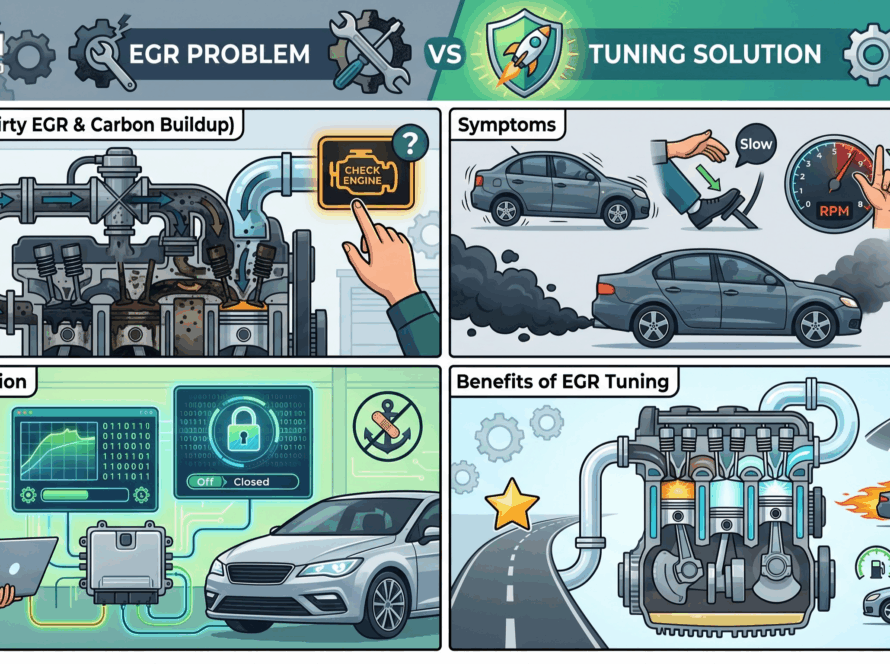
The primary enemy of the EGR valve is carbon buildup. Exhaust gases contain soot, and when mixed with oil vapors in the intake, they form a thick, tar-like substance. This sludge eventually causes the valve to stick or completely clogs the intake manifold.

Symptoms of a Faulty EGR Valve
If you experience any of the following, your EGR system is likely failing:

Loss of Power: Especially noticeable during acceleration.

Increased Fuel Consumption: The ECU struggles to find the correct air-fuel ratio.

Rough Idling: The car shakes or vibrates when stopped.

Limp Mode: The vehicle limits its RPM to prevent engine damage.

Excessive Smoke: Dark smoke from the exhaust due to poor combustion.

The Tuning Solution: Why EGR Delete?
At North Tuned, we believe in long-term reliability. Replacing a faulty EGR valve is often a “band-aid” fix, as the new part will inevitably clog again. Our EGR Software Optimization offers a permanent solution.

Benefits of EGR Tuning & Deletion:
Enhanced Engine Longevity: By preventing soot from entering the engine, you extend the life of your internal components.

Improved Throttle Response: With only fresh, oxygen-rich air entering the cylinders, the engine responds much faster to your inputs.

Cost-Effective: Software adjustment is often cheaper than buying a brand-new mechanical valve and paying for labor multiple times.

Better Fuel Economy: A cleaner burn means every drop of fuel is used more efficiently.

Professional Calibration at North Tuned
When we perform an EGR delete, we modify the Engine Control Unit (ECU) maps. We don’t just “turn off the light”; we recalibrate the air mass flow and fuel injection parameters to ensure the engine operates perfectly without the EGR cycle. This results in a smoother drive and total peace of mind.

read more