

When you invest in an ECU remap or hardware upgrades (like upgraded turbos or downpipes) to unleash your vehicle’s potential, you want to see the numbers to prove it. In the performance tuning world, there is only one way to measure that power: The Dynamometer (Dyno).
However, there has been an ongoing debate in the tuning industry for years: Does the traditional Roller Dyno or the direct-bolt-on Hub Dyno provide more accurate and reliable results? At Hướng Bắc, we dive deep into the engineering behind power measurement and explain why certain methods are critical during the calibration process.
What is a Roller Dyno (Rolling Road)?
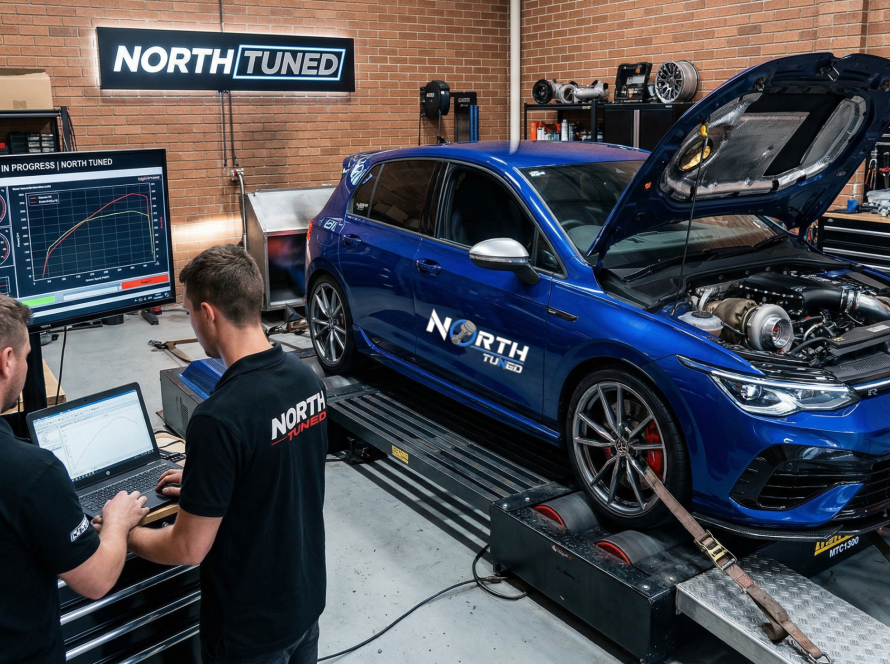
A Roller Dyno, also known as a rolling road or chassis dyno, is the most common system in the industry. The vehicle is driven onto massive steel cylinders (rollers) and strapped down tightly from the front and rear. When you accelerate, the car’s wheels spin the rollers, and the system calculates horsepower and torque based on the rotational inertia and resistance of those cylinders.
Pros of a Roller Dyno
- Fast Setup: Driving the car onto the rollers and strapping it down is relatively quick and straightforward.
- Real-World Simulation: Because it accounts for the friction between the tyres and the road (the rollers), it gives a rough idea of how much power the car is actually putting to the tarmac.
Cons of a Roller Dyno
- Wheel Slip Risk: On high-torque vehicles (especially Stage 2 and beyond), the tyres can lose traction and slip on the rollers. This causes severe spikes in the power curve and inaccurate readings.
- Too Many Variables: Tyre pressure, tyre compound temperature, and even how tightly the mechanic straps the car down can alter the final reading (sometimes by up to 10-15 HP).
- Safety Concerns: Running a 600+ HP car at 250 km/h on rollers while held back by nothing but a few ratchet straps always carries a certain level of risk.
What is a Hub Dyno?
With a Hub Dyno system, the vehicle’s driven wheels are completely removed. The dynamometer units are then bolted directly onto the vehicle’s wheel hubs or axles using special adaptors. This means the power produced by the engine is measured directly from the drivetrain, bypassing the tyres entirely.
Pros of a Hub Dyno
- Zero Slip, Absolute Accuracy: Because the tyres are removed from the equation, the chance of wheel slip is zero. Every single Nm of torque and kW of power is transferred directly into the measuring equipment.
- Repeatability: Without variables like tyre temperature, pressure, or strap tension, 10 consecutive power runs will yield virtually identical results. This consistency is exactly what a calibrator needs when tuning an engine.
- Maximum Safety: Because the car is physically bolted to massive hydraulic/braked pods via its axles, there is no risk of the vehicle launching off the dyno or snapping a strap.
Cons of a Hub Dyno
- Setup Time: Removing the wheels, aligning the heavy pods, and bolting them to the axles requires more time and manual labour compared to a roller dyno.
- Drivetrain Loss Calculation: Because it doesn’t measure tyre friction, the power figures obtained from a hub dyno are inherently slightly higher than those from a roller dyno (usually by about 5-8%).
So, Which is More Accurate?
The answer depends on what you are trying to measure, but from an engineering and calibration standpoint, the Hub Dyno is undeniably superior.
When fine-tuning an Engine Control Unit (ECU), the most critical factor for professional tuning companies like Hướng Bắc is “repeatability.” If we increase the ignition timing by 1 degree or raise the boost pressure by 0.1 bar, we need to see the exact impact on power. If a roller dyno shows a different result simply because the tyre pressure changed between runs, we cannot accurately measure the effect of our calibration. A hub dyno eliminates this “noise” and provides us with the pure, unaltered truth of the engine and the software.
The North Tuned Approach
When modifying high-performance vehicles, there is no room for guesswork. Whether it is a heavily modified project car or a daily-driven Stage 1 calibration, verified data is everything. Reading power in its purest form, stripped of outside variables, is the safest way to ensure you extract maximum performance without ever compromising the health and reliability of your engine.

 English
  Turkish
  German
  Spanish
  Hindi
Hindi  Arabic
  Italian
  Greek
Greek  Vietnamese
  Chinese
  Malay
Malay