
Blog

What is a Downpipe? The Essential Upgrade for Performance
In the automotive world, Downpipe is one of the first modifications that come to mind for enthusiasts. It is a critical exhaust component, especially for turbocharged vehicles, designed to unleash the engine’s true potential. Technically, a downpipe connects the turbocharger outlet to the rest of the exhaust system.
Limitations of Factory Systems
Today, car manufacturers must minimize costs and meet stringent emission standards during mass production. Consequently, factory exhaust systems are often designed with narrow diameters and numerous restrictive bends. Specifically, the high-density catalytic converters within these systems create significant “backpressure,” hindering the turbocharger’s efficiency and slowing down the evacuation of exhaust gases.
Why Choose North Tuned Downpipe?
At North Tuned, our downpipe solutions are engineered to remove these factory restrictions. By utilizing larger diameters and smooth-walled piping, we allow your engine to “breathe” far more effectively than with stock components.
Key Benefits of Downpipe Upgrades:
Faster Turbo Spool: Since exhaust gases encounter minimal resistance, the turbocharger reaches its optimum RPM much quicker, eliminating turbo lag.
Increased Horsepower and Torque: Improved gas flow leads to better engine volumetric efficiency, resulting in measurable gains in both HP and torque.
Thermal Management: Efficiently moving hot gases away from the turbo reduces operating temperatures, protecting the longevity of your turbocharger.
Perfect Synergy with Chiptuning: For Stage 2 and higher performance software, a North Tuned downpipe is essential to handle increased boost levels and maximize power delivery.
Enhanced Sound: It provides a deeper, more aggressive, and sportier exhaust note that reflects the power under the hood.

How to Protect Your Engine: Critical Tuning Mistakes and Prevention
Performance tuning is a craft that balances art and engineering. At North Tuned, we believe that true performance isn’t just about the peak numbers on a dyno sheet—it’s about how long that engine can sustain those numbers.
1. Tuning Without Pre-Inspection
Tuning an engine with existing mechanical issues is like building a skyscraper on a swamp.
The Mistake: Installing a performance map on a car with old spark plugs, a tired fuel pump, or vacuum leaks.
The Outcome: The added stress of increased boost or timing will inevitably cause the weakest link to fail.
North Tuned Pro-Tip: Always perform a diagnostic scan and check for boost leaks before modifying the ECU.
2. Neglecting Thermal Management
Power is a byproduct of combustion, and combustion generates heat. If you increase the energy, you must increase the cooling.
The Mistake: Pushing high boost levels on a stock intercooler.
The Outcome: High Intake Air Temperatures (IATs) lead to ignition timing pull and potential engine knock (detonation).
Solution: For Stage 2+ builds, upgrading the cooling system is not optional; it is a necessity for engine longevity.
3. Chasing Boost Instead of Efficiency
A common misconception is that “More Boost = More Power.”
The Mistake: Overworking a small turbocharger beyond its efficiency map.
The Technical Side: When a turbo is pushed too hard, it simply blows hot, turbulent air. This increases backpressure and heat without adding significant oxygen.
Solution: Focus on optimizing the Air-Fuel Ratio (AFR) and ignition timing. Sometimes, less boost with better timing yields more reliable power.
4. The Danger of “Generic” Off-the-Shelf Tunes
Every car lives a different life. A car in a high-altitude region needs different parameters than one at sea level.
The Mistake: Using cheap, non-adjustable files that don’t account for fuel quality or hardware health.
The Outcome: Poor drivability and a high risk of catastrophic failure under load.
The North Tuned Approach: We prioritize Data Logging. By analyzing how your specific engine reacts in real-time, we fine-tune the software to ensure maximum safety margins.
5. Forgetting the Drivetrain
An engine is only as good as the wheels it turns.
The Mistake: Increasing torque significantly without recalibrating the Transmission Control Unit (TCU).
The Outcome: Slipped clutches in DSG/ZF gearboxes or snapped axles.
Solution: Match your ECU tune with a TCU tune to increase clutch clamping pressure and optimize shift points.

The Ultimate Guide to Dump Valves: Performance and Protection
For performance enthusiasts, the sound and speed of a turbo are indispensable. However, managing and protecting that power is just as crucial as generating it. At North Tuned, we are diving deep into the Dump Valve (Blow-Off Valve) system, covering everything from technical mechanics to its vital role in high-performance tuning.
What is a Dump Valve and Why is it Essential?
A turbocharger works by using exhaust gases to spin a compressor wheel, forcing high-pressure air into the intake manifold. As long as you are on the throttle, this cycle works perfectly. However, when you lift your foot off the gas to shift gears or decelerate, the throttle body closes instantly.
This creates a major physical problem: due to inertia, the turbo continues to spin at thousands of RPMs and keeps pushing air. With the throttle closed, this high-pressure air hits a “wall,” bounces back, and travels toward the spinning turbo blades. This phenomenon, known as compressor surge, applies massive counter-force to the turbine, trying to stop it or spin it backward. A Dump Valve is the safety component designed to vent this trapped air, allowing the turbo to spin freely.
Technical Mechanics: How It Operates at North Tuned Standards
The operation of a dump valve is a masterpiece of pressure dynamics:
The Vacuum Effect: When the throttle closes, a vacuum is created in the intake manifold.
Actuation: This vacuum pulls the internal piston or diaphragm of the dump valve open.
Pressure Release: Once open, the high-pressure air trapped between the turbo and the throttle is vented out—either to the atmosphere (creating the signature “pssh” sound) or recirculated back into the intake.
Maintaining Momentum: Because the backpressure is removed, the turbo doesn’t lose its speed. It keeps spinning freely.
Why Should You Install a High-Quality Dump Valve?
Eliminating Turbo Lag: Since the turbocharger maintains its RPM during gear shifts, you get nearly instantaneous boost response the moment you step back on the accelerator.
Protecting Your Investment: High-performance turbos are expensive. A dump valve protects the internal shafts, bearings, and compressor wheels from the violent “shocks” of air surges, significantly extending the turbo’s lifespan.
Optimized Thermal Management: Trapped, compressed air heats up rapidly. By venting this hot air and allowing the intercooler to process fresh, cool air, the engine benefits from a denser oxygen mixture and better combustion.
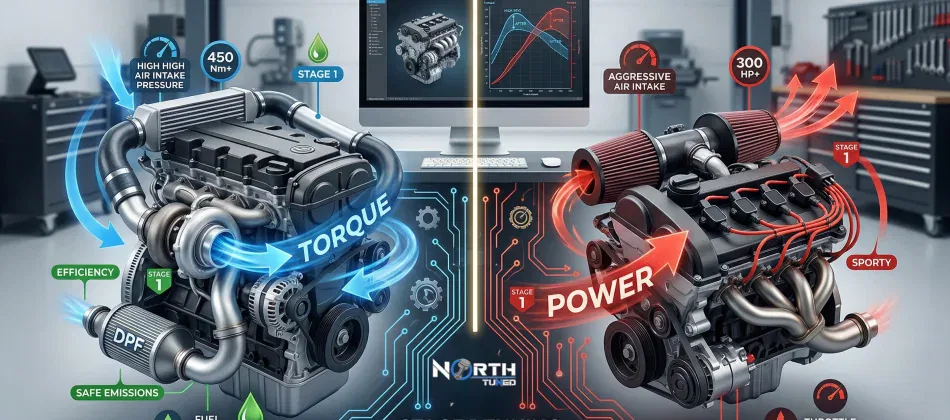
Comprehensive Guide to Stage 1 Tuning for Petrol vs. Diesel Engines
For automotive enthusiasts, Stage 1 Tuning is the most effective way to personalize a vehicle and surpass factory limitations. While many drivers wonder why manufacturers don’t deliver maximum power from the factory, the truth is that Stage 1 is an engineering optimization. In this guide, North Tuned explores the reactions, advantages, and technical nuances of petrol and diesel engines in the most profound detail.
What is Stage 1? Behind the Software
Stage 1 involves recalibrating the software on the ECU (Engine Control Unit) without changing any physical mechanical parts. Car manufacturers release vehicles with “de-tuned” engines (often at 70-80% efficiency) to ensure they can handle poor fuel quality, extreme climates, and different tax brackets worldwide. Stage 1 awakens this “sleeping” potential within safe margins.
1. Stage 1 in Diesel Engines: The Power of Torque
Diesel engines, with their high compression ratios and turbochargers, are the most “eager” units to respond to software tuning. Even though they are often built for economy, their character changes completely after Stage 1.
Torque Increase and Driving Dynamics
In diesels, the biggest gain is in Torque (Nm) rather than just horsepower. The massive pulling power felt at low RPMs (1500-2500 RPM) after tuning carries the car’s mid-range acceleration to an incredible level. Especially for heavy SUVs or loaded commercial vehicles, Stage 1 is almost a necessity for driving comfort.
Economy and Efficiency
One of the primary motivations for tuning a diesel is fuel economy. The increased torque allows the engine to maintain the same speed at lower RPMs. This translates back to you as up to 10% fuel savings in urban stop-and-go traffic and long-distance cruising.
Critical Components: DPF and EGR
Diesel owners often worry about emission systems. North Tuned’s professional software optimizes combustion efficiency without disrupting the working principles of the Diesel Particulate Filter (DPF) and EGR systems. Unlike low-quality “smoky” tunes, your engine performs a cleaner combustion process.
2. Stage 1 in Petrol Engines: The Joy of the Rev Range
A Stage 1 application in petrol engines offers two different scenarios depending on the intake type (Turbocharged or Naturally Aspirated).
Turbocharged Petrol Units (TSI, T-GDI, EcoBoost)
Modern turbo-petrol engines receive a magical touch with Stage 1. Precise recalibration of turbo boost and ignition timing provides a much more dramatic increase in horsepower compared to diesels. Power is delivered continuously until the end of the rev range, meaning the car continues to accelerate even at high speeds.
Naturally Aspirated Engines: Throttle Response and Fluidity
While HP gains in non-turbo engines usually stay within the 5-10% range, the real impact of Stage 1 is felt in throttle sensitivity. The sluggish factory response is eliminated; the car becomes more vivid and “fluid,” responding instantly to the driver’s commands.
Technical Comparison: Gains and Characteristics
Power Character: While power in diesels comes with a sudden torque burst, turbo petrol vehicles exhibit a more linear and aggressive acceleration curve.
Mechanical Tolerance: Diesel engine blocks are generally more robust, making them resistant to high torque. In petrol vehicles, the health of the cooling and ignition systems is the priority.
Longevity: In both engine types, Stage 1 does not shorten engine life as long as regular maintenance is performed. In fact, a more efficient engine provides the same performance with less effort.
Why Choose North Tuned?
While many places use “generic maps,” at North Tuned, we treat every vehicle as an engineering project.
Individual Calibration: We analyze your vehicle’s current mileage, turbo condition, and injector health to write a software specifically for you.
Transmission Harmony: While increasing engine power, we meticulously protect transmission torque limits, especially in automatic (DSG, ZF, EDC) vehicles.
Safe Limits: Our priority is not “maximum power” but “safest performance.” We never push your engine’s mechanical boundaries.
Stage 1 Tuning is a technical art that reveals the soul of your vehicle. Are you ready to discover your car’s true potential with North Tuned?
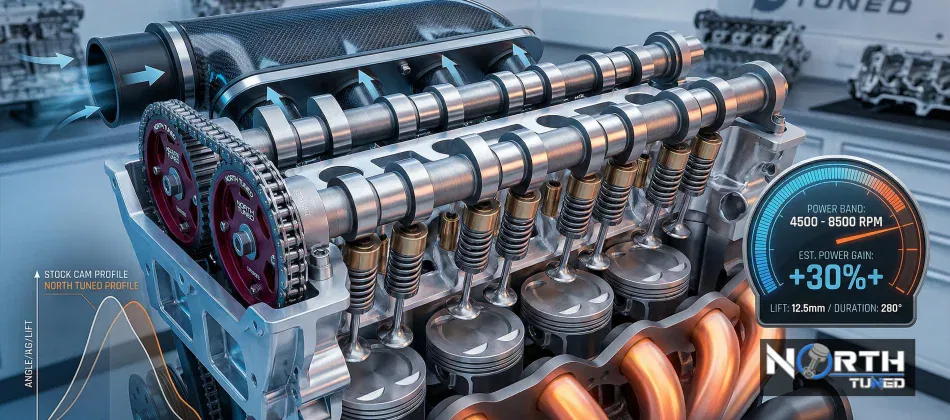
Camshaft and Performance (High-Cam) Camshaft Guide: With North Tuned Expertise
At the heart of every engine lies the master of synchronization: the Camshaft. At North Tuned, we understand that efficiency and pure power are hidden within the precise calibration of this vital component.
What is a Camshaft and How Does It Work?
The camshaft is a critical auxiliary shaft that receives its motion from the crankshaft to manage engine valves. In a standard four-stroke engine, while the crankshaft completes two full rotations (720°), the camshaft completes one (360°).
Its primary duty is to dictate exactly when the intake and exhaust valves open and how long they remain open with millimetric precision. Usually manufactured from high-quality carbon steel through casting or forging, the camshaft features journals, drive gears, and the “cams” that physically actuate the valves.
Power Transmission and Risk Factors
The method of driving the camshaft varies by engine architecture:
Timing Belt/Chain: Used in inline engines where the distance between shafts is significant. At North Tuned, we warn that a snapped or slipped timing belt causes valves to collide with pistons, leading to catastrophic engine failure.
Gear-to-Gear: Common in some V-type configurations where the shafts are close, offering the most durable and efficient transfer.
Signs of Wear and Performance Loss
Even slight wear on the cam lobes results in reduced valve lift or incorrect timing. This restricts the engine’s “breathing,” leading to power loss, poor combustion, and increased fuel consumption.
The Key to Performance: High-Duration (Performance) Camshafts
For those seeking to unlock the true potential of their engine, the first stop is the Performance Camshaft. With North Tuned solutions, we bypass the restrictive profiles of OEM shafts to redefine your engine’s character.
How Does It Generate Power?
High-performance camshafts increase the “duration” (time open) and “lift” (depth of opening) of the valves. Allowing more air-fuel mixture into the combustion chamber per cycle results in a more powerful explosion, leading to power gains of up to 35%.
Technical Terminology & North Tuned Analysis
LIFT: Indicates how far the camshaft pushes the valve open. Higher lift means a larger “curtain area” for airflow.
DURATION: The measurement of how long the valve stays off its seat, measured in degrees of crankshaft rotation.
OVERLAP: The critical window where both intake and exhaust valves are open simultaneously. This scavenges exhaust gases and pulls in fresh charge at high RPMs.
POWER BAND: The RPM range where the camshaft profile is most efficient. At North Tuned, we optimize this band based on your needs, whether for the track or the street.
Vital Note: A performance camshaft is not a standalone miracle. To achieve maximum reliability and output, this modification should be supported by reinforced valve springs, adjustable cam gears, and most importantly, a custom North Tuned ECU Remap.
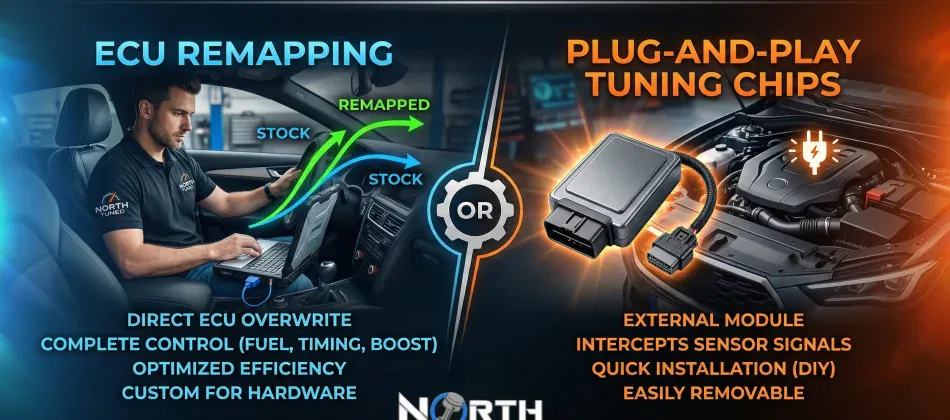
ECU Remapping vs. Plug-and-Play Chips: Which One is Right for You?
For performance enthusiasts, there are two primary ways to unlock a vehicle’s hidden potential: ECU Remapping and Plug-and-Play (PnP) Tuning Modules. At North Tuned, we’ve analyzed both methods to help you make the best decision for your ride.
1. What is ECU Remapping?
ECU Remapping involves rewriting the original software within your vehicle’s Electronic Control Unit. By removing factory-set restrictions, parameters such as fuel mapping, ignition timing, and boost pressure are fully optimized.
Pros:
Total Control: Every parameter of the engine can be adjusted.
Linear Power Delivery: Power is spread across the entire RPM range for a smoother feel.
Custom Tailored: If you have hardware upgrades (like an intake or exhaust), the map can be customized specifically for those parts.
Speed Limiter Removal: Most remaps allow for the removal of factory speed governors.
Cons:
Reversibility: Requires a professional to flash the car back to stock.
Warranty Concerns: Deep diagnostic scans at dealerships can often detect software changes.
2. What are Plug-and-Play Chips?
PnP modules are external boxes that sit between the engine sensors and the ECU. They function by intercepting and modifying sensor signals to “trick” the ECU into producing more power.
Pros:
Easy Installation: Usually a “DIY” job that takes about 15-20 minutes.
Instant Removal: You can unplug the device before a service visit or when selling the car, leaving no physical trace.
Transferability: Can often be moved to another vehicle with the same engine type.
Cons:
Limited Scope: It can only manipulate a few signals (mostly boost and fuel pressure) rather than managing the entire engine logic.
Less Refined: May not feel as smooth as a remap and can sometimes cause “jerky” power delivery in lower gears.
Feature,ECU Remapping,Plug-and-Play Chip
Power Gains,Maximum & Optimized,Moderate / Standardized
Driveability,Smooth & Natural,Aggressive but can be inconsistent
Installation,Professional Required,DIY Possible
Traceability,Software-visible,Physically removable
North Tuned Verdict
If you are looking for the most efficient, healthy, and bespoke performance increase, ECU Remapping is the superior choice. However, if your car is under a strict warranty or you want a temporary boost that you can remove at any time, a high-quality Plug-and-Play Module is a solid alternative.
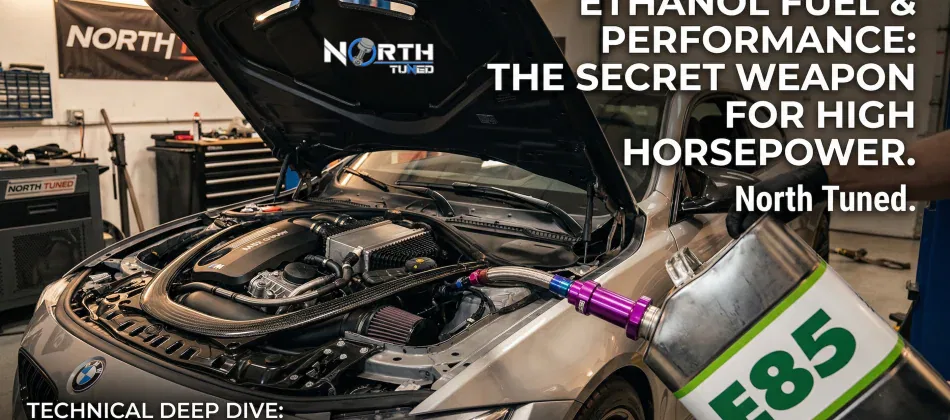
Ethanol Fuel and Performance: The Secret Weapon for High Horsepower
In the world of automotive tuning, fuel is just as critical as the hardware itself. When you push the limits of standard pump gas, you eventually hit a wall called “knock” or “detonation.” This is where Ethanol (Ethyl Alcohol) becomes a game-changer. At North Tuned, we frequently utilize ethanol blends to unlock the true potential of turbocharged and high-compression engines.
Here is an in-depth technical look at why ethanol is the preferred choice for high-performance applications and what you need to know about the transition.
What is Ethanol Fuel?
Ethanol is a renewable fuel source produced by fermenting sugars from agricultural feedstocks like corn, sugar cane, and wheat. While it can be used in its pure form, it is most commonly mixed with gasoline in varying ratios:
E10: 10% Ethanol / 90% Gasoline (Commonly found at standard gas stations).
E85: 85% Ethanol / 15% Gasoline (The “Gold Standard” for performance tuning).
Why Ethanol Wins: The Technical Advantages
The reason ethanol is so highly regarded in the motorsport and tuning industry boils down to two main factors: Octane Rating and Latent Heat of Vaporization.
1. Massive Octane Boost
Standard premium gasoline usually sits between 91 and 93 AKI (95-98 RON). Pure ethanol, however, boasts an octane rating of approximately 116 AKI / 129 RON. Even at an E85 blend, the effective octane rating is usually 105+.
The Benefit: High octane means the fuel is incredibly resistant to pre-ignition. This allows tuners to advance ignition timing and increase boost pressure significantly without the risk of engine damage.
2. Superior Cooling Effect
Ethanol has a much higher latent heat of vaporization than gasoline. This means that as ethanol is injected and evaporates, it absorbs a significant amount of heat from the intake air and the combustion chamber.
Turbo Longevity: By lowering Exhaust Gas Temperatures (EGT), ethanol protects the turbocharger turbine and internal engine components from thermal stress. It essentially acts as a chemical intercooler.
The “Ethanol Ready” Conversion: What Changes?
Ethanol contains about 34% less energy by volume than gasoline. This means that to maintain the correct Air/Fuel Ratio (AFR), the engine must spray more fuel. For E85, you typically need 30% to 35% more fuel flow compared to gasoline.
To make a vehicle compatible, North Tuned focuses on these essential upgrades:
High-Flow Fuel Pumps & Injectors: Since the volume requirement increases, upgraded pumps and larger injectors are mandatory to prevent the engine from running lean.
Flex Fuel Sensors: We install sensors that detect the exact ethanol content in the tank. This allows the ECU to automatically adjust the tune in real-time, whether you are running 10% or 85% ethanol.
Material Compatibility: While most modern cars (post-2000s) have fuel systems resistant to alcohol, older projects may require replacing rubber lines with PTFE (Teflon) lines to prevent corrosion.
Daily Driving and Environmental Impact
While ethanol is a “cleaner” burning fuel in terms of carbon emissions, it does have some quirks:
Cold Starts: Ethanol does not vaporize well at temperatures below 13°C (55°F). Specialized tuning is required to ensure the car starts smoothly on cold mornings.
Fuel Economy: Because more fuel is required to produce the same energy, you will notice a roughly 25-30% drop in MPG when running E85.
Ethanol is not just a fuel; it’s a performance tool. It allows us to reach power levels that were previously only possible with expensive, leaded racing fuels. If you are looking to maximize the efficiency and output of your turbocharged engine while keeping engine temperatures in check, an ethanol conversion is the most effective path forward.

Optimizing Your Car for Track Days via Tuning Software: The Ultimate North Tuned Guide
For automotive enthusiasts, a “Track Day” is more than a hobby; it’s a test of engineering and skill. Those few hours spent pushing your car to its absolute limits require a perfect symphony between mechanical hardware and digital software. While most focus on brakes and tires, the true potential of a modern vehicle lies within its ECU (Engine Control Unit).
At North Tuned, we specialize in unlocking that potential, transforming a street-legal car into a consistent, high-performance track weapon through precision software calibration.
1. Power Delivery and Predictability
On the street, software is designed for fuel economy. On the track, the goal is “predictability.”
Linear Power Delivery: Factory turbo maps often have sudden spikes in boost. In the middle of a high-speed corner, this can cause an upset in the chassis. North Tuned reshapes the boost curve to ensure that power builds progressively, giving you total control over traction.
Torque Management: By optimizing torque delivery in lower gears, we reduce unnecessary wheel spin, ensuring that every bit of power is converted into forward momentum as you exit the apex.
2. Advanced Thermal Management
Heat is the silent killer on the track. A 20-minute session subjects the engine to thermal stresses that a street car rarely sees.
Component Protection (EGT): Our calibrations include sophisticated safety maps. If Exhaust Gas Temperatures reach critical levels, the ECU automatically adjusts fueling to cool the internal components, preventing catastrophic failure.
Cooling System Optimization: We recalibrate fan duty cycles and water pump flow to trigger earlier. This ensures the engine remains in its optimal operating window even during the final laps of a hot summer session.
3. TCU Tuning: The Transmission Connection
For owners of DSG, PDK, or ZF8 gearboxes, the transmission software is just as vital as the engine map.
Shift Speed & Force: We decrease shift times to near-instantaneous levels, ensuring there is zero “dead time” during acceleration.
Kickdown Deactivation: Nothing is more frustrating than a car downshifting automatically when you are holding a gear for balance. Our TCU tunes give you 100% manual control, preventing unwanted gear changes at the limit.
4. Track-Specific Calibration Features
Left Foot Braking: Factory logic often cuts the throttle if the brake is pressed simultaneously. We remove this restriction, allowing advanced drivers to use the brake to tuck the nose into a corner while maintaining boost.
Dynamic Throttle Mapping: We sharpen the throttle response to eliminate lag, creating a telepathic connection between your right foot and the engine’s output.
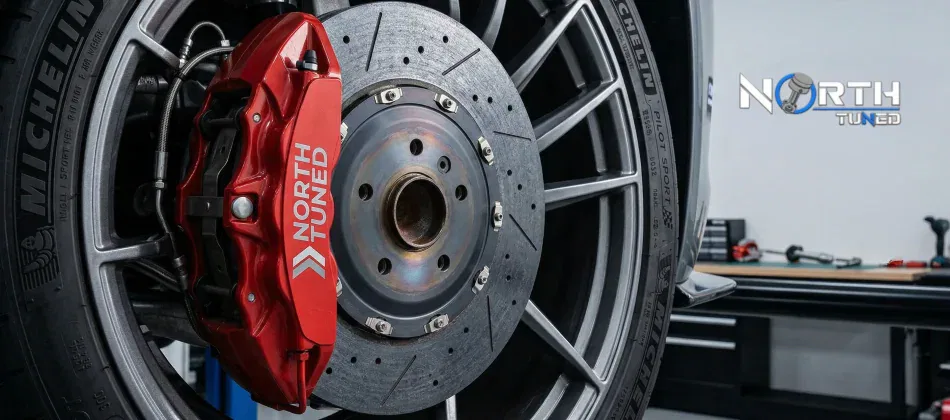
High-Performance Braking Systems and North Tuned Engineering
In the automotive world, the ability to harness speed is just as vital as achieving it. At North Tuned, we don’t just accelerate your driving experience; we secure it with world-class stopping power. Unlike standard components, performance-oriented braking systems provide a high and consistent friction coefficient under demanding conditions, granting the driver total command over the vehicle.
Why Upgrade to High-Performance Brakes?
Large-scale performance discs utilize their increased surface area to convert kinetic energy into heat and dissipate it rapidly. This effectively eliminates “brake fade”—the dangerous phenomenon where overheated brakes lose their effectiveness. Optimized through North Tuned expertise, these systems shorten stopping distances and maintain consistent bite even after repeated, high-speed decelerations.
Carbon Ceramic Technology: The Pinnacle of Braking
Considered the gold standard of braking technology, carbon ceramic discs first proved their worth in extreme environments like Formula 1. Commercialized by Porsche in 1999 under the PCCB (Porsche Ceramic Composite Brake) moniker, this technology is now the benchmark for luxury and supercar performance.
Key Features of High-Performance Brakes by North Tuned:
Extreme Thermal Stability: Engineered to withstand blistering temperatures ranging from 1000°C to 1600°C.
Lightweight Agility: Ceramic discs are significantly lighter than traditional cast-iron discs. This reduction in “unsprung weight” enhances suspension geometry, handling, and steering precision.
All-Weather Reliability: Ceramic pads do not absorb moisture. This ensures immediate braking response on wet roads without the typical delay found in standard systems.
Acoustic Comfort and Aesthetics: These systems are designed to minimize brake squeal. Furthermore, they produce minimal, light-colored dust that doesn’t adhere to your wheels, keeping your rims pristine.
Superior Durability: Under optimal conditions, ceramic components offer a much longer service life compared to conventional braking materials.
Whether on the track or the open road, North Tuned ensures that your vehicle’s stopping power is always a step ahead of its speed.

The Environmental Impact of DPF and EGR Deletes: Performance vs. Planet
In the world of diesel tuning, the debate over DPF (Diesel Particulate Filter) and EGR (Exhaust Gas Recirculation) deletes is often framed as a choice between reliability and bureaucratic regulations. However, at North Tuned, we believe it is crucial to understand the scientific and environmental weight of these modifications. While deleting these components might offer a slight boost in horsepower, the ecological footprint left behind is massive.
The Science Behind the Shield
To appreciate why these systems are vital, we must look at what they prevent:
EGR Systems: By recirculating a portion of exhaust gas, the oxygen concentration in the combustion chamber is lowered, which in turn reduces the peak combustion temperature. This is critical because Nitrogen Oxides ($NO_x$)—one of the most dangerous pollutants—are only formed at extreme temperatures.
DPF Systems: This is a sophisticated honeycomb structure that captures up to 99% of particulate matter (soot). Without it, these particles are released directly into the air we breathe.
The Real-World Consequences of “Deleting”
When a vehicle undergoes a DPF or EGR delete, it ceases to be a modern, clean machine and becomes a significant source of pollution.
1. The Nitrogen Oxide Crisis
Removing the EGR valve leads to a massive spike in $NO_x$ emissions. These gases are precursors to ground-level ozone, which causes severe respiratory distress in humans and contributes to the formation of “smog” that blankets major cities. On a global scale, $NO_x$ is a significant driver of the greenhouse effect, being far more potent than $CO_2$.
2. Invisible Killers: Particulate Matter
A DPF-deleted truck or car releases PM2.5—fine particles smaller than 2.5 micrometers. These particles are small enough to bypass the body’s natural filters, settling deep in the lungs and even entering the bloodstream. Scientific studies have linked this exposure to heart attacks, aggravated asthma, and decreased lung function in children.
3. Environmental Degradation
The environmental impact extends beyond human health. High levels of $NO_x$ contribute to the acidification of oceans and soil. This affects biodiversity, kills sensitive plant species, and disrupts the nitrogen cycle in our forests.
The North Tuned Philosophy: Engineering a Greener Future
At North Tuned, we don’t believe you should have to choose between a fast car and a clean planet. Our approach to tuning is rooted in optimization, not destruction.
Smart Tuning: We use advanced software to optimize fuel maps and timing, improving throttle response and fuel economy while keeping the DPF and EGR fully functional.
Professional Maintenance: We advocate for specialized cleaning services that restore these components to factory efficiency, saving you money on replacements without hurting the environment.
Ethical Performance: True engineering excellence lies in making a system work better within its intended design.
By choosing responsible tuning, you ensure that your vehicle performs at its peak while respecting the air we all share. At North Tuned, we lead the way in sustainable performance.