

In the world of automotive performance tuning, upgrades like larger turbochargers, front-mount intercoolers, and aggressive software optimizations usually take center stage. However, behind every additional horsepower an engine produces lies one fundamental component: an adequate volume of fuel delivered at the correct pressure.
As performance levels rise, the factory stock fuel pump often struggles to keep up with the increased demand. A struggling fuel system does not merely lead to a loss of power; it directly risks severe engine damage, such as melted pistons or cracked blocks caused by a lean air-fuel mixture.
At North Tuned, we approach performance by balancing power output with structural engine longevity. In this guide, we will explore when it becomes necessary to upgrade your fuel pump, the symptoms of fuel starvation, and the differences between low-pressure and high-pressure fuel systems.
1. The Function and Operating Principle of the Fuel Pump
The fuel pump is a mechanical or electrical component responsible for drawing fuel from the tank and delivering it to the injectors under precise pressure levels.
In modern direct-injection engines (GDI, TSI, TFSI), the fuel delivery architecture is split into two distinct pump systems:
- Low-Pressure Fuel Pump (LPFP): Located inside the fuel tank, the LPFP draws fuel and feeds it to the engine bay at pressures typically ranging between 4 to 7 bar (58 to 100 PSI).
- High-Pressure Fuel Pump (HPFP): Mounted on the engine cylinder head and driven mechanically by the camshaft, the HPFP takes the fuel supplied by the LPFP and pressurizes it up to 150 to 350+ bar (2,100 to 5,000+ PSI) before delivering it directly into the combustion chamber via direct injectors.
In traditional port-injected engines, a single primary fuel pump (functioning similarly to an LPFP) supplies the entire fuel rail.
2. When Is a Fuel Pump Upgrade Necessary?
Stock fuel pumps are engineered to accommodate roughly 15% to 20% more power than the vehicle’s factory output. Beyond these margins, upgrading the fuel supply becomes a necessity:
Stage 2+ and Beyond
While Stage 1 calibrations generally operate safely within the margins of stock fuel hardware, Stage 2 (downpipe, full exhaust, cold air intake) and Stage 3 (Big Turbo) setups dramatically increase injector duty cycles. The stock pump simply cannot maintain the required volume flow rate at high RPMs.
E85 / Bioethanol and Flex-Fuel Conversions
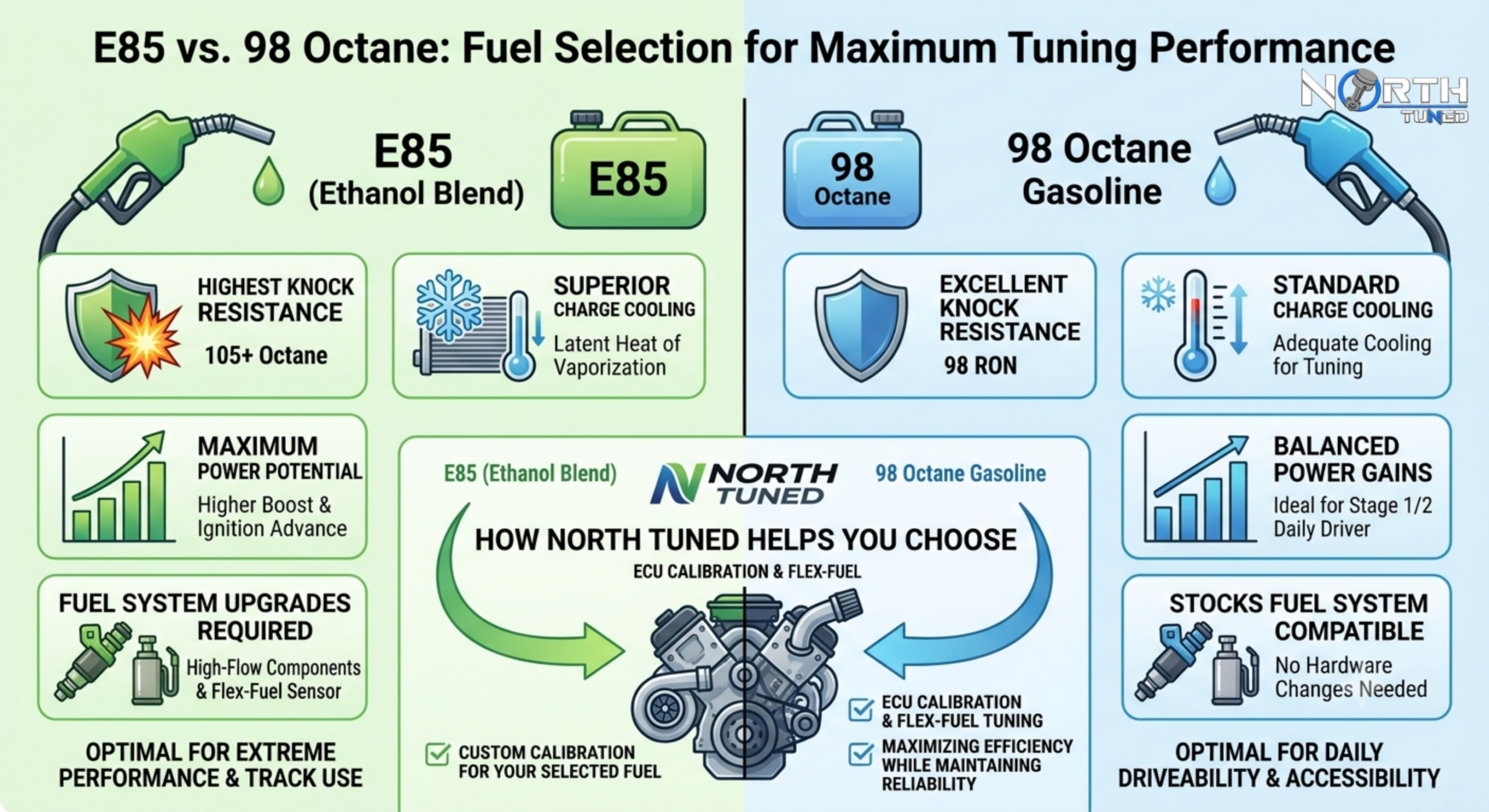
Ethanol has a lower energy density than standard gasoline. To produce equivalent power, the fuel system must deliver approximately 30% more volume by mass into the cylinders. If you are tuning for E85 or implementing a Flex-Fuel setup, upgrading both the LPFP and HPFP is typically a mandatory first step.
Upgraded Fuel Injectors
If you install higher-cc performance injectors, the supply pump must be capable of flowing sufficient volume and maintaining line pressure to feed those larger injectors effectively under heavy load.
3. Symptoms of Fuel Pump Starvation
When a fuel pump reaches its operational limit, the vehicle exhibits distinct behavioral warnings. Ignoring these signs can lead to catastrophic mechanical failure:
- High-RPM Fuel Cut / Hesitation: Under wide-open throttle (WOT), particularly above 5,000 RPM, the vehicle may violently jerk or instantly lose acceleration as the ECU cuts power to protect the engine.
- Lean Air-Fuel Ratios (AFR): The air-fuel mixture becomes excessively lean at high loads. Instead of enriching to safe targets, the AFR drifts high due to a lack of fuel volume.
- Elevated Exhaust Gas Temperatures (EGT): A lean mixture creates extreme thermal conditions inside the combustion chamber, leading to melted spark plugs, burnt valves, or piston failure.
- Fuel Rail Pressure Drop: Datalogging shows a sharp drop in actual rail pressure compared to the target rail pressure requested by the ECU (often triggering fault codes like P0087).
4. LPFP vs. HPFP Upgrade Options
Determining which pump to upgrade depends directly on your engine’s fuel injection design and your target horsepower goals:
- LPFP Upgrades: The in-tank pump assembly is replaced or augmented with high-flow pumps rated for higher LPH (Liters Per Hour), such as Walbro 450/525 or brushless units. This ensures a consistent volume of fuel reaches the front of the vehicle.
- HPFP Upgrades: On direct-injection engines, the HPFP internal piston diameter is enlarged using upgraded internal kits (such as Autotech or VIS Motorsport) or replaced with a complete high-flow HPFP assembly. This prevents rail pressure drops under high boost conditions.
5. The North Tuned Perspective
Power generation is a chain reaction, and the system is only as strong as its weakest link. Regardless of how much air you push into the engine with a larger turbocharger, if you cannot deliver the matching volume of fuel at the correct pressure, you cannot make safe power.
At North Tuned, we analyze your vehicle’s torque demands and monitor ECU log data—specifically Fuel Pump Duty Cycle and actual vs. specified rail pressure. By identifying fueling bottlenecks before they cause damage, we specify and integrate the exact LPFP or HPFP upgrades needed to keep your engine running strong, safe, and reliable.


 English
  Turkish
  German
  Spanish
  Hindi
Hindi  Arabic
  Italian
  Greek
Greek  Vietnamese
  Chinese
  Malay
Malay