

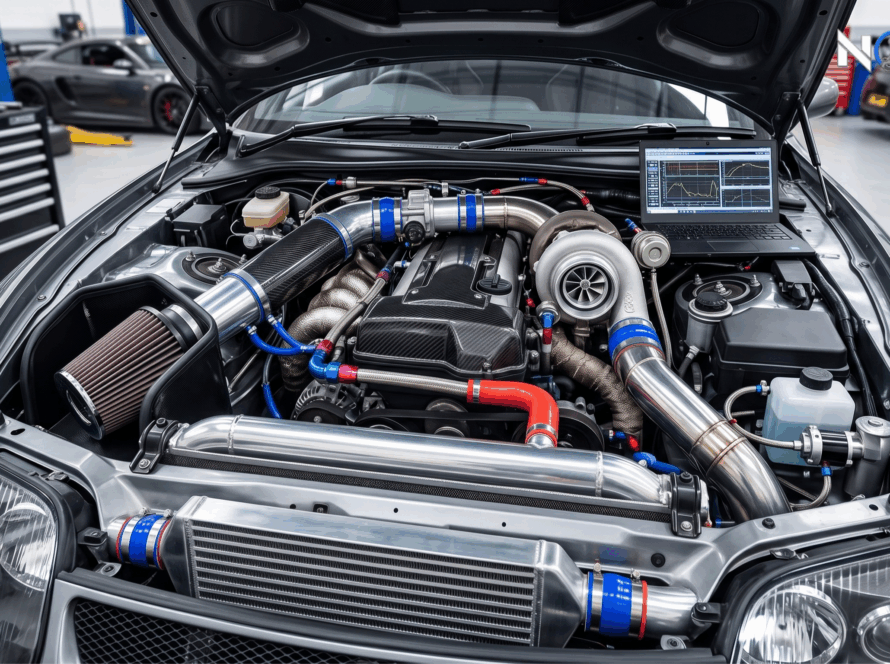
In the progression of engine performance tuning, completing a Stage 1 software calibration naturally leads enthusiasts toward Stage 2 upgrades. However, Stage 2 extends beyond ECU software modifications alone; it requires supporting mechanical upgrades that allow the engine to breathe freely and efficiently evacuate high-temperature exhaust gases.
The most significant flow restriction (bottleneck) in a factory exhaust system resides immediately downstream of the turbocharger: the OEM downpipe and catalytic converter assembly.
In this comprehensive guide by North Tuned, we examine what a downpipe is, how high-flow catalytic converters work, the physical concept of backpressure, and the essential role these mechanical components play in unlocking Stage 2 horsepower gains.
1. What Is a Downpipe and What Is Its Role?
In turbocharged engines, the downpipe is the section of piping that connects the turbocharger turbine housing directly to the remainder of the exhaust system and mufflers. High-temperature, high-pressure exhaust gases exiting the turbocharger must pass through this initial pipe section to exit the vehicle.
Automotive manufacturers design factory downpipes with narrow pipe diameters and dense ceramic-core catalytic converters to strictly satisfy global emissions regulations and lower production costs.
This restrictive design inhibits optimal gas velocity, creating substantial flow resistance directly behind the turbocharger turbine wheel.
2. Understanding Backpressure and Thermal Buildup
To maximize efficiency in a turbocharged engine, flow resistance downstream of the turbocharger must be minimized. High backpressure created by restrictive OEM downpipes introduces several mechanical disadvantages:
- Increased Turbo Lag: The turbine wheel encounters opposing resistance from trapped exhaust gases, slowing down turbocharger spool-up times.
- Excessive Heat Accumulation (High EGTs): Trapped exhaust gases retain thermal energy near the turbine housing and cylinder head. Elevated Exhaust Gas Temperatures (EGT) increase thermal stress on engine components.
- Power Output Restriction: Incomplete scavenging of spent exhaust gases from the combustion chambers limits the volume of fresh air-fuel mixture that can enter during the intake stroke.
3. Performance Downpipes vs. High-Flow Catalytic Converters
To eliminate this restriction during a Stage 2 build, two primary configurations are utilized:
Catless Downpipes
A catless downpipe is a completely straight, unrestricted pipe containing no internal catalytic converter core. It offers near-zero resistance to exhaust gas flow, maximizing horsepower and torque gains while dramatically lowering Exhaust Gas Temperatures (EGTs) and enhancing turbo sound. However, it does not comply with road emissions standards.
High-Flow Catalytic Converters (High-Flow Cats)
Factory catalytic converters typically utilize dense ceramic substrates rated at 400 to 600 CPSI (Cells Per Square Inch). Conversely, high-performance high-flow catalytic converters feature durable metallic substrates with reduced densities of 100 to 200 CPSI.
High-flow cats reduce exhaust gas flow resistance by up to 70-80% while retaining functional emissions control. They represent the ideal compromise for drivers seeking Stage 2 power delivery while maintaining environmental responsibility and compliance.
4. Impact of Downpipe Upgrades on Stage 2 Power Delivery
Replacing the restrictive factory downpipe with a larger-diameter performance downpipe or high-flow catalytic system delivers immediate operational benefits:
Significant Horsepower and Torque Gains
Eliminating exhaust backpressure allows the turbocharger to operate at peak efficiency. Combining a performance downpipe with a dedicated Stage 2 ECU calibration typically yields an additional 20 to 45+ horsepower alongside substantial mid-range torque increases, depending on engine displacement.
Sharper Throttle Response and Faster Spool
With reduced opposition against the turbine wheel, the turbocharger achieves target boost pressure at lower RPM thresholds. This minimizes turbo lag and enhances immediate throttle responsiveness.
Reduced Exhaust Gas Temperatures (EGT)
Rapid evacuation of hot exhaust gases lowers thermal retention within the turbocharger housing and engine head, ensuring safer engine operation under sustained heavy loads.
Enhanced Exhaust Note
Removing flow restrictions uncovers the natural acoustic tone of the engine, delivering a deeper, more refined performance exhaust note without introducing harsh drone.
5. Is Stage 2 ECU Calibration Required with a Downpipe?
Installing a performance downpipe requires updating the vehicle’s ECU software to a matching Stage 2 calibration.
This calibration is necessary for two key reasons:
- Check Engine Light (CEL) Prevention: Removing the OEM catalytic converter or switching to a high-flow unit alters secondary oxygen sensor (O2) readings, triggering emission fault codes. Stage 2 software recalibrates these sensor parameters appropriately.
- Overboost Prevention and Control: Reduced flow resistance allows the turbocharger to spool significantly faster, which can cause uncontrolled overboost conditions on stock software. A Stage 2 calibration recalibrates wastegate duty cycles and fuel maps to safely match the increased airflow.
Conclusion: Unlock Stage 2 Performance with North Tuned
Upgrading your downpipe and integrating high-flow catalytic technology represents one of the most impactful mechanical upgrades for any turbocharged platform. By relieving backpressure, you enable your turbocharger to deliver its full performance potential safely.
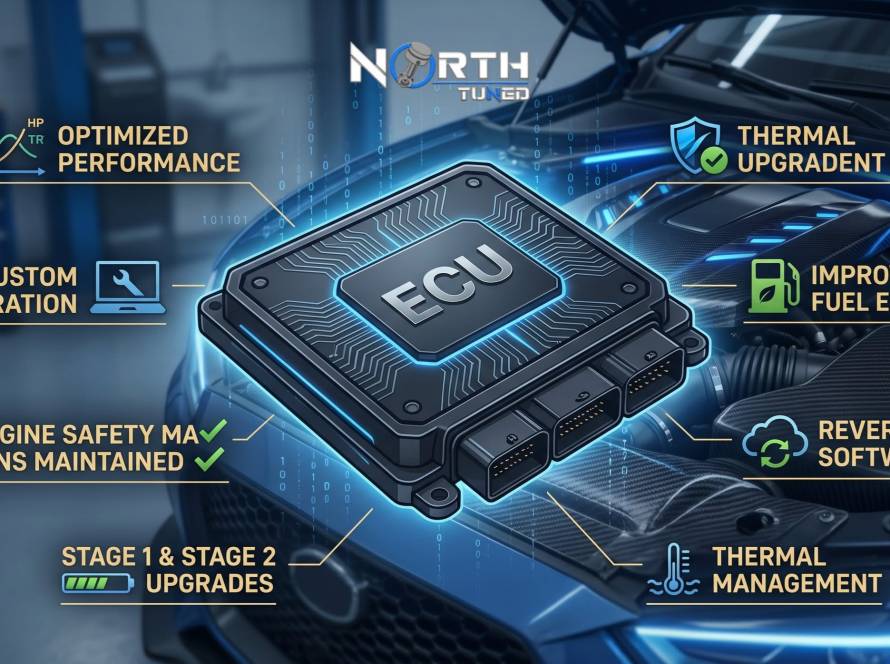
At North Tuned, engineered Stage 2 ECU calibrations are tailored specifically to match your mechanical hardware upgrades, delivering reliable power gains and smooth driveability. Contact our technical team today to elevate your vehicle’s performance.

 English
  Turkish
  German
  Spanish
  Hindi
Hindi  Arabic
  Italian
  Greek
Greek  Vietnamese
  Chinese
  Malay
Malay