

Transitioning from a Stage 1 calibration to a Stage 2 tune unlocks the true performance potential of a turbocharged engine. While most enthusiasts focus heavily on hardware upgrades such as high-flow downpipes, upgraded intercoolers, and cold air intakes, the capacity of the fueling system is an equally vital component that should never be overlooked.
Increased airflow demands a proportional increase in fuel delivery. But do factory fuel injectors possess sufficient headroom to support Stage 2 power levels, or is upgrading to higher-flow injectors mandatory?
In this technical guide by North Tuned, we examine fuel injector operations, Injector Duty Cycle (IDC), the differences between Direct Injection (DI) and Port Injection (PI) setups, and the specific scenarios where upgraded injectors become necessary for Stage 2 configurations.
1. The Function and Operation of Fuel Injectors
Fuel injectors are precision electro-mechanical valves designed to deliver atomized fuel into the intake manifold or directly into the combustion chamber under regulated pressures. The Engine Control Unit (ECU) calculates the exact injection duration in milliseconds based on readings from the Mass Air Flow (MAF) or Manifold Absolute Pressure (MAP) sensors.
As an engine generates more power, a larger volume of fresh air enters the cylinders. To maintain the target Air-Fuel Ratio (AFR) for optimal combustion and engine safety, the fueling system must supply additional fuel to match the increased airflow.
2. Understanding Injector Duty Cycle (IDC)
The primary metric used to evaluate fuel injector headroom is Injector Duty Cycle (IDC). Expressed as a percentage, IDC represents the amount of time an injector remains open during a single engine cycle.
- Optimal Operating Range: For reliable performance, peak Injector Duty Cycle should ideally stay between 80% and 85%.
- Overworked Range (85% to 100%): When IDC exceeds 90%, injector solenoid coils heat up rapidly. At 100% duty cycle, the injector remains continuously open (static state), losing its ability to properly atomize fuel into a fine spray.
Operating factory injectors above 90% duty cycle risks lean air-fuel mixtures, elevated combustion temperatures, engine knock, and premature injector failure.
3. Direct Injection (DI) vs. Port Injection (PI)
Modern performance platforms typically utilize either Port Fuel Injection or Direct Injection (GDI, TFSI, EcoBoost). The underlying architecture dictates how fueling upgrades are approached:
Port Fuel Injection (PI)
In PI systems, fuel is sprayed into the intake runners at lower operating pressures (typically 3 to 6 bar). Upgrading port injectors is straightforward and cost-effective, allowing tuners to select larger cc/min injectors to support substantial airflow increases.
Direct Injection (DI)
Direct injection systems deliver fuel directly into the combustion chamber under extreme pressures ranging from 150 to over 350 bar. In DI platforms, system limits are defined not only by the injectors but also by the High-Pressure Fuel Pump (HPFP) and Low-Pressure Fuel Pump (LPFP). Replacing DI injectors is technically complex and financially intensive.
4. When Are Upgraded Injectors Required for Stage 2?
Whether you need larger injectors for a Stage 2 tune depends on engine architecture, factory headroom, and fuel type:
Gasoline Engines on Pump Fuel
On the vast majority of modern turbocharged gasoline platforms (e.g., 2.0 TFSI/TSI, BMW 2.0 B48/N20, 1.5 EcoBoost), factory injectors feature sufficient built-in safety margin from the factory to support Stage 2 airflow on pump gasoline. Injector upgrades are rarely required at this stage; upgrading the High-Pressure Fuel Pump (HPFP) is often sufficient when fueling limits are reached.
E85 Blend and Ethanol Fueling
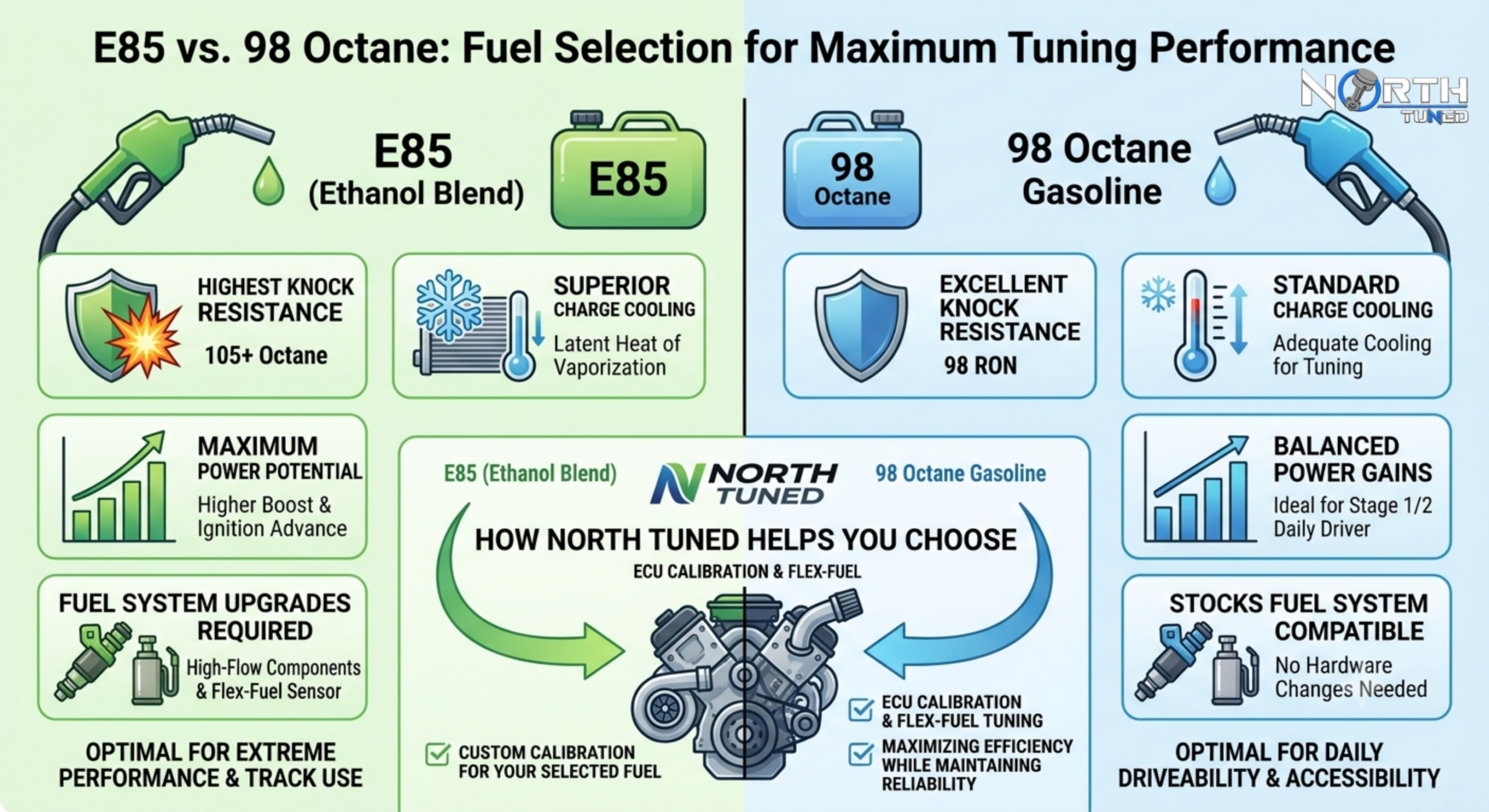
Ethanol possesses lower energy density per unit mass compared to standard gasoline. Operating an engine on E85 or high-ethanol blends requires approximately 30% more fuel volume to achieve equivalent target AFRs. Under ethanol conditions, factory injectors reach maximum duty cycle quickly, making upgraded injectors or auxiliary fueling mandatory even at Stage 2 power levels.
Turbo-Diesel Platforms (TDI, dCi, CRDi)
In diesel engines, power output is directly governed by injected fuel mass. High-flow nozzles or upgraded diesel injectors are frequently integrated into Stage 2 diesel builds to achieve higher torque output while maintaining clean combustion and manageable EGTs.
Platforms with Undersized OEM Injectors
Certain factory engines leave minimal fueling margin from the factory. Pushing these specific platforms to Stage 2 airflow forces stock injectors beyond safe duty cycle limits (90%+). In these applications, injector upgrades are required regardless of stage to prevent lean conditions.
5. Symptoms and Risks of Inadequate Injector Capacity
Attempting to run a Stage 2 tune on an over-extended fuel system introduces severe operational risks:
- High-RPM Hesitation or Fuel Cut: The engine may stutter or lose power at higher engine speeds when fuel supply cannot meet target demand.
- Lean Condition Fault Codes: The ECU detects an unmetered lean air-fuel mixture via the primary O2 sensor and triggers check engine codes (e.g., P0171).
- Engine Knock and Pre-Ignition: Lean mixtures dramatically elevate cylinder temperatures, inducing destructive pre-ignition or detonation.
- Excessive EGTs: High combustion temperatures cause thermal stress, threatening exhaust valves, turbine housings, and internal components.
Conclusion: Precision Fueling Solutions with North Tuned
Determining whether your vehicle requires upgraded injectors for Stage 2 tuning relies on comprehensive ECU data logging under real-world load conditions.
At North Tuned, we analyze critical engine parameters including Injector Duty Cycle (IDC), Air-Fuel Ratios (AFR), High/Low Fuel Rail Pressures, and Exhaust Gas Temperatures. Our custom Stage 2 calibrations are tailored specifically to your hardware constraints, ensuring safe fuel delivery and uncompromised engine reliability.

 English
  Turkish
  German
  Spanish
  Hindi
Hindi  Arabic
  Italian
  Greek
Greek  Vietnamese
  Chinese
  Malay
Malay