
The term Horsepower (HP) is undoubtedly one of the most frequently used terms by car enthusiasts. Although it is the first criterion we look at when measuring a vehicle’s performance, it is not exactly equal to “the power of a single horse,” contrary to popular belief. So, how did this unit, which we at North Tuned place at the center of performance, come about?
James Watt and Marketing Genius
The term was first coined in 1782 by James Watt, a successful Scottish engineer and inventor who improved steam engines. To explain the capability of his engines to the public, Watt chose horses—the most common “engine” of that era—as a point of comparison.
How Was 1 Horsepower Calculated?
Watt observed horses working in coal mines. He calculated that, on average, a horse could pull 45 kg of coal 1.1 meters in one second. This mathematically equated to approximately 50 kg-m/s of work. However, to make his engines seem even more reliable and impressive, Watt increased this figure by 50%, rounding it up to 75 kg-m/s, and defined this as 1 Horsepower (HP).
In short, the modern definition is:
1 Horsepower (HP) is the amount of power required to lift a 75 kg load 1 meter vertically in 1 second.
Today, at North Tuned, we take James Watt’s fundamental legacy and optimize it with modern software and engineering solutions, efficiently awakening the “sleeping” horses within your vehicle.
For many enthusiasts, a car is more than just a tool for commuting; it’s a passion project. When the factory power feels insufficient, Stage 2 tuning is often the next logical step. But is it practical for a vehicle you drive every single day?
What is Stage 2?
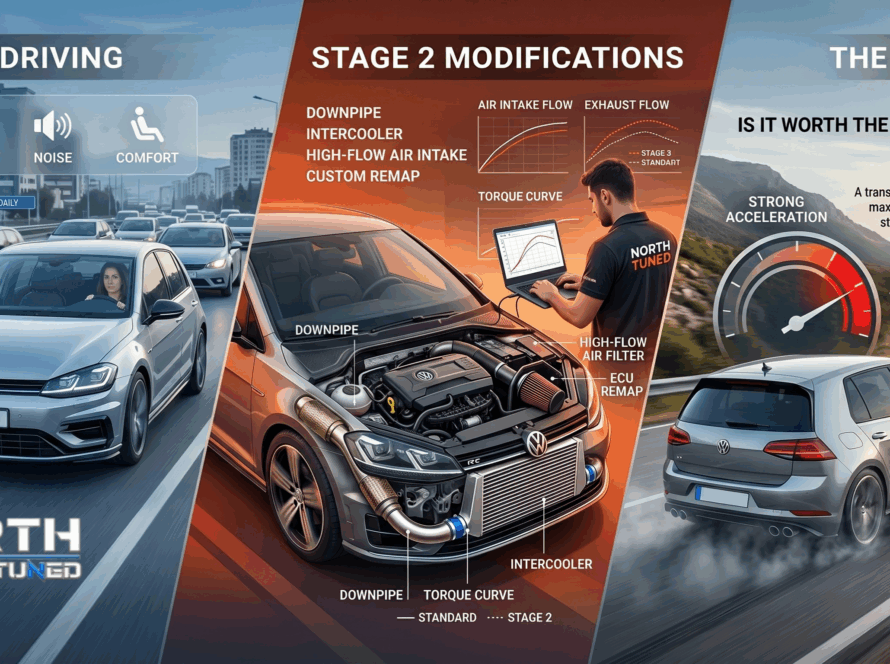
Unlike Stage 1, which is primarily a software-only upgrade, Stage 2 requires hardware modifications to help the engine “breathe” better. Typical upgrades include:
Downpipe: For faster exhaust gas evacuation.
Upgraded Intercooler: To ensure cooler, denser air intake.
High-Flow Air Intake: To reduce intake restriction.
Custom Remap: ECU calibration optimized for these specific hardware changes.
Pros and Cons for the Daily Drive
A Stage 2 vehicle offers a much broader torque curve and more aggressive acceleration compared to Stage 1. However, there are trade-offs to consider:
Performance: Significant gains in overtaking power and highway merging.
Fuel Economy: While efficiency can improve during cruising, spirited driving will see a noticeable jump in fuel consumption.
NVH (Noise, Vibration, Harshness): An aftermarket downpipe will increase exhaust volume. This might be thrilling for some but tiring for others in heavy traffic.
Reliability: Since you are pushing the engine further, high-quality maintenance becomes non-negotiable.
The Verdict: Is it worth it?
If you view driving as an experience rather than a chore and are willing to invest in the supporting hardware, Stage 2 is absolutely worth it. It transforms the character of the car without sacrificing total usability. At North Tuned, we believe the key is balance—achieving maximum performance while staying within the safe mechanical limits of your engine.