
Performance tuning is a craft that balances art and engineering. At North Tuned, we believe that true performance isn’t just about the peak numbers on a dyno sheet—it’s about how long that engine can sustain those numbers.
1. Tuning Without Pre-Inspection
Tuning an engine with existing mechanical issues is like building a skyscraper on a swamp.
The Mistake: Installing a performance map on a car with old spark plugs, a tired fuel pump, or vacuum leaks.
The Outcome: The added stress of increased boost or timing will inevitably cause the weakest link to fail.
North Tuned Pro-Tip: Always perform a diagnostic scan and check for boost leaks before modifying the ECU.
2. Neglecting Thermal Management
Power is a byproduct of combustion, and combustion generates heat. If you increase the energy, you must increase the cooling.
The Mistake: Pushing high boost levels on a stock intercooler.
The Outcome: High Intake Air Temperatures (IATs) lead to ignition timing pull and potential engine knock (detonation).
Solution: For Stage 2+ builds, upgrading the cooling system is not optional; it is a necessity for engine longevity.
3. Chasing Boost Instead of Efficiency
A common misconception is that “More Boost = More Power.”
The Mistake: Overworking a small turbocharger beyond its efficiency map.
The Technical Side: When a turbo is pushed too hard, it simply blows hot, turbulent air. This increases backpressure and heat without adding significant oxygen.
Solution: Focus on optimizing the Air-Fuel Ratio (AFR) and ignition timing. Sometimes, less boost with better timing yields more reliable power.
4. The Danger of “Generic” Off-the-Shelf Tunes
Every car lives a different life. A car in a high-altitude region needs different parameters than one at sea level.
The Mistake: Using cheap, non-adjustable files that don’t account for fuel quality or hardware health.
The Outcome: Poor drivability and a high risk of catastrophic failure under load.
The North Tuned Approach: We prioritize Data Logging. By analyzing how your specific engine reacts in real-time, we fine-tune the software to ensure maximum safety margins.
5. Forgetting the Drivetrain
An engine is only as good as the wheels it turns.
The Mistake: Increasing torque significantly without recalibrating the Transmission Control Unit (TCU).
The Outcome: Slipped clutches in DSG/ZF gearboxes or snapped axles.
Solution: Match your ECU tune with a TCU tune to increase clutch clamping pressure and optimize shift points.
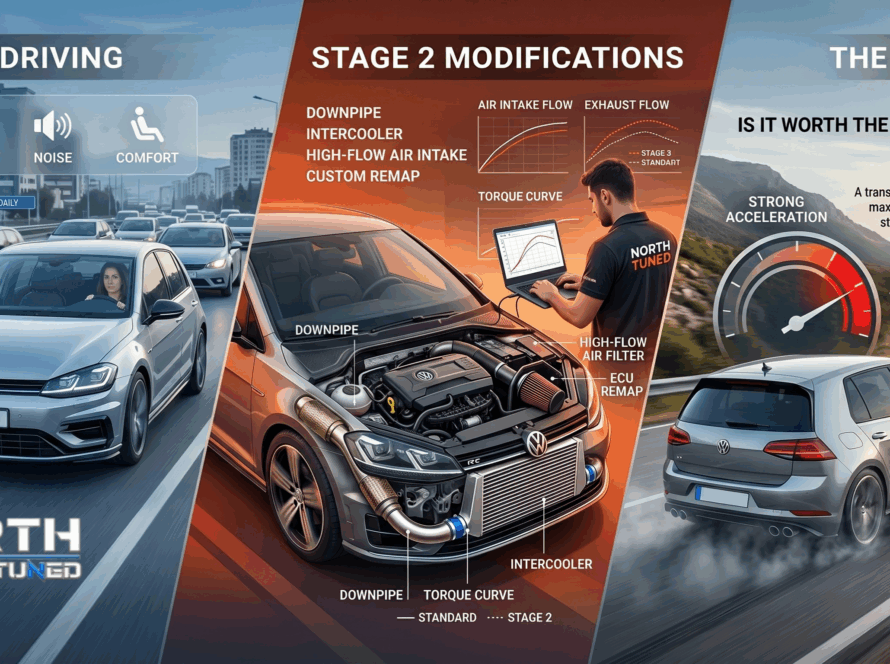
For many enthusiasts, a car is more than just a tool for commuting; it’s a passion project. When the factory power feels insufficient, Stage 2 tuning is often the next logical step. But is it practical for a vehicle you drive every single day?
What is Stage 2?
Unlike Stage 1, which is primarily a software-only upgrade, Stage 2 requires hardware modifications to help the engine “breathe” better. Typical upgrades include:
Downpipe: For faster exhaust gas evacuation.
Upgraded Intercooler: To ensure cooler, denser air intake.
High-Flow Air Intake: To reduce intake restriction.
Custom Remap: ECU calibration optimized for these specific hardware changes.
Pros and Cons for the Daily Drive
A Stage 2 vehicle offers a much broader torque curve and more aggressive acceleration compared to Stage 1. However, there are trade-offs to consider:
Performance: Significant gains in overtaking power and highway merging.
Fuel Economy: While efficiency can improve during cruising, spirited driving will see a noticeable jump in fuel consumption.
NVH (Noise, Vibration, Harshness): An aftermarket downpipe will increase exhaust volume. This might be thrilling for some but tiring for others in heavy traffic.
Reliability: Since you are pushing the engine further, high-quality maintenance becomes non-negotiable.
The Verdict: Is it worth it?
If you view driving as an experience rather than a chore and are willing to invest in the supporting hardware, Stage 2 is absolutely worth it. It transforms the character of the car without sacrificing total usability. At North Tuned, we believe the key is balance—achieving maximum performance while staying within the safe mechanical limits of your engine.