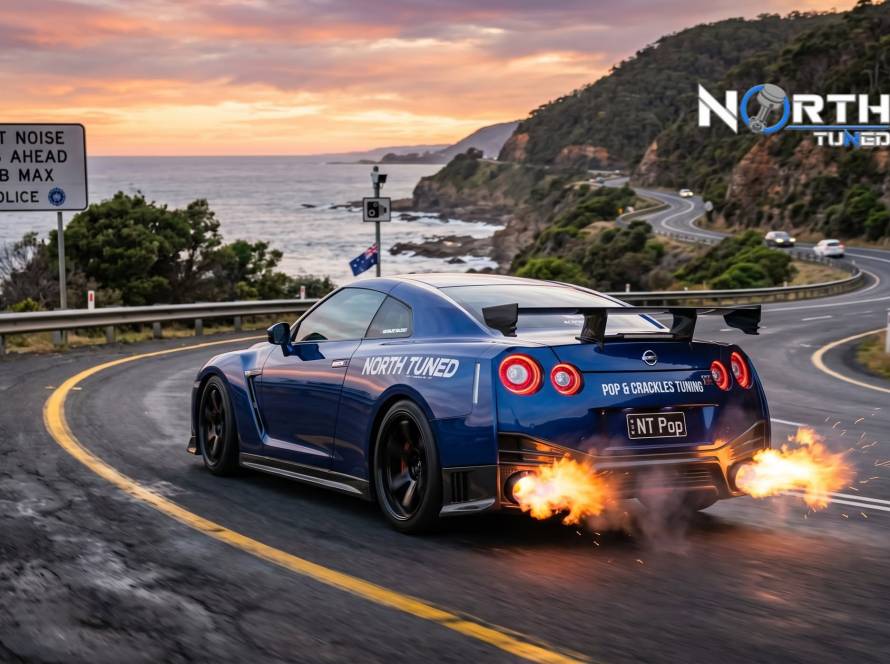

When it comes to driving dynamics and handling, wheel alignment angles are the most critical factors defining your vehicle’s character. At North Tuned, we focus not only on power gains but also on how that power is delivered to the asphalt. Let’s take a closer look at these three fundamental angles that affect everything from tire life to high-speed stability.

Camber
Camber is the tilt of the wheels on the vertical axis when viewed from the front of the vehicle. If the top of the wheel tilts inward, it is called negative camber; if it tilts outward, it is positive camber.
Negative Camber: Provides superior grip during cornering by increasing the tire’s contact patch. However, excessive negative camber can lead to uneven tire wear on the inner edges during straight-line driving.
Positive Camber: Generally preferred in heavy-duty vehicles or certain off-road setups to stabilize steering response.
North Tuned Note: For track-oriented or high-performance street cars, an ideal level of negative camber is crucial to maximize cornering performance.
Caster
Caster is the angle of the steering axis (the line connecting the ball joints or strut line) when viewed from the side. If the axis tilts toward the rear, it is defined as positive caster.
Advantages: Positive caster enhances straight-line stability at high speeds and helps the steering wheel return to the center position after a turn.
Cross-Caster: In many passenger cars, the caster is slightly adjusted to ensure that if the driver loses control, the vehicle drifts toward the curb rather than into oncoming traffic.

Toe Angle (Toe-in & Toe-out)
Toe represents the distance between the front and rear of the tires when viewed from above. If the front edges are closer together, it’s Toe-in; if they are further apart, it’s Toe-out.
Drivetrain Relationship: Front-wheel-drive vehicles tend to pull the wheels inward under acceleration, so they are often balanced with toe-out. Rear-wheel-drive vehicles tend to push the wheels outward, requiring a toe-in adjustment.
Consequences of Misalignment: Incorrect toe settings cause irregular “sawtooth” tire wear and increase rolling resistance, leading to higher fuel consumption.
Precision alignment services performed with North Tuned expertise ensure that your vehicle doesn’t just go fast, but stays glued to the road like it’s on rails.

The term Horsepower (HP) is undoubtedly one of the most frequently used terms by car enthusiasts. Although it is the first criterion we look at when measuring a vehicle’s performance, it is not exactly equal to “the power of a single horse,” contrary to popular belief. So, how did this unit, which we at North Tuned place at the center of performance, come about?
James Watt and Marketing Genius
The term was first coined in 1782 by James Watt, a successful Scottish engineer and inventor who improved steam engines. To explain the capability of his engines to the public, Watt chose horses—the most common “engine” of that era—as a point of comparison.
How Was 1 Horsepower Calculated?
Watt observed horses working in coal mines. He calculated that, on average, a horse could pull 45 kg of coal 1.1 meters in one second. This mathematically equated to approximately 50 kg-m/s of work. However, to make his engines seem even more reliable and impressive, Watt increased this figure by 50%, rounding it up to 75 kg-m/s, and defined this as 1 Horsepower (HP).
In short, the modern definition is:
1 Horsepower (HP) is the amount of power required to lift a 75 kg load 1 meter vertically in 1 second.
Today, at North Tuned, we take James Watt’s fundamental legacy and optimize it with modern software and engineering solutions, efficiently awakening the “sleeping” horses within your vehicle.