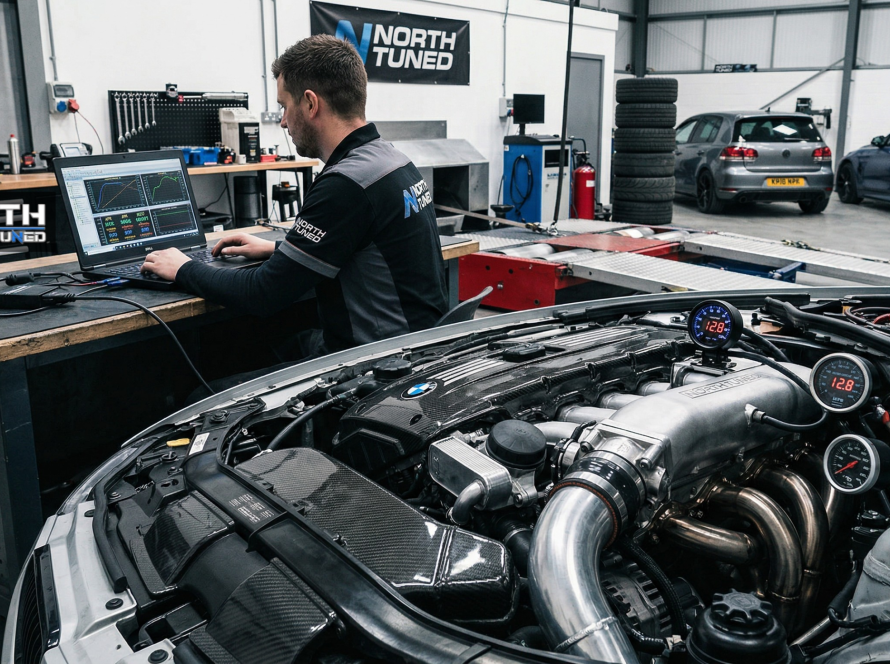

For performance enthusiasts, the sound and speed of a turbo are indispensable. However, managing and protecting that power is just as crucial as generating it. At North Tuned, we are diving deep into the Dump Valve (Blow-Off Valve) system, covering everything from technical mechanics to its vital role in high-performance tuning.
What is a Dump Valve and Why is it Essential?
A turbocharger works by using exhaust gases to spin a compressor wheel, forcing high-pressure air into the intake manifold. As long as you are on the throttle, this cycle works perfectly. However, when you lift your foot off the gas to shift gears or decelerate, the throttle body closes instantly.
This creates a major physical problem: due to inertia, the turbo continues to spin at thousands of RPMs and keeps pushing air. With the throttle closed, this high-pressure air hits a “wall,” bounces back, and travels toward the spinning turbo blades. This phenomenon, known as compressor surge, applies massive counter-force to the turbine, trying to stop it or spin it backward. A Dump Valve is the safety component designed to vent this trapped air, allowing the turbo to spin freely.
Technical Mechanics: How It Operates at North Tuned Standards
The operation of a dump valve is a masterpiece of pressure dynamics:
The Vacuum Effect: When the throttle closes, a vacuum is created in the intake manifold.
Actuation: This vacuum pulls the internal piston or diaphragm of the dump valve open.
Pressure Release: Once open, the high-pressure air trapped between the turbo and the throttle is vented out—either to the atmosphere (creating the signature “pssh” sound) or recirculated back into the intake.
Maintaining Momentum: Because the backpressure is removed, the turbo doesn’t lose its speed. It keeps spinning freely.
Why Should You Install a High-Quality Dump Valve?
Eliminating Turbo Lag: Since the turbocharger maintains its RPM during gear shifts, you get nearly instantaneous boost response the moment you step back on the accelerator.
Protecting Your Investment: High-performance turbos are expensive. A dump valve protects the internal shafts, bearings, and compressor wheels from the violent “shocks” of air surges, significantly extending the turbo’s lifespan.
Optimized Thermal Management: Trapped, compressed air heats up rapidly. By venting this hot air and allowing the intercooler to process fresh, cool air, the engine benefits from a denser oxygen mixture and better combustion.
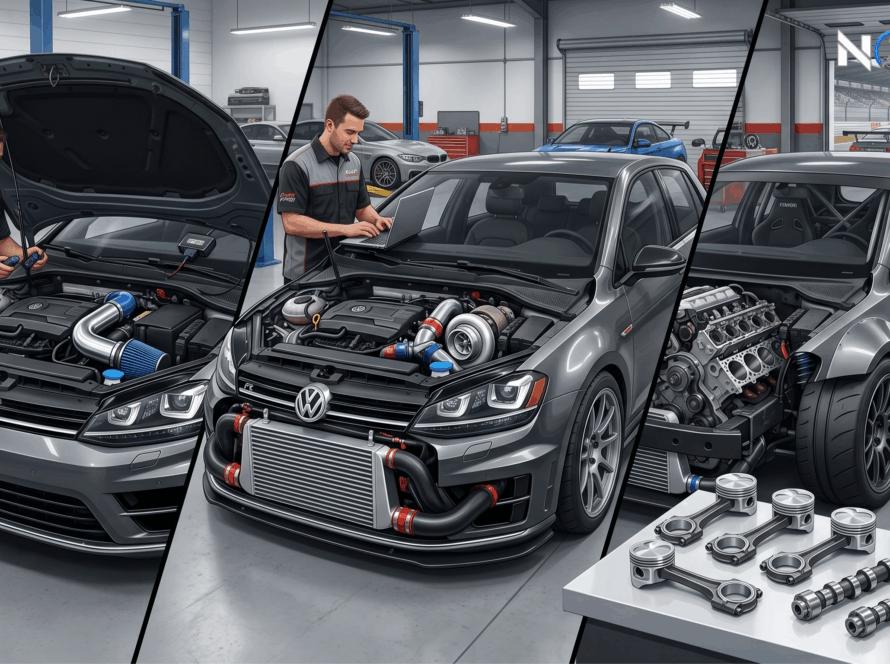
In the car modification world, the concept of a tuning “Stage” is something we hear frequently, yet even experienced car enthusiasts sometimes struggle to define their exact boundaries. Let’s summarize what kind of modifications are done at each level to improve your car’s performance, using a clear and straightforward approach:
Stage 1: The Beginner and Foundation Phase
This is the most practical modification step, achieved without altering the car’s original mechanical structure, opening the engine block, or engaging in heavy fabrication. It mostly utilizes “plug-and-play” parts. While being the most cost-effective stage, it allows the car to breathe better and builds a solid foundation for future, larger power upgrades.
Key Upgrades Include:
Cold Air Intake kits
Sports exhaust systems and Downpipes (catalytic converter removal/decats)
Colder performance spark plugs and ignition coils
Blow Off / Dump Valves for turbocharged cars
Mild performance software that doesn’t stress the engine internals (Soft Chip Tuning / Remap)
Ignition timing optimization
Stage 2: The Intermediate Level and Mechanical Enhancement
This is the stage you move to when the power gained from Stage 1 simply isn’t enough, marking the beginning of significant hardware changes to the engine. Although it doesn’t require a heavy internal engine rebuild, professional labor and a custom software update are mandatory to ensure the new, larger parts work together in harmony.
Key Upgrades Include:
Enlarging the existing turbo (Hybrid turbo upgrades)
Installing a larger capacity Intercooler to better cool the compressed air
Fuel injector and high-pressure fuel pump upgrades to supply more fuel
Street-profile upgraded camshafts
Upgraded Stage 2 clutch to transmit the increased power to the transmission without slipping
Custom-made, large-volume intake or exhaust manifolds
Supercharger or larger turbo conversions
Stage 3: The Advanced Level and Track-Focused Phase
This is the most aggressive stage where the car almost completely breaks away from comfortable, daily street use and transforms into a purebred race car. You literally dive into the heart of the engine (opening the engine block), and the internal moving parts are replaced with heavy-duty materials designed to withstand extreme pressure.
Key Upgrades Include:
High-pressure resistant Forged pistons and connecting rods (Forged internals)
Upgraded engine valves, heavy-duty valve springs, and titanium retainers
Race-spec (highly aggressive) camshafts that noticeably alter the engine’s idle
Heavy-duty Stage 3 bronze/puck clutch kits
Drivetrain upgrades (heavy-duty driveshafts, axles) to prevent snapping under load
Massive Big Brake Kits (BBK) to tame the dangerous speeds the car can now reach
A completely Custom Engine Tune (Remap) built from scratch specifically for this extensive hardware list
A Quick Summary:
A Stage 3 setup is absolutely not recommended for a daily driver that you use to commute to work or go grocery shopping. Vehicles pushed to their absolute mechanical limits like this require a much more expensive, frequent, and highly meticulous maintenance routine compared to standard cars.