
For performance enthusiasts, the sound and speed of a turbo are indispensable. However, managing and protecting that power is just as crucial as generating it. At North Tuned, we are diving deep into the Dump Valve (Blow-Off Valve) system, covering everything from technical mechanics to its vital role in high-performance tuning.
What is a Dump Valve and Why is it Essential?
A turbocharger works by using exhaust gases to spin a compressor wheel, forcing high-pressure air into the intake manifold. As long as you are on the throttle, this cycle works perfectly. However, when you lift your foot off the gas to shift gears or decelerate, the throttle body closes instantly.
This creates a major physical problem: due to inertia, the turbo continues to spin at thousands of RPMs and keeps pushing air. With the throttle closed, this high-pressure air hits a “wall,” bounces back, and travels toward the spinning turbo blades. This phenomenon, known as compressor surge, applies massive counter-force to the turbine, trying to stop it or spin it backward. A Dump Valve is the safety component designed to vent this trapped air, allowing the turbo to spin freely.
Technical Mechanics: How It Operates at North Tuned Standards
The operation of a dump valve is a masterpiece of pressure dynamics:
The Vacuum Effect: When the throttle closes, a vacuum is created in the intake manifold.
Actuation: This vacuum pulls the internal piston or diaphragm of the dump valve open.
Pressure Release: Once open, the high-pressure air trapped between the turbo and the throttle is vented out—either to the atmosphere (creating the signature “pssh” sound) or recirculated back into the intake.
Maintaining Momentum: Because the backpressure is removed, the turbo doesn’t lose its speed. It keeps spinning freely.
Why Should You Install a High-Quality Dump Valve?
Eliminating Turbo Lag: Since the turbocharger maintains its RPM during gear shifts, you get nearly instantaneous boost response the moment you step back on the accelerator.
Protecting Your Investment: High-performance turbos are expensive. A dump valve protects the internal shafts, bearings, and compressor wheels from the violent “shocks” of air surges, significantly extending the turbo’s lifespan.
Optimized Thermal Management: Trapped, compressed air heats up rapidly. By venting this hot air and allowing the intercooler to process fresh, cool air, the engine benefits from a denser oxygen mixture and better combustion.
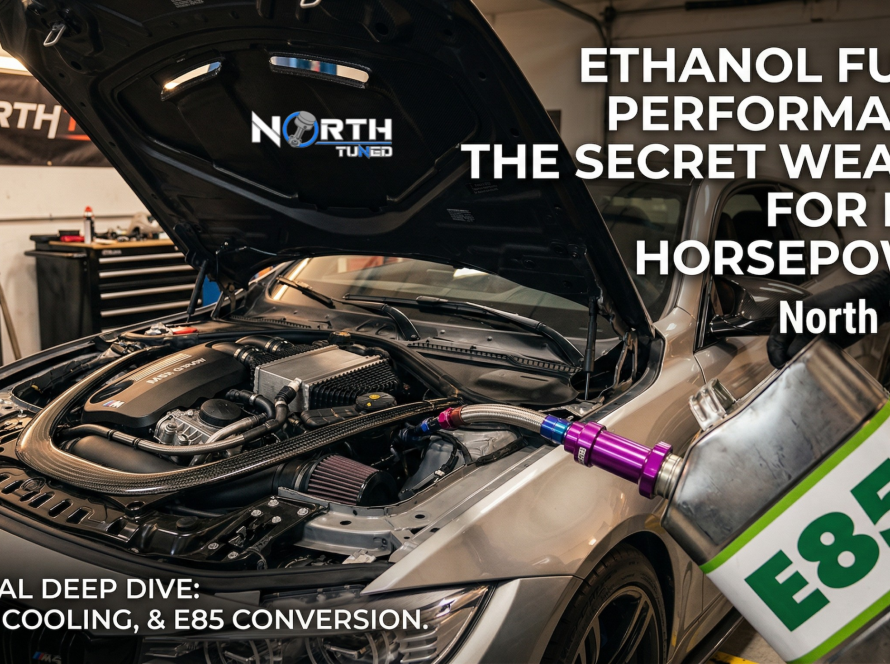
In the world of automotive tuning, fuel is just as critical as the hardware itself. When you push the limits of standard pump gas, you eventually hit a wall called “knock” or “detonation.” This is where Ethanol (Ethyl Alcohol) becomes a game-changer. At North Tuned, we frequently utilize ethanol blends to unlock the true potential of turbocharged and high-compression engines.
Here is an in-depth technical look at why ethanol is the preferred choice for high-performance applications and what you need to know about the transition.
What is Ethanol Fuel?
Ethanol is a renewable fuel source produced by fermenting sugars from agricultural feedstocks like corn, sugar cane, and wheat. While it can be used in its pure form, it is most commonly mixed with gasoline in varying ratios:
E10: 10% Ethanol / 90% Gasoline (Commonly found at standard gas stations).
E85: 85% Ethanol / 15% Gasoline (The “Gold Standard” for performance tuning).
Why Ethanol Wins: The Technical Advantages
The reason ethanol is so highly regarded in the motorsport and tuning industry boils down to two main factors: Octane Rating and Latent Heat of Vaporization.
1. Massive Octane Boost
Standard premium gasoline usually sits between 91 and 93 AKI (95-98 RON). Pure ethanol, however, boasts an octane rating of approximately 116 AKI / 129 RON. Even at an E85 blend, the effective octane rating is usually 105+.
The Benefit: High octane means the fuel is incredibly resistant to pre-ignition. This allows tuners to advance ignition timing and increase boost pressure significantly without the risk of engine damage.
2. Superior Cooling Effect
Ethanol has a much higher latent heat of vaporization than gasoline. This means that as ethanol is injected and evaporates, it absorbs a significant amount of heat from the intake air and the combustion chamber.
Turbo Longevity: By lowering Exhaust Gas Temperatures (EGT), ethanol protects the turbocharger turbine and internal engine components from thermal stress. It essentially acts as a chemical intercooler.
The “Ethanol Ready” Conversion: What Changes?
Ethanol contains about 34% less energy by volume than gasoline. This means that to maintain the correct Air/Fuel Ratio (AFR), the engine must spray more fuel. For E85, you typically need 30% to 35% more fuel flow compared to gasoline.
To make a vehicle compatible, North Tuned focuses on these essential upgrades:
High-Flow Fuel Pumps & Injectors: Since the volume requirement increases, upgraded pumps and larger injectors are mandatory to prevent the engine from running lean.
Flex Fuel Sensors: We install sensors that detect the exact ethanol content in the tank. This allows the ECU to automatically adjust the tune in real-time, whether you are running 10% or 85% ethanol.
Material Compatibility: While most modern cars (post-2000s) have fuel systems resistant to alcohol, older projects may require replacing rubber lines with PTFE (Teflon) lines to prevent corrosion.
Daily Driving and Environmental Impact
While ethanol is a “cleaner” burning fuel in terms of carbon emissions, it does have some quirks:
Cold Starts: Ethanol does not vaporize well at temperatures below 13°C (55°F). Specialized tuning is required to ensure the car starts smoothly on cold mornings.
Fuel Economy: Because more fuel is required to produce the same energy, you will notice a roughly 25-30% drop in MPG when running E85.
Ethanol is not just a fuel; it’s a performance tool. It allows us to reach power levels that were previously only possible with expensive, leaded racing fuels. If you are looking to maximize the efficiency and output of your turbocharged engine while keeping engine temperatures in check, an ethanol conversion is the most effective path forward.
When it comes to performance and longevity in turbocharged vehicles, one of the most critical components is the Turbo Timer. Especially after high-performance driving or long journeys, shutting down the engine abruptly can cause irreversible damage to the turbocharger system. At North Tuned, we have detailed the technical importance of this technology and the advantages it offers to protect the heart of your vehicle.
What is a Turbo Timer?
A Turbo Timer is an electronic device designed to keep an engine running for a pre-specified period of time in order to automatically execute the required cool-down period. Even after you turn the ignition off and remove the key, the device allows the engine to continue idling, ensuring that the turbocharger cools down properly without requiring the driver to wait inside the car.
Why Should You Use a Turbo Timer?
Vehicles with forced induction (Turbo/Supercharger) systems reach extremely high RPMs and intense temperatures during operation. Shutting down the engine immediately after a drive leads to two major technical risks:
Thermal Stress and Cooling: After spirited driving or heavy loads, exhaust gas temperatures remain very high. A turbo timer allows the engine to idle, enabling the intake and exhaust tracks to cool down through the circulation of lower-temperature gases.
Preventing Oil Coking: The turbo shaft spins at hundreds of thousands of revolutions per minute and is lubricated by engine oil. If the engine is stopped suddenly, the oil pump stops as well, but the turbo shaft continues to spin due to inertia. The stagnant oil trapped between the glowing hot shaft and the bearings can “cook” (carbonize), leading to sludge buildup. Over time, this causes shaft seizure and catastrophic turbo failure.
Modern Solutions and Security
Today’s modern turbo timer systems are built on sophisticated digital electronic platforms. At North Tuned, safety is our priority during installation. These systems are typically integrated with the handbrake mechanism or a dedicated safety switch. If the handbrake is released or the vehicle is tampered with while the timer is active, the system immediately kills the engine to prevent theft.
Protect Your Turbo with North Tuned
Increasing your vehicle’s performance is only half the battle; the other half is building the infrastructure to protect that power. A turbo timer is not just a convenience—it is a protective shield that can significantly extend the lifespan of your turbocharger.
If you want to preserve your engine health and avoid premature turbo wear or costly repair bills, contact the expert team at North Tuned for professional Turbo Timer applications.
North Tuned: Where Performance Meets Reliability.
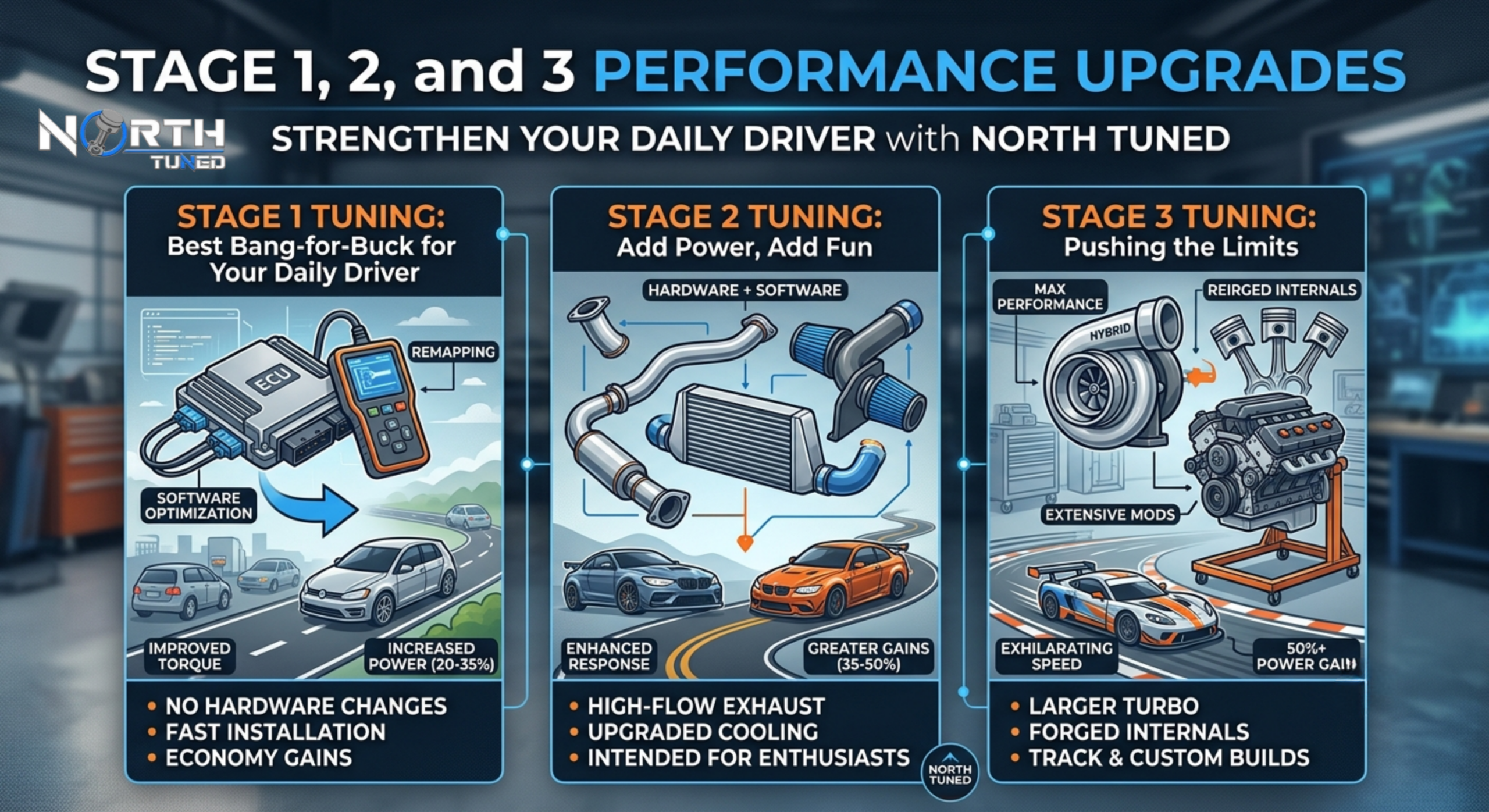
If you are looking to build a true power monster on Australian streets or tracks, “Stage 1” and “Stage 2” are merely the appetizers. Stage 3 is where the rules of the game truly change. This level involves turbo upgrades, fuel system overhauls, and internal engine reinforcements, turning a standard daily driver into a “supercar killer.”
At North Tuned, we have selected the best platforms for Stage 3 tuning, keeping in mind Australia’s unique climate conditions and fuel quality.
What is Stage 3?
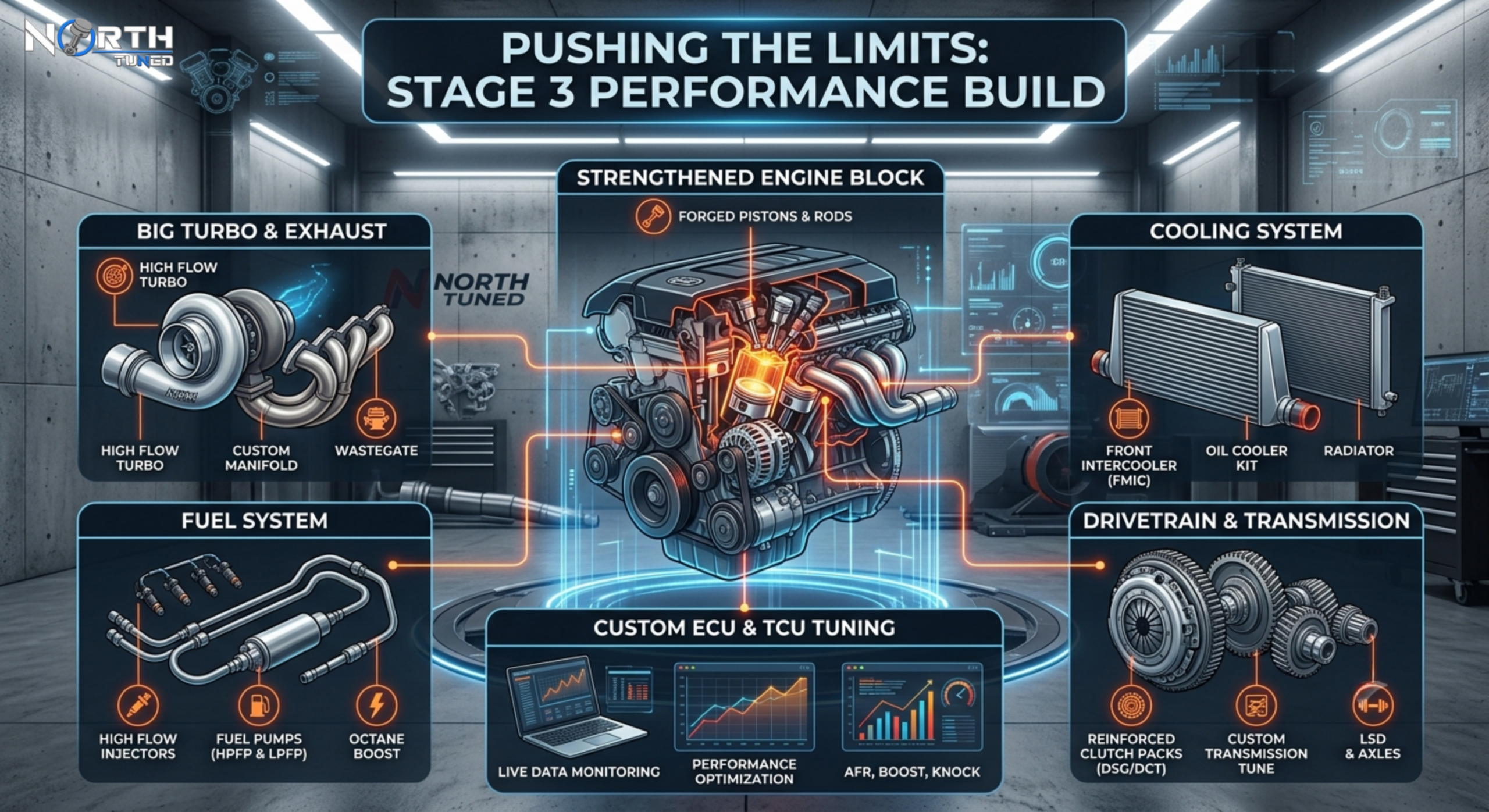
Stage 3 is the phase where we go beyond just software (ECU remapping) and push the physical limits of the hardware. It typically includes:
Upgraded Hybrid or Big Turbo kits.
High-pressure fuel pumps (HPFP) and larger injectors.
Advanced intercoolers and cooling systems.
Transmission (TCU) tuning and clutch upgrades.
Top Stage 3 Candidates in the Australian Market
1. Volkswagen Golf R (Mk7 / Mk7.5 / Mk8)
VAG group vehicles are the gold standard for Stage 3 tuning. The EA888 engine block can easily reach 500+ hp with just a turbo swap and a precision North Tuned map.
Why? Massive aftermarket support and the 4Motion AWD system that puts the power down effectively.
2. BMW M3/M4 (S55 & S58 Engines)
Bavarian engineering takes on a whole new identity at Stage 3. The new S58 engine, in particular, is so robust that pushing past the 700hp mark with “bolt-on” turbo kits is becoming a common sight at Australian drag strips.
3. Nissan Patrol (Y61 & Y62) – Australia’s Heavyweight
Australia is synonymous with off-roading. Adding a supercharger or a twin-turbo setup to the Y62’s V8 transforms this massive SUV into a desert-conquering rocket.
4. Audi RS3 (DAZA / DNWA)
The legendary 5-cylinder engine is a masterpiece. A Stage 3 RS3 is perhaps the most efficient way to achieve 0-100 km/h times in the 2-second range. With a TTE or Garrett turbo upgrade, the sound and speed are unmatched.
Why Choose North Tuned?
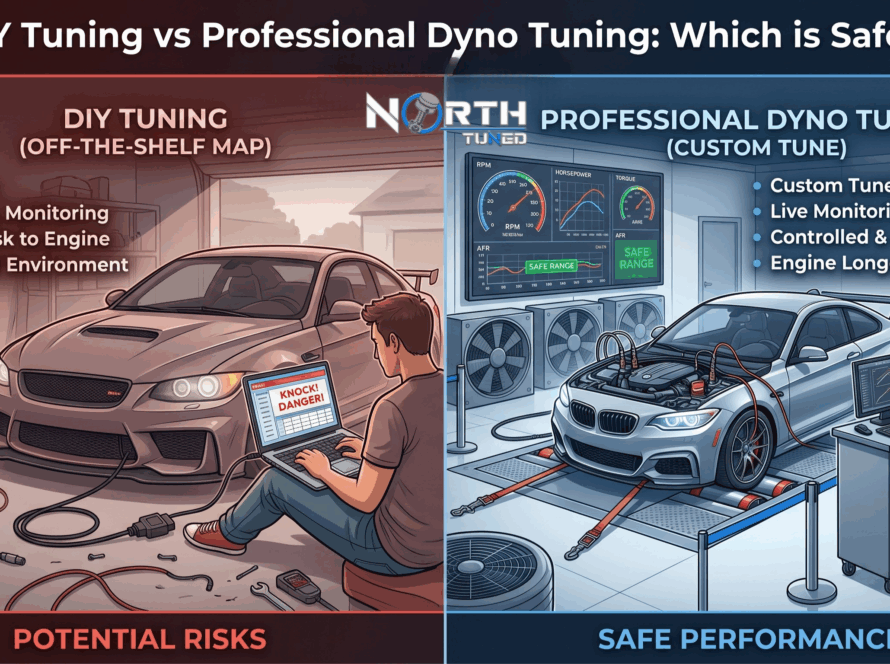
Stage 3 tuning leaves no room for error. An incorrect air-fuel ratio or excessive boost can lead to catastrophic engine failure. At North Tuned, we specialize in Custom Dyno Tuning tailored to your specific hardware, ensuring that your quest for more power doesn’t compromise reliability.
When it comes to driving dynamics and handling, wheel alignment angles are the most critical factors defining your vehicle’s character. At North Tuned, we focus not only on power gains but also on how that power is delivered to the asphalt. Let’s take a closer look at these three fundamental angles that affect everything from tire life to high-speed stability.

Camber
Camber is the tilt of the wheels on the vertical axis when viewed from the front of the vehicle. If the top of the wheel tilts inward, it is called negative camber; if it tilts outward, it is positive camber.
Negative Camber: Provides superior grip during cornering by increasing the tire’s contact patch. However, excessive negative camber can lead to uneven tire wear on the inner edges during straight-line driving.
Positive Camber: Generally preferred in heavy-duty vehicles or certain off-road setups to stabilize steering response.
North Tuned Note: For track-oriented or high-performance street cars, an ideal level of negative camber is crucial to maximize cornering performance.
Caster
Caster is the angle of the steering axis (the line connecting the ball joints or strut line) when viewed from the side. If the axis tilts toward the rear, it is defined as positive caster.
Advantages: Positive caster enhances straight-line stability at high speeds and helps the steering wheel return to the center position after a turn.
Cross-Caster: In many passenger cars, the caster is slightly adjusted to ensure that if the driver loses control, the vehicle drifts toward the curb rather than into oncoming traffic.

Toe Angle (Toe-in & Toe-out)
Toe represents the distance between the front and rear of the tires when viewed from above. If the front edges are closer together, it’s Toe-in; if they are further apart, it’s Toe-out.
Drivetrain Relationship: Front-wheel-drive vehicles tend to pull the wheels inward under acceleration, so they are often balanced with toe-out. Rear-wheel-drive vehicles tend to push the wheels outward, requiring a toe-in adjustment.
Consequences of Misalignment: Incorrect toe settings cause irregular “sawtooth” tire wear and increase rolling resistance, leading to higher fuel consumption.
Precision alignment services performed with North Tuned expertise ensure that your vehicle doesn’t just go fast, but stays glued to the road like it’s on rails.

Getting a professional tune (remapping) is the most exciting way to unlock your vehicle’s hidden potential. However, simply saying “it feels faster” isn’t enough. To truly understand the gains, you need empirical data. Here is how we at North Tuned recommend verifying your performance increase:
1. Dyno (Dynamometer) Testing
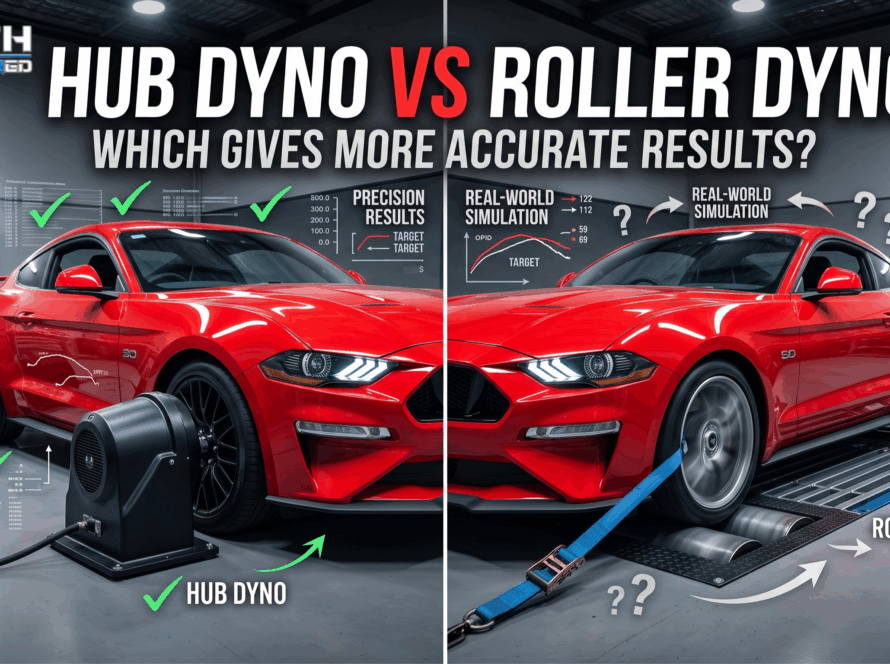
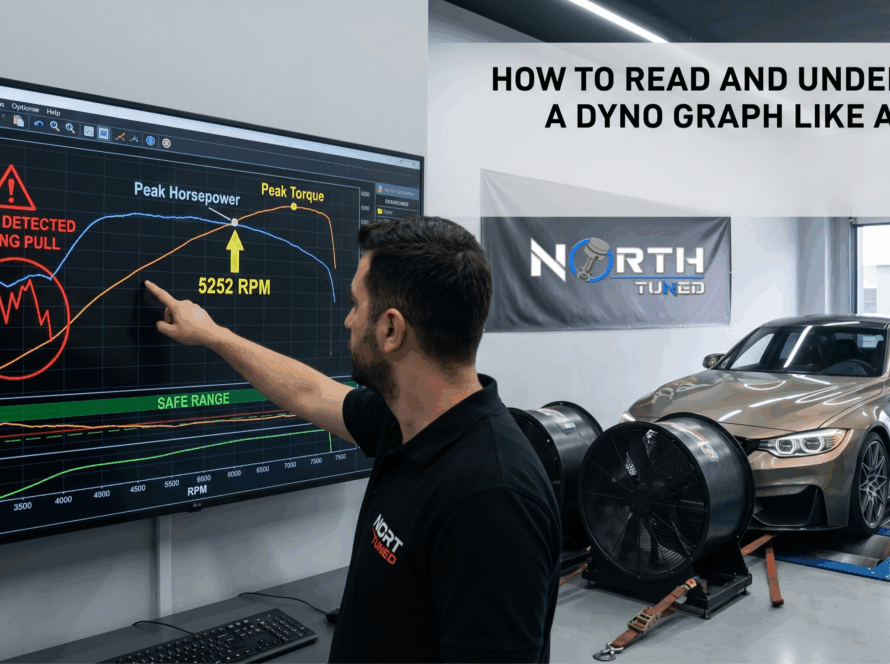
This is the gold standard. A dyno measures the horsepower (HP) and torque (Nm) delivered to the wheels.
Before/After: Performing a run right before and right after the tune provides a clear picture of the changes in the power band.
Health Check: It allows technicians to monitor Air-Fuel Ratios (AFR) to ensure the tune is running safely under load.
2. GPS-Based Performance Meters (Dragy or VBOX)
Devices like Dragy are the best way to turn feelings into facts. These use high-frequency GPS (10Hz or higher) to track acceleration with extreme precision.
0-100 km/h & 100-200 km/h: These are the industry standards for measuring real-world acceleration.
Slope Correction: These devices account for road incline, giving you a “valid” and honest result regardless of the terrain.
3. OBDII Data Logging
Speed is only one part of the story; how the engine achieves that speed matters for longevity. Use an OBDII scanner to log:
Boost Levels: Is the turbo hitting the requested targets?
Ignition Timing: Is the engine running efficiently without “pulling” timing due to knock?
Intake Air Temperatures (IAT): Is your cooling system handling the extra power effectively?
4. In-Gear Acceleration (Flexibility)
This is the most relevant metric for daily driving. For example, measure the time it takes to go from 80 km/h to 120 km/h in 4th gear. The reduction in this timeframe is the best indicator of your car’s increased “punch” and torque delivery.
Your car is capable of much more than what the factory settings allow. Manufacturers often “detune” engines to account for global variables like low-grade fuel or extreme environmental conditions. If you are a driving enthusiast, these restrictions are holding you back.
Here are the top 5 signs it’s time to visit North Tuned for a professional remap:
1. Significant Throttle Lag
Does your car feel “disconnected” when you hit the accelerator? This delay is often due to restrictive factory throttle mapping. A professional ECU remap sharpens the communication between your foot and the engine, providing instant power delivery.
2. Poor Fuel Economy Relative to Output
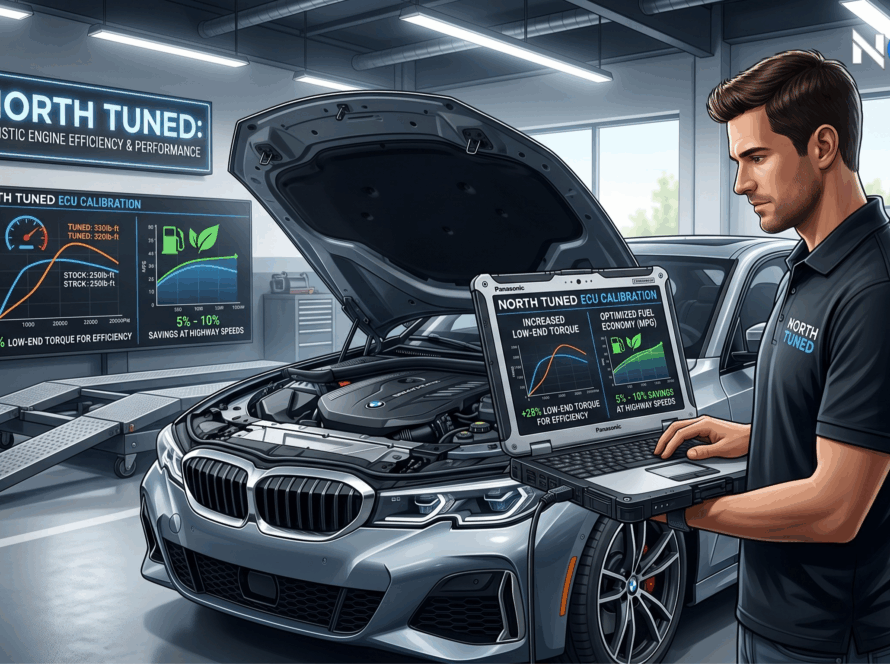
A performance tune isn’t just about speed; it’s about efficiency. By optimizing the air-fuel ratio and increasing low-end torque, the engine works less to maintain cruising speeds. If you’re visiting the gas station more often than you’d like, a specialized tune can actually improve your MPG.
3. Lack of Power During Overtaking
Overtaking requires a burst of confidence. If you find yourself hesitating because the car lacks that “punch” in the mid-range RPM, you are missing out on essential torque. Tuning expands the power band, making highway merges and overtaking maneuvers safer and more exhilarating.
4. Inefficient Gear Hunting
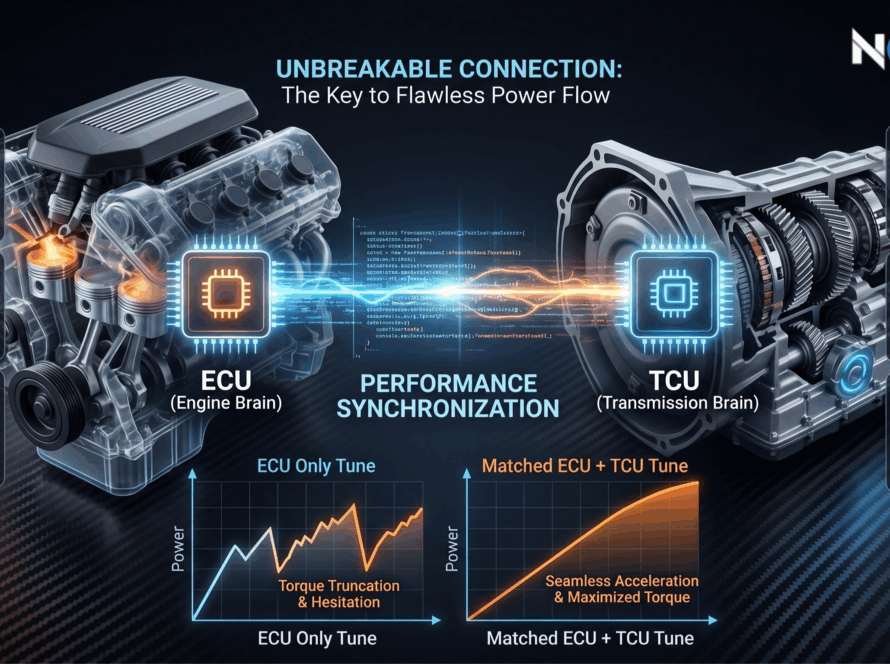
If you drive an automatic or dual-clutch vehicle, you might notice the car “hunts” for gears or stays in a high gear for too long during an incline. A North Tuned performance map harmonizes the engine’s output with the gearbox logic, ensuring you are always in the optimal power range.
5. The “Safety Margin” Is Too Wide
Standard cars are built for the “average” driver. If you maintain your vehicle well and use high-quality fuel, you don’t need the massive safety buffers set by the factory. Unleashing that dormant 20-30% of horsepower and torque is the most cost-effective way to transform your driving experience without mechanical modifications.
Why Choose North Tuned?
At North Tuned, we don’t just “plug and play.” We provide custom-tailored software solutions that respect your engine’s longevity while maximizing its output. Whether you are looking for a Stage 1 remap, DPF/EGR solutions, or Eco-Tuning, our expert team ensures your vehicle performs at its peak.