
Tag: dyno test

What is Horsepower (HP)? A Brief History of Power

What is Horsepower (HP)? A Brief History of Power

The term Horsepower (HP) is undoubtedly one of the most frequently used terms by car enthusiasts. Although it is the first criterion we look at when measuring a vehicle’s performance, it is not exactly equal to “the power of a single horse,” contrary to popular belief. So, how did this unit, which we at North Tuned place at the center of performance, come about?

James Watt and Marketing Genius
The term was first coined in 1782 by James Watt, a successful Scottish engineer and inventor who improved steam engines. To explain the capability of his engines to the public, Watt chose horses—the most common “engine” of that era—as a point of comparison.

How Was 1 Horsepower Calculated?
Watt observed horses working in coal mines. He calculated that, on average, a horse could pull 45 kg of coal 1.1 meters in one second. This mathematically equated to approximately 50 kg-m/s of work. However, to make his engines seem even more reliable and impressive, Watt increased this figure by 50%, rounding it up to 75 kg-m/s, and defined this as 1 Horsepower (HP).

In short, the modern definition is:

1 Horsepower (HP) is the amount of power required to lift a 75 kg load 1 meter vertically in 1 second.

Today, at North Tuned, we take James Watt’s fundamental legacy and optimize it with modern software and engineering solutions, efficiently awakening the “sleeping” horses within your vehicle.

read more

How to Measure Your Car’s Performance After a Tune

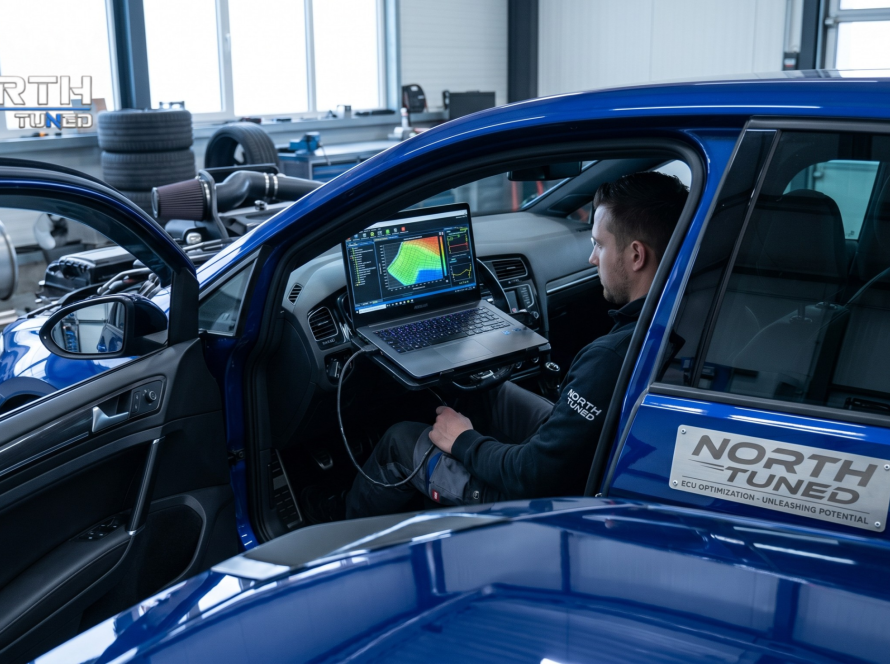
Getting a professional tune (remapping) is the most exciting way to unlock your vehicle’s hidden potential. However, simply saying “it feels faster” isn’t enough. To truly understand the gains, you need empirical data. Here is how we at North Tuned recommend verifying your performance increase:

1. Dyno (Dynamometer) Testing
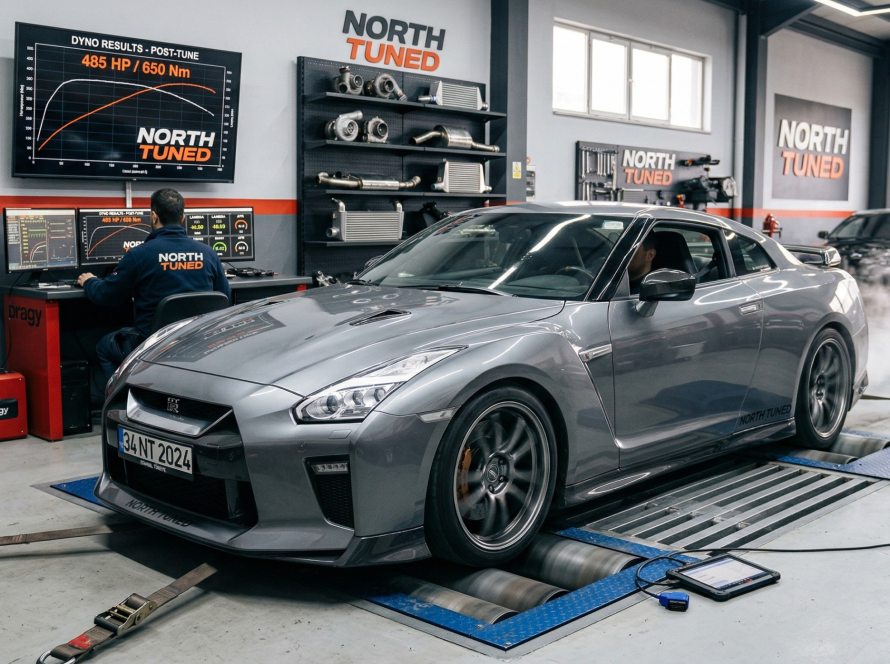
This is the gold standard. A dyno measures the horsepower (HP) and torque (Nm) delivered to the wheels.

Before/After: Performing a run right before and right after the tune provides a clear picture of the changes in the power band.

Health Check: It allows technicians to monitor Air-Fuel Ratios (AFR) to ensure the tune is running safely under load.

2. GPS-Based Performance Meters (Dragy or VBOX)
Devices like Dragy are the best way to turn feelings into facts. These use high-frequency GPS (10Hz or higher) to track acceleration with extreme precision.

0-100 km/h & 100-200 km/h: These are the industry standards for measuring real-world acceleration.

Slope Correction: These devices account for road incline, giving you a “valid” and honest result regardless of the terrain.

3. OBDII Data Logging
Speed is only one part of the story; how the engine achieves that speed matters for longevity. Use an OBDII scanner to log:

Boost Levels: Is the turbo hitting the requested targets?

Ignition Timing: Is the engine running efficiently without “pulling” timing due to knock?

Intake Air Temperatures (IAT): Is your cooling system handling the extra power effectively?

4. In-Gear Acceleration (Flexibility)
This is the most relevant metric for daily driving. For example, measure the time it takes to go from 80 km/h to 120 km/h in 4th gear. The reduction in this timeframe is the best indicator of your car’s increased “punch” and torque delivery.

read more