
In the automotive world, Downpipe is one of the first modifications that come to mind for enthusiasts. It is a critical exhaust component, especially for turbocharged vehicles, designed to unleash the engine’s true potential. Technically, a downpipe connects the turbocharger outlet to the rest of the exhaust system.
Limitations of Factory Systems
Today, car manufacturers must minimize costs and meet stringent emission standards during mass production. Consequently, factory exhaust systems are often designed with narrow diameters and numerous restrictive bends. Specifically, the high-density catalytic converters within these systems create significant “backpressure,” hindering the turbocharger’s efficiency and slowing down the evacuation of exhaust gases.
Why Choose North Tuned Downpipe?
At North Tuned, our downpipe solutions are engineered to remove these factory restrictions. By utilizing larger diameters and smooth-walled piping, we allow your engine to “breathe” far more effectively than with stock components.
Key Benefits of Downpipe Upgrades:
Faster Turbo Spool: Since exhaust gases encounter minimal resistance, the turbocharger reaches its optimum RPM much quicker, eliminating turbo lag.
Increased Horsepower and Torque: Improved gas flow leads to better engine volumetric efficiency, resulting in measurable gains in both HP and torque.
Thermal Management: Efficiently moving hot gases away from the turbo reduces operating temperatures, protecting the longevity of your turbocharger.
Perfect Synergy with Chiptuning: For Stage 2 and higher performance software, a North Tuned downpipe is essential to handle increased boost levels and maximize power delivery.
Enhanced Sound: It provides a deeper, more aggressive, and sportier exhaust note that reflects the power under the hood.
At the heart of every engine lies the master of synchronization: the Camshaft. At North Tuned, we understand that efficiency and pure power are hidden within the precise calibration of this vital component.
What is a Camshaft and How Does It Work?
The camshaft is a critical auxiliary shaft that receives its motion from the crankshaft to manage engine valves. In a standard four-stroke engine, while the crankshaft completes two full rotations (720°), the camshaft completes one (360°).
Its primary duty is to dictate exactly when the intake and exhaust valves open and how long they remain open with millimetric precision. Usually manufactured from high-quality carbon steel through casting or forging, the camshaft features journals, drive gears, and the “cams” that physically actuate the valves.
Power Transmission and Risk Factors
The method of driving the camshaft varies by engine architecture:
Timing Belt/Chain: Used in inline engines where the distance between shafts is significant. At North Tuned, we warn that a snapped or slipped timing belt causes valves to collide with pistons, leading to catastrophic engine failure.
Gear-to-Gear: Common in some V-type configurations where the shafts are close, offering the most durable and efficient transfer.
Signs of Wear and Performance Loss
Even slight wear on the cam lobes results in reduced valve lift or incorrect timing. This restricts the engine’s “breathing,” leading to power loss, poor combustion, and increased fuel consumption.
The Key to Performance: High-Duration (Performance) Camshafts
For those seeking to unlock the true potential of their engine, the first stop is the Performance Camshaft. With North Tuned solutions, we bypass the restrictive profiles of OEM shafts to redefine your engine’s character.
How Does It Generate Power?
High-performance camshafts increase the “duration” (time open) and “lift” (depth of opening) of the valves. Allowing more air-fuel mixture into the combustion chamber per cycle results in a more powerful explosion, leading to power gains of up to 35%.
Technical Terminology & North Tuned Analysis
LIFT: Indicates how far the camshaft pushes the valve open. Higher lift means a larger “curtain area” for airflow.
DURATION: The measurement of how long the valve stays off its seat, measured in degrees of crankshaft rotation.
OVERLAP: The critical window where both intake and exhaust valves are open simultaneously. This scavenges exhaust gases and pulls in fresh charge at high RPMs.
POWER BAND: The RPM range where the camshaft profile is most efficient. At North Tuned, we optimize this band based on your needs, whether for the track or the street.
Vital Note: A performance camshaft is not a standalone miracle. To achieve maximum reliability and output, this modification should be supported by reinforced valve springs, adjustable cam gears, and most importantly, a custom North Tuned ECU Remap.
In the world of automotive tuning, fuel is just as critical as the hardware itself. When you push the limits of standard pump gas, you eventually hit a wall called “knock” or “detonation.” This is where Ethanol (Ethyl Alcohol) becomes a game-changer. At North Tuned, we frequently utilize ethanol blends to unlock the true potential of turbocharged and high-compression engines.
Here is an in-depth technical look at why ethanol is the preferred choice for high-performance applications and what you need to know about the transition.
What is Ethanol Fuel?
Ethanol is a renewable fuel source produced by fermenting sugars from agricultural feedstocks like corn, sugar cane, and wheat. While it can be used in its pure form, it is most commonly mixed with gasoline in varying ratios:
E10: 10% Ethanol / 90% Gasoline (Commonly found at standard gas stations).
E85: 85% Ethanol / 15% Gasoline (The “Gold Standard” for performance tuning).
Why Ethanol Wins: The Technical Advantages
The reason ethanol is so highly regarded in the motorsport and tuning industry boils down to two main factors: Octane Rating and Latent Heat of Vaporization.
1. Massive Octane Boost
Standard premium gasoline usually sits between 91 and 93 AKI (95-98 RON). Pure ethanol, however, boasts an octane rating of approximately 116 AKI / 129 RON. Even at an E85 blend, the effective octane rating is usually 105+.
The Benefit: High octane means the fuel is incredibly resistant to pre-ignition. This allows tuners to advance ignition timing and increase boost pressure significantly without the risk of engine damage.
2. Superior Cooling Effect
Ethanol has a much higher latent heat of vaporization than gasoline. This means that as ethanol is injected and evaporates, it absorbs a significant amount of heat from the intake air and the combustion chamber.
Turbo Longevity: By lowering Exhaust Gas Temperatures (EGT), ethanol protects the turbocharger turbine and internal engine components from thermal stress. It essentially acts as a chemical intercooler.
The “Ethanol Ready” Conversion: What Changes?
Ethanol contains about 34% less energy by volume than gasoline. This means that to maintain the correct Air/Fuel Ratio (AFR), the engine must spray more fuel. For E85, you typically need 30% to 35% more fuel flow compared to gasoline.
To make a vehicle compatible, North Tuned focuses on these essential upgrades:
High-Flow Fuel Pumps & Injectors: Since the volume requirement increases, upgraded pumps and larger injectors are mandatory to prevent the engine from running lean.
Flex Fuel Sensors: We install sensors that detect the exact ethanol content in the tank. This allows the ECU to automatically adjust the tune in real-time, whether you are running 10% or 85% ethanol.
Material Compatibility: While most modern cars (post-2000s) have fuel systems resistant to alcohol, older projects may require replacing rubber lines with PTFE (Teflon) lines to prevent corrosion.
Daily Driving and Environmental Impact
While ethanol is a “cleaner” burning fuel in terms of carbon emissions, it does have some quirks:
Cold Starts: Ethanol does not vaporize well at temperatures below 13°C (55°F). Specialized tuning is required to ensure the car starts smoothly on cold mornings.
Fuel Economy: Because more fuel is required to produce the same energy, you will notice a roughly 25-30% drop in MPG when running E85.
Ethanol is not just a fuel; it’s a performance tool. It allows us to reach power levels that were previously only possible with expensive, leaded racing fuels. If you are looking to maximize the efficiency and output of your turbocharged engine while keeping engine temperatures in check, an ethanol conversion is the most effective path forward.
In the world of diesel tuning, the debate over DPF (Diesel Particulate Filter) and EGR (Exhaust Gas Recirculation) deletes is often framed as a choice between reliability and bureaucratic regulations. However, at North Tuned, we believe it is crucial to understand the scientific and environmental weight of these modifications. While deleting these components might offer a slight boost in horsepower, the ecological footprint left behind is massive.
The Science Behind the Shield
To appreciate why these systems are vital, we must look at what they prevent:
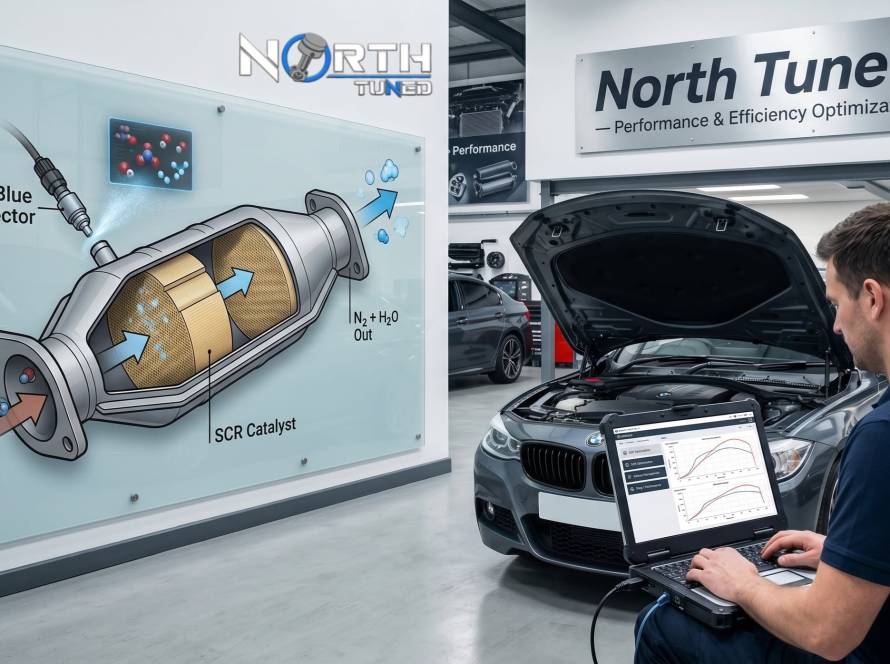
EGR Systems: By recirculating a portion of exhaust gas, the oxygen concentration in the combustion chamber is lowered, which in turn reduces the peak combustion temperature. This is critical because Nitrogen Oxides ($NO_x$)—one of the most dangerous pollutants—are only formed at extreme temperatures.
DPF Systems: This is a sophisticated honeycomb structure that captures up to 99% of particulate matter (soot). Without it, these particles are released directly into the air we breathe.
The Real-World Consequences of “Deleting”
When a vehicle undergoes a DPF or EGR delete, it ceases to be a modern, clean machine and becomes a significant source of pollution.
1. The Nitrogen Oxide Crisis
Removing the EGR valve leads to a massive spike in $NO_x$ emissions. These gases are precursors to ground-level ozone, which causes severe respiratory distress in humans and contributes to the formation of “smog” that blankets major cities. On a global scale, $NO_x$ is a significant driver of the greenhouse effect, being far more potent than $CO_2$.
2. Invisible Killers: Particulate Matter
A DPF-deleted truck or car releases PM2.5—fine particles smaller than 2.5 micrometers. These particles are small enough to bypass the body’s natural filters, settling deep in the lungs and even entering the bloodstream. Scientific studies have linked this exposure to heart attacks, aggravated asthma, and decreased lung function in children.
3. Environmental Degradation
The environmental impact extends beyond human health. High levels of $NO_x$ contribute to the acidification of oceans and soil. This affects biodiversity, kills sensitive plant species, and disrupts the nitrogen cycle in our forests.
The North Tuned Philosophy: Engineering a Greener Future
At North Tuned, we don’t believe you should have to choose between a fast car and a clean planet. Our approach to tuning is rooted in optimization, not destruction.
Smart Tuning: We use advanced software to optimize fuel maps and timing, improving throttle response and fuel economy while keeping the DPF and EGR fully functional.
Professional Maintenance: We advocate for specialized cleaning services that restore these components to factory efficiency, saving you money on replacements without hurting the environment.
Ethical Performance: True engineering excellence lies in making a system work better within its intended design.
By choosing responsible tuning, you ensure that your vehicle performs at its peak while respecting the air we all share. At North Tuned, we lead the way in sustainable performance.
The term Horsepower (HP) is undoubtedly one of the most frequently used terms by car enthusiasts. Although it is the first criterion we look at when measuring a vehicle’s performance, it is not exactly equal to “the power of a single horse,” contrary to popular belief. So, how did this unit, which we at North Tuned place at the center of performance, come about?
James Watt and Marketing Genius
The term was first coined in 1782 by James Watt, a successful Scottish engineer and inventor who improved steam engines. To explain the capability of his engines to the public, Watt chose horses—the most common “engine” of that era—as a point of comparison.
How Was 1 Horsepower Calculated?
Watt observed horses working in coal mines. He calculated that, on average, a horse could pull 45 kg of coal 1.1 meters in one second. This mathematically equated to approximately 50 kg-m/s of work. However, to make his engines seem even more reliable and impressive, Watt increased this figure by 50%, rounding it up to 75 kg-m/s, and defined this as 1 Horsepower (HP).
In short, the modern definition is:
1 Horsepower (HP) is the amount of power required to lift a 75 kg load 1 meter vertically in 1 second.
Today, at North Tuned, we take James Watt’s fundamental legacy and optimize it with modern software and engineering solutions, efficiently awakening the “sleeping” horses within your vehicle.

If you want to feel the true power of your engine, the ignition must be flawless. This is where the spark plug comes into play. But what exactly does this small yet mighty component do?
How Does a Spark Plug Work?
The primary role of a spark plug is to ignite the air-fuel mixture in the combustion chamber within milliseconds. It takes a massive voltage of 20,000 – 30,000 volts from the ignition coil and forces it across a gap, creating an electric arc (spark). This spark triggers the explosion that powers your vehicle.
Which Vehicles Use Spark Plugs?
Spark plugs are essential for gasoline, LPG, and hybrid engines. However, keep in mind: Diesel engines do not have ignition spark plugs. Diesel engines operate by compressing air to extreme pressures to cause spontaneous combustion.
Hot vs. Cold Spark Plugs: What’s the Difference?
Choosing the right plug based on your engine’s character is vital:
Cold Spark Plug: Has a shorter insulator nose and dissipates heat quickly. It is preferred for high-performance and tuned engines.
Hot Spark Plug: Has a longer insulator nose and retains more heat. It’s ideal for daily drivers and lower RPM engines.
North Tuned Insight: Does Changing Spark Plugs Affect Fuel Efficiency?
Absolutely! A worn-out spark plug or an incorrect gap causes inefficient combustion. This leads to higher fuel consumption and robs your engine of its performance. The right spark plug ensures:
Lower fuel consumption,
Sharper throttle response,
Smoother idling.
Pro Tip: The spark plug gap widens over time due to wear. In modern electronic ignition systems, this gap is typically between 0.8mm – 1.1mm. Don’t skip your periodic checks to maintain peak performance!
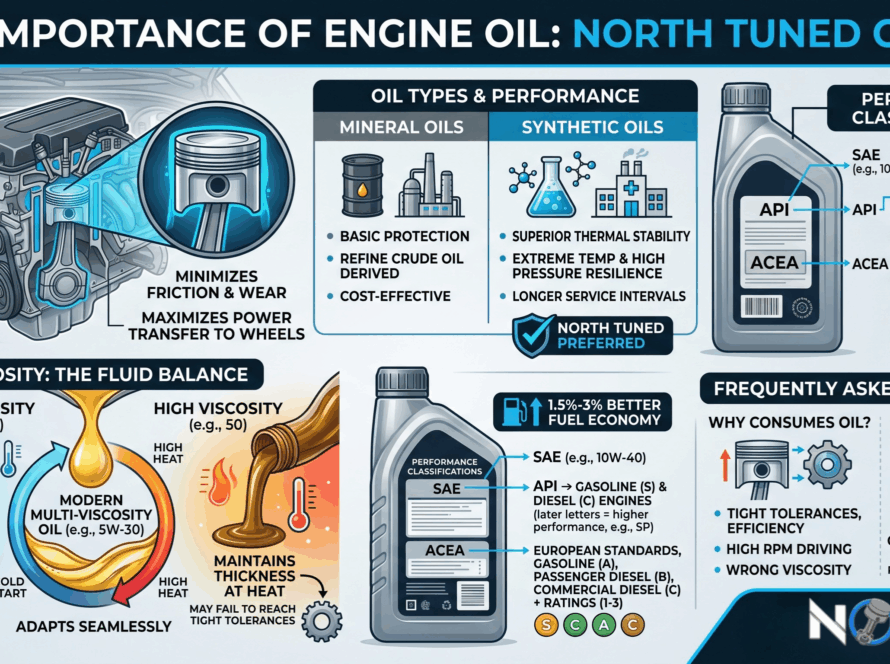
Engine oil is more than just a lubricant; it is a protective shield within your vehicle’s engine. By forming a microscopic film over moving components, it minimizes friction and wear. At North Tuned, we emphasize that selecting the premium oil reduces friction-induced power loss, allowing more effective power transfer to the wheels.
Oil Types and Performance Variations
Mineral Oils: Derived from refined crude oil. While cost-effective, they typically provide only basic protection for modern, high-performance engines.
Synthetic Oils: Engineered in laboratory environments using advanced chemical processes. Within North Tuned performance standards, synthetic oils are preferred for their superior thermal stability and resilience under extreme temperatures or high pressure. They offer longer service intervals and maximum engine longevity.
Viscosity: The Fluid Balance
Viscosity measures an oil’s resistance to flow.
Low Viscosity (e.g., 0W): Flows quickly in cold temperatures, ensuring protection during cold starts.
High Viscosity (e.g., 50): Maintains thickness at high heat but may fail to reach tight engine tolerances if too thick.
North Tuned Note: Modern multi-viscosity oils (like 5W-30) adapt seamlessly to changing climates. These oils provide 1.5% to 3% better fuel economy compared to single-grade oils.
Performance Classifications (SAE, API, ACEA)
The codes on the back of the bottle are vital for your engine’s health:
SAE: Defines the flow grade (e.g., 10W-40).
API: Indicates suitability for Gasoline (S) or Diesel (C) engines. Later letters in the alphabet (e.g., SP) signify higher performance levels.
ACEA: European standards categorizing oils for Gasoline (A), Passenger Diesel (B), and Commercial Diesel (C), followed by performance ratings (1-3).
Frequently Asked Questions
Why does my engine consume oil? Modern engines use tight metal-to-metal tolerances for efficiency, which can lead to slight consumption. Excessive loss is often due to high RPM driving, incorrect oil viscosity, or mechanical wear.
Can I mix different brands? In emergencies, you can top up with the same viscosity and API class. However, mixing mineral and synthetic oils compromises the chemical structure. North Tuned recommends a full oil change as soon as possible after mixing.