
Performance tuning is a craft that balances art and engineering. At North Tuned, we believe that true performance isn’t just about the peak numbers on a dyno sheet—it’s about how long that engine can sustain those numbers.
1. Tuning Without Pre-Inspection
Tuning an engine with existing mechanical issues is like building a skyscraper on a swamp.
The Mistake: Installing a performance map on a car with old spark plugs, a tired fuel pump, or vacuum leaks.
The Outcome: The added stress of increased boost or timing will inevitably cause the weakest link to fail.
North Tuned Pro-Tip: Always perform a diagnostic scan and check for boost leaks before modifying the ECU.
2. Neglecting Thermal Management
Power is a byproduct of combustion, and combustion generates heat. If you increase the energy, you must increase the cooling.
The Mistake: Pushing high boost levels on a stock intercooler.
The Outcome: High Intake Air Temperatures (IATs) lead to ignition timing pull and potential engine knock (detonation).
Solution: For Stage 2+ builds, upgrading the cooling system is not optional; it is a necessity for engine longevity.
3. Chasing Boost Instead of Efficiency
A common misconception is that “More Boost = More Power.”
The Mistake: Overworking a small turbocharger beyond its efficiency map.
The Technical Side: When a turbo is pushed too hard, it simply blows hot, turbulent air. This increases backpressure and heat without adding significant oxygen.
Solution: Focus on optimizing the Air-Fuel Ratio (AFR) and ignition timing. Sometimes, less boost with better timing yields more reliable power.
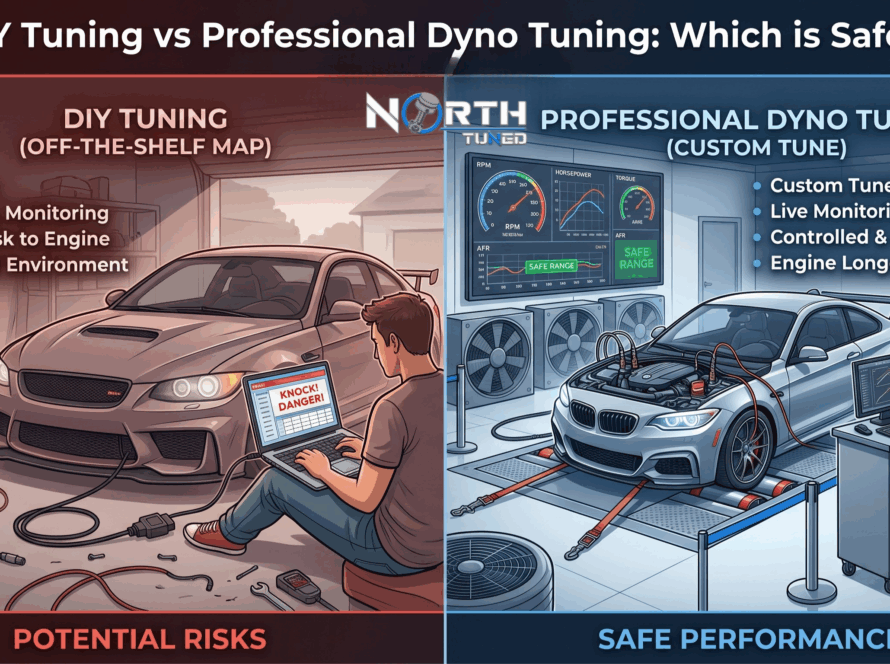
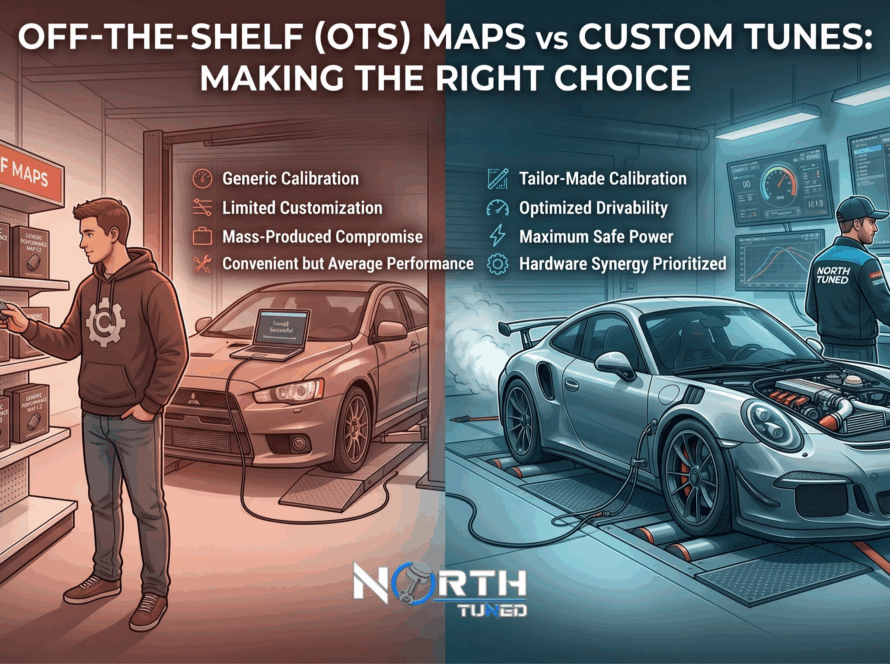
4. The Danger of “Generic” Off-the-Shelf Tunes
Every car lives a different life. A car in a high-altitude region needs different parameters than one at sea level.
The Mistake: Using cheap, non-adjustable files that don’t account for fuel quality or hardware health.
The Outcome: Poor drivability and a high risk of catastrophic failure under load.
The North Tuned Approach: We prioritize Data Logging. By analyzing how your specific engine reacts in real-time, we fine-tune the software to ensure maximum safety margins.
5. Forgetting the Drivetrain
An engine is only as good as the wheels it turns.
The Mistake: Increasing torque significantly without recalibrating the Transmission Control Unit (TCU).
The Outcome: Slipped clutches in DSG/ZF gearboxes or snapped axles.
Solution: Match your ECU tune with a TCU tune to increase clutch clamping pressure and optimize shift points.
For speed enthusiasts and performance seekers, NOS (Nitrous Oxide System) remains one of the most intriguing and effective ways to achieve instantaneous power gains in internal combustion engines. But how exactly does this system work, and what happens at the heart of your vehicle? As North Tuned, we take a closer look at this adrenaline-pumping technology.
How Does NOS Work? The Formula of Power
The power generated by an internal combustion engine depends on how violently the oxygen taken in can be detonated with the injected fuel. In standard engine tuning, the goal is to increase the air-fuel mixture entering the engine. NOS takes this process to a much more radical level.
Oxygen Enrichment: When Nitrous Oxide gas enters the combustion chamber, it breaks down due to heat, releasing pure oxygen. This represents a much higher concentration of oxygen compared to regular atmospheric air.
Cooling Effect: The cooling effect created as the gas exits the cylinder increases the density of the intake air. Cooler air is denser, allowing significantly more oxygen to fill the combustion chamber than normal.
Powerful Combustion: With the increased oxygen, more fuel is delivered to the system. The result is a much more powerful explosion, leading to a massive increase in horsepower delivered to the wheels.
Why Choose NOS?
Factory-spec cars are manufactured with performance values below their true potential to ensure fuel economy and durability under all road conditions. A NOS kit, applied with North Tuned expertise, awakens the “sleeping giant” within your vehicle’s DNA—only when you need it.
The biggest advantage of the system is that it is “on-demand.” While providing a standard driving experience for daily city use, you can transform your car into a high-performance machine with a single touch whenever extra power is required.
Does NOS Damage the Engine?
Let’s provide a clear answer to the most frequently asked question: Not with the right setup and correct limits.
The key to preventing engine damage is selecting the appropriate horsepower gain. As long as you do not exceed the load capacity that your engine components (pistons, rods, bearings) can tolerate, no additional wear occurs.
Safe Power Gains with North Tuned:
Precise Calibration: For high-level horsepower increases, we meticulously perform critical adjustments such as spark plug selection and ignition timing retardation.
Fuel Optimization: We ensure the fuel system and octane levels are correctly tuned to support the increased power.
Controlled Power: By activating the system only when performance is needed, you preserve the overall longevity of your engine.
Push the Limits with North Tuned
If you want to discover your vehicle’s true potential and achieve safe performance gains, you are in the right place. To get detailed information about NOS applications and our other performance solutions, and to determine the most suitable kit for your vehicle, feel free to contact us.
In this article, we will examine the purpose and working principle of the Oil Catch Tank, one of the critical components of forced induction and modified vehicles, from the perspective of North Tuned.
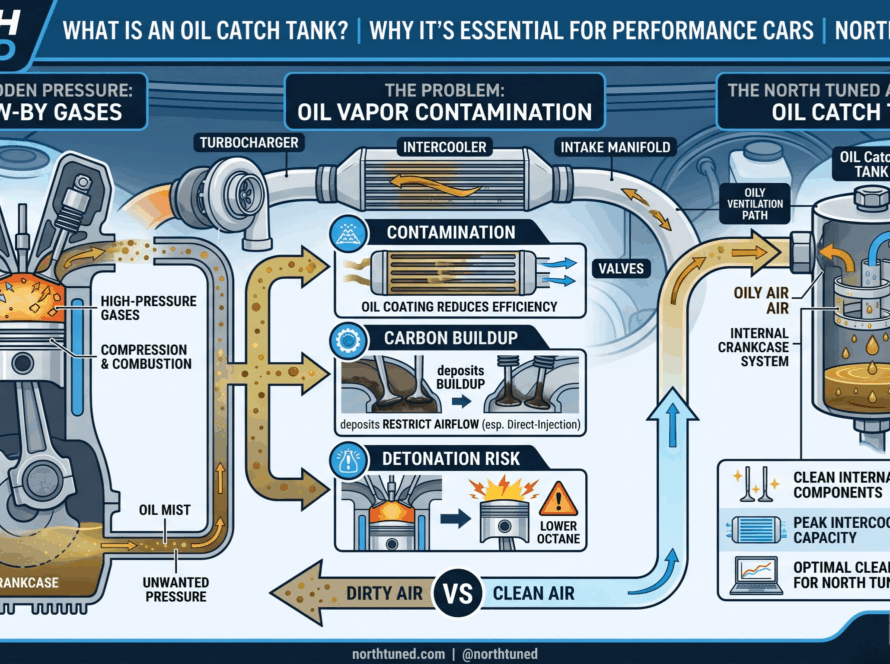
The Hidden Pressure: Blow-By Gases
In a four-stroke engine, as the piston moves from the top to the bottom, the intake valves open to draw in the air-fuel mixture. When the piston moves back up, all valves close to compress this mixture.
During this compression and combustion phase, a portion of the high-pressure gases leaks past the piston rings into the crankcase. This is known as “Blow-by.” To manage this unwanted pressure without releasing harmful gases into the atmosphere, manufacturers route this air back into the intake system through a ventilation channel.

The Problem with Oil Vapor
The air evacuated from the crankcase is not just air; it contains a significant amount of oil vapor from the engine oil being tossed around at high temperatures. In factory setups, this oily mist is sent directly back into the turbocharger, intercooler pipes, and intake manifold.
Over time, this leads to:
Contamination: Oil coating the inside of the intercooler significantly reduces its cooling efficiency.
Carbon Buildup: In direct-injection engines, oil accumulates on the intake valves, hardening into carbon deposits that restrict airflow.
Detonation Risk: Oil mist entering the combustion chamber lowers the effective octane rating, which can lead to engine knock.

The North Tuned Advantage: Why Use a Catch Tank?
An Oil Catch Tank acts as a high-efficiency filter. Instead of the oily crankcase air going straight to the intake, it first passes through this tank. The internal baffling system causes the oil droplets to condense and settle at the bottom of the reservoir.
The result: Only purified air is returned to the engine. This keeps your internal components clean, ensures your intercooler works at peak capacity, and allows your North Tuned performance map to operate under optimal, clean conditions.