
When it comes to performance and longevity in turbocharged vehicles, one of the most critical components is the Turbo Timer. Especially after high-performance driving or long journeys, shutting down the engine abruptly can cause irreversible damage to the turbocharger system. At North Tuned, we have detailed the technical importance of this technology and the advantages it offers to protect the heart of your vehicle.
What is a Turbo Timer?
A Turbo Timer is an electronic device designed to keep an engine running for a pre-specified period of time in order to automatically execute the required cool-down period. Even after you turn the ignition off and remove the key, the device allows the engine to continue idling, ensuring that the turbocharger cools down properly without requiring the driver to wait inside the car.
Why Should You Use a Turbo Timer?
Vehicles with forced induction (Turbo/Supercharger) systems reach extremely high RPMs and intense temperatures during operation. Shutting down the engine immediately after a drive leads to two major technical risks:
Thermal Stress and Cooling: After spirited driving or heavy loads, exhaust gas temperatures remain very high. A turbo timer allows the engine to idle, enabling the intake and exhaust tracks to cool down through the circulation of lower-temperature gases.
Preventing Oil Coking: The turbo shaft spins at hundreds of thousands of revolutions per minute and is lubricated by engine oil. If the engine is stopped suddenly, the oil pump stops as well, but the turbo shaft continues to spin due to inertia. The stagnant oil trapped between the glowing hot shaft and the bearings can “cook” (carbonize), leading to sludge buildup. Over time, this causes shaft seizure and catastrophic turbo failure.
Modern Solutions and Security
Today’s modern turbo timer systems are built on sophisticated digital electronic platforms. At North Tuned, safety is our priority during installation. These systems are typically integrated with the handbrake mechanism or a dedicated safety switch. If the handbrake is released or the vehicle is tampered with while the timer is active, the system immediately kills the engine to prevent theft.
Protect Your Turbo with North Tuned
Increasing your vehicle’s performance is only half the battle; the other half is building the infrastructure to protect that power. A turbo timer is not just a convenience—it is a protective shield that can significantly extend the lifespan of your turbocharger.
If you want to preserve your engine health and avoid premature turbo wear or costly repair bills, contact the expert team at North Tuned for professional Turbo Timer applications.
North Tuned: Where Performance Meets Reliability.
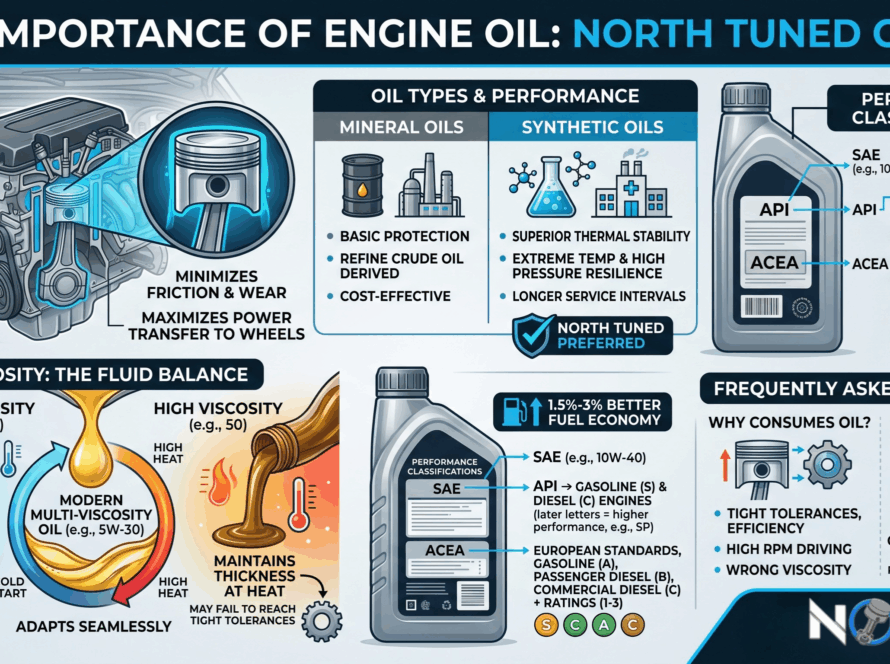
Engine oil is more than just a lubricant; it is a protective shield within your vehicle’s engine. By forming a microscopic film over moving components, it minimizes friction and wear. At North Tuned, we emphasize that selecting the premium oil reduces friction-induced power loss, allowing more effective power transfer to the wheels.
Oil Types and Performance Variations
Mineral Oils: Derived from refined crude oil. While cost-effective, they typically provide only basic protection for modern, high-performance engines.
Synthetic Oils: Engineered in laboratory environments using advanced chemical processes. Within North Tuned performance standards, synthetic oils are preferred for their superior thermal stability and resilience under extreme temperatures or high pressure. They offer longer service intervals and maximum engine longevity.
Viscosity: The Fluid Balance
Viscosity measures an oil’s resistance to flow.
Low Viscosity (e.g., 0W): Flows quickly in cold temperatures, ensuring protection during cold starts.
High Viscosity (e.g., 50): Maintains thickness at high heat but may fail to reach tight engine tolerances if too thick.
North Tuned Note: Modern multi-viscosity oils (like 5W-30) adapt seamlessly to changing climates. These oils provide 1.5% to 3% better fuel economy compared to single-grade oils.
Performance Classifications (SAE, API, ACEA)
The codes on the back of the bottle are vital for your engine’s health:
SAE: Defines the flow grade (e.g., 10W-40).
API: Indicates suitability for Gasoline (S) or Diesel (C) engines. Later letters in the alphabet (e.g., SP) signify higher performance levels.
ACEA: European standards categorizing oils for Gasoline (A), Passenger Diesel (B), and Commercial Diesel (C), followed by performance ratings (1-3).
Frequently Asked Questions
Why does my engine consume oil? Modern engines use tight metal-to-metal tolerances for efficiency, which can lead to slight consumption. Excessive loss is often due to high RPM driving, incorrect oil viscosity, or mechanical wear.
Can I mix different brands? In emergencies, you can top up with the same viscosity and API class. However, mixing mineral and synthetic oils compromises the chemical structure. North Tuned recommends a full oil change as soon as possible after mixing.