
Tag: engine remapping
What Are Stage 1, 2, and 3 Tunes?
In the car modification world, the concept of a tuning “Stage” is something we hear frequently, yet even experienced car enthusiasts sometimes struggle to define their exact boundaries. Let’s summarize what kind of modifications are done at each level to improve your car’s performance, using a clear and straightforward approach:
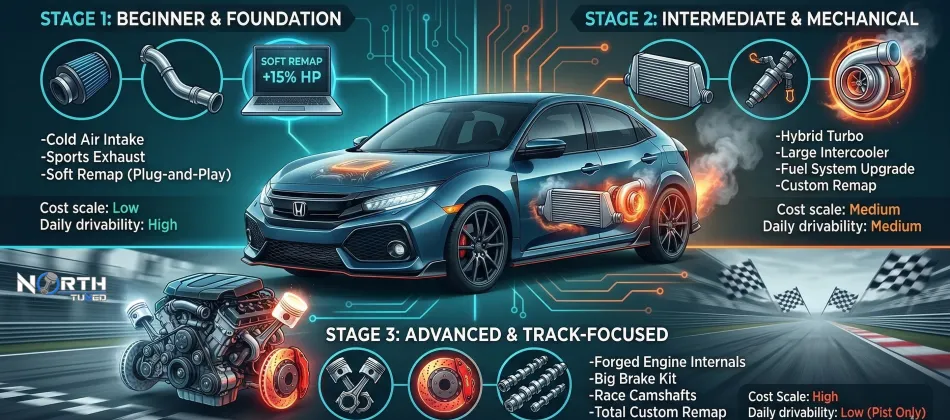
Stage 1: The Beginner and Foundation Phase
This is the most practical modification step, achieved without altering the car’s original mechanical structure, opening the engine block, or engaging in heavy fabrication. It mostly utilizes “plug-and-play” parts. While being the most cost-effective stage, it allows the car to breathe better and builds a solid foundation for future, larger power upgrades.
Key Upgrades Include:
Cold Air Intake kits
Sports exhaust systems and Downpipes (catalytic converter removal/decats)
Colder performance spark plugs and ignition coils
Blow Off / Dump Valves for turbocharged cars
Mild performance software that doesn’t stress the engine internals (Soft Chip Tuning / Remap)
Ignition timing optimization
Stage 2: The Intermediate Level and Mechanical Enhancement
This is the stage you move to when the power gained from Stage 1 simply isn’t enough, marking the beginning of significant hardware changes to the engine. Although it doesn’t require a heavy internal engine rebuild, professional labor and a custom software update are mandatory to ensure the new, larger parts work together in harmony.
Key Upgrades Include:
Enlarging the existing turbo (Hybrid turbo upgrades)
Installing a larger capacity Intercooler to better cool the compressed air
Fuel injector and high-pressure fuel pump upgrades to supply more fuel
Street-profile upgraded camshafts
Upgraded Stage 2 clutch to transmit the increased power to the transmission without slipping
Custom-made, large-volume intake or exhaust manifolds
Supercharger or larger turbo conversions
Stage 3: The Advanced Level and Track-Focused Phase
This is the most aggressive stage where the car almost completely breaks away from comfortable, daily street use and transforms into a purebred race car. You literally dive into the heart of the engine (opening the engine block), and the internal moving parts are replaced with heavy-duty materials designed to withstand extreme pressure.
Key Upgrades Include:
High-pressure resistant Forged pistons and connecting rods (Forged internals)
Upgraded engine valves, heavy-duty valve springs, and titanium retainers
Race-spec (highly aggressive) camshafts that noticeably alter the engine’s idle
Heavy-duty Stage 3 bronze/puck clutch kits
Drivetrain upgrades (heavy-duty driveshafts, axles) to prevent snapping under load
Massive Big Brake Kits (BBK) to tame the dangerous speeds the car can now reach
A completely Custom Engine Tune (Remap) built from scratch specifically for this extensive hardware list
A Quick Summary:
A Stage 3 setup is absolutely not recommended for a daily driver that you use to commute to work or go grocery shopping. Vehicles pushed to their absolute mechanical limits like this require a much more expensive, frequent, and highly meticulous maintenance routine compared to standard cars.
How ECU Tuning Can Boost Your Car’s Performance and Fuel Efficiency
Have you ever felt that your car has more potential than it actually delivers on the road? If you drive a modern vehicle, you are absolutely right. When cars roll off the factory assembly line, they are intentionally restricted. Manufacturers program vehicles to operate well within their maximum capabilities to account for varying global climates, poor-quality fuel, and owners who might neglect regular maintenance.
The secret to unlocking this hidden potential lies in your car’s computer. Through a process known as ECU tuning (or remapping), you can optimize your engine’s software to significantly boost performance, improve throttle response, and, surprisingly, even increase fuel efficiency.
Here is a deep dive into how ECU tuning works and why it might be the best upgrade you can get for your car.
What is an ECU (Engine Control Unit)?
Before understanding how tuning works, it is essential to understand the brain of your car: the Engine Control Unit (ECU).
In modern vehicles, the engine is entirely controlled by this computerized brain. The ECU constantly monitors a vast array of sensors located throughout the engine bay and exhaust system. These include oxygen sensors, mass airflow (MAF) sensors, throttle position sensors, and knock sensors.
Based on the data it receives from these sensors hundreds of times a second, the ECU dictates crucial engine functions, including:
Air/Fuel Ratio (AFR): How much fuel to inject into the cylinders relative to the amount of air entering.
Ignition Timing: Exactly when the spark plug should fire to ignite the mixture.
Boost Pressure: In turbocharged or supercharged cars, the ECU controls the wastegate to determine how much boost the turbo produces.
Valve Timing: In engines with variable valve timing (like VTEC or VANOS), the ECU controls when and how long the valves open.
The ECU operates based on “maps”—essentially a set of lookup tables programmed by the manufacturer.
What is ECU Tuning?
ECU tuning, also known as remapping, chipping, or flashing, is the process of modifying these factory-installed maps. By reading the original software from the ECU and overwriting it with customized, optimized parameters, a tuner can change how the engine behaves under different conditions.
Rather than physically replacing engine parts (like installing a larger exhaust or a new turbo), ECU tuning is purely a software upgrade. A professional tuner will adjust the parameters to safely narrow the broad tolerances left by the manufacturer, tailoring the engine’s operation to yield the best possible output for the specific fuel quality and climate you drive in.
How ECU Tuning Boosts Performance
The most common reason enthusiasts tune their vehicles is to unlock more power. Here is how altering the software translates to physical horsepower and torque gains:
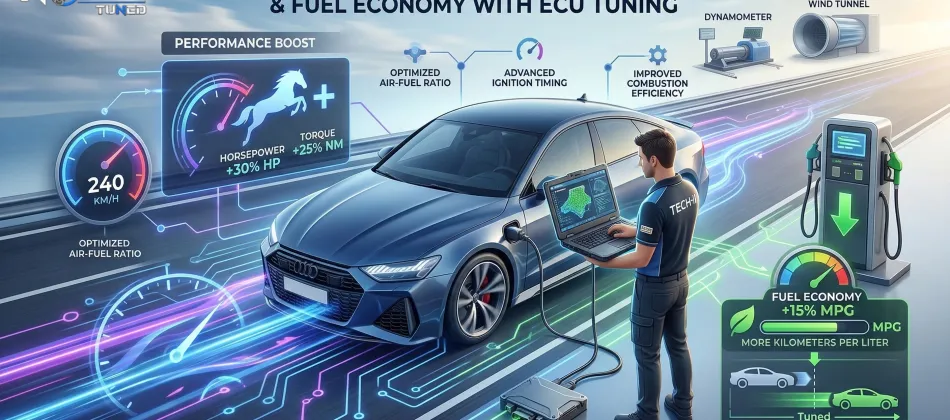
1. Optimizing the Air-Fuel Ratio (AFR)
Manufacturers often tune cars to run slightly “rich” (more fuel than necessary) under heavy load to keep internal engine temperatures down and protect the catalytic converters. A tuner will adjust the AFR to a leaner, more optimal mixture that produces maximum power while still remaining within safe temperature limits.
2. Advancing Ignition Timing
Ignition timing refers to the exact millisecond the spark plug fires during the piston’s compression stroke. Factory settings are usually “retarded” (delayed) to prevent engine knock when using low-octane fuel. If you consistently use high-quality, high-octane premium fuel, a tuner can “advance” the timing. This causes the combustion event to push down on the piston at the perfect moment, generating significantly more mechanical force (torque).
3. Increasing Turbocharger Boost
If your car has a turbocharger, ECU tuning offers massive gains. The factory software severely limits how much air pressure (boost) the turbo can force into the engine. A remap can instruct the electronic wastegate to stay closed longer, safely increasing boost pressure. More air combined with the corresponding amount of fuel equals a much larger explosion in the cylinder, resulting in massive horsepower and torque increases.
4. Sharpening Throttle Response
Many modern cars suffer from “throttle lag”—a frustrating delay between pressing the accelerator pedal and the engine responding. This is often programmed in by manufacturers for a smoother, less jerky ride. ECU tuning can adjust the electronic throttle map to provide a crisp, instantaneous, and linear response, making the car feel much more aggressive and alive.
How ECU Tuning Improves Fuel Efficiency
It sounds counterintuitive: how can a car that makes more power consume less fuel? While driving with a “heavy foot” to enjoy your new horsepower will inevitably burn more gas, normal daily driving can actually yield an improvement of 5% to 15% in fuel economy. Here is why:
1. Increased Low-End Torque
Because a tuned engine produces more torque at lower RPMs, you do not need to rev the engine as high to get the car moving or to maintain speed. The car feels lighter and more effortless to drive.
2. Fewer Gear Changes
With more torque available across the power band, you will find yourself downshifting less frequently. Whether you drive a manual or an automatic, the engine can pull strongly in higher gears (which consume less fuel) even when climbing hills or overtaking, rather than having to drop down to a gas-guzzling lower gear.
3. Better Combustion Efficiency
By fine-tuning the ignition timing and air-fuel ratios, the engine burns the fuel more completely and efficiently. Less unburned fuel is wasted as exhaust, meaning you extract more kinetic energy from every single drop of gas.
Types of ECU Tuning
There are several ways to upgrade your vehicle’s software, depending on the make, model, and your specific goals:
OBD Port Flashing (Remapping): This is the most common and safest method today. The tuner plugs a laptop or handheld device directly into the car’s OBD-II (On-Board Diagnostics) port under the steering wheel and flashes the new software directly onto the ECU.
Bench Tuning: For some newer cars with highly encrypted ECUs, the unit must be physically removed from the car, opened, and connected directly to a computer on a workbench to bypass security protocols.
Piggyback Tuning Boxes: Instead of rewriting the ECU’s brain, a piggyback box is spliced into the engine’s sensor wiring. It intercepts the signals coming from the sensors, alters them, and sends the “tricked” data to the ECU. The ECU responds by providing more fuel or boost. While easy to install and remove, they are generally less precise than a true remap.
Custom Dyno Tuning: The ultimate gold standard. The car is strapped to a dynamometer (a treadmill for cars), and a tuner writes custom software specifically for your exact vehicle while measuring the power output and engine safety parameters in real-time.
Is ECU Tuning Safe? (The Pros and Cons)
While the benefits are highly attractive, it is important to be realistic about the potential drawbacks.
The Pros:
Cost-Effective: It provides the best horsepower-per-dollar ratio of any car modification.
Reversible: If you decide to sell the car or don’t like the tune, the original factory software can easily be re-installed.
Customizable: Tunes can be customized to your specific driving style (e.g., maximizing fuel economy vs. maximizing track performance).
The Cons & Risks:
Warranty Issues: If your car is brand new, flashing the ECU will almost certainly void the manufacturer’s powertrain warranty. Dealership diagnostic tools can easily detect if the software has been altered.
Increased Wear and Tear: Pushing more power through the engine, transmission, and drivetrain will accelerate wear. Clutches, brakes, and tires may need replacing sooner if you utilize the extra power aggressively.
The “Bad Tuner” Risk: A poorly written map from an inexperienced tuner can run the engine too lean or push too much boost, leading to catastrophic engine failure. It is vital to use reputable, well-reviewed tuning companies.
Higher Maintenance Requirements: A tuned car requires meticulous maintenance. You will likely need to switch to premium fuel exclusively, change your oil more frequently, and upgrade to colder spark plugs.
Who Should Consider ECU Tuning?
Not all cars benefit equally from a remap.
Turbocharged and Supercharged Vehicles (Petrol and Diesel):
These see the most dramatic results. It is common for a simple Stage 1 remap on a turbocharged car to yield a 20% to 30% increase in horsepower and torque without any physical hardware changes. Turbo-diesels, in particular, see massive improvements in low-end torque and fuel economy.
Naturally Aspirated Vehicles (No Turbo/Supercharger):
If your car has a standard naturally aspirated engine, the gains are much more modest—typically around 5% to 10%. Because you cannot artificially force more air into the engine with software alone, tuners can only optimize timing and fueling. While you might not get a massive horsepower bump, you will still benefit from sharper throttle response, removed speed limiters, and a smoother power delivery.
Conclusion
ECU tuning is a brilliant way to awaken the dormant performance in your vehicle. By refining the broad, conservative parameters set by manufacturers, you can tailor your car to deliver thrilling acceleration, a highly responsive throttle, and a more efficient daily commute.
As long as you prioritize the health of your vehicle by keeping up with maintenance and utilizing a reputable, professional tuner, remapping your ECU can make falling in love with your car all over again an incredibly rewarding experience.