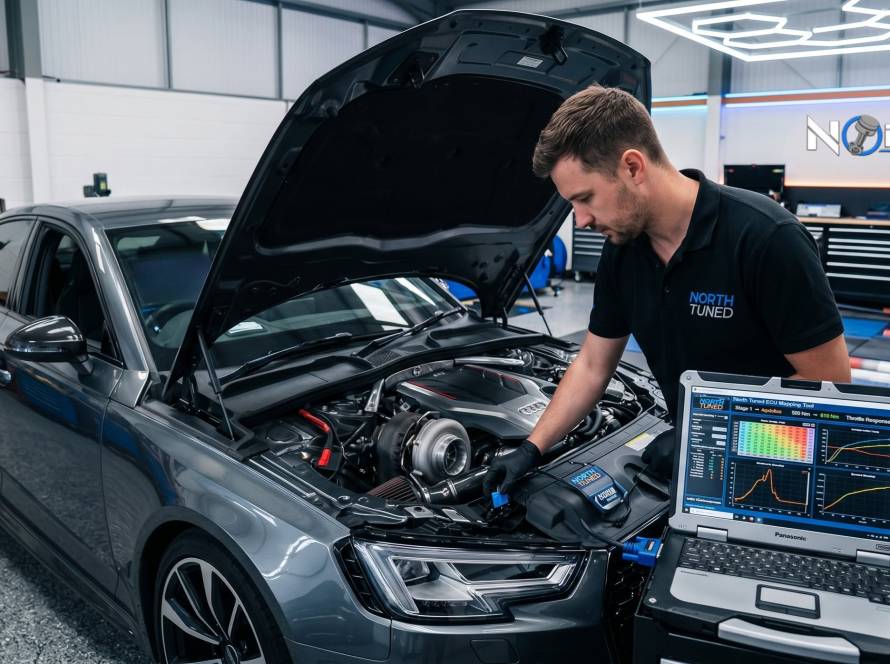

The primary function of a standalone electronic ignition system is to ignite the air-fuel mixture in the combustion chamber at the most optimal moment, providing the necessary ignition advance for peak engine performance. At North Tuned, we prioritize millisecond precision in ignition timing to ensure a superior high-performance driving experience.

Operating Principle
In this system, an independent ignition coil is utilized for each cylinder. These coils integrate the igniter unit, primary, and secondary windings, connecting directly to the spark plug. Unlike traditional systems, there are no spark plug wires; the coils are powered by a 12V supply and controlled via signal currents directly from the ECU.
As we emphasize in North Tuned software optimization processes, the Engine Control Unit (ECU) processes real-time data from crankshaft and camshaft sensors. By controlling the primary circuit of each cylinder’s coil, it generates high voltage at the exact required moment to trigger flawless combustion.
Key Sensors and Their Roles
The ECU manages the ignition map based on data from several critical sensors:
Crankshaft & TDC Sensor: Determines engine RPM and piston position.
Camshaft (Phase) Sensor: Verifies the timing of the cylinders.
Knock Sensor: Monitors pre-ignition to ensure engine safety.
MAP/MAF Sensor: Measures intake manifold pressure and air mass flow.
Temperature Sensors: Optimizes advance based on coolant and intake air temperatures.
Advantages of the System with North Tuned
High Voltage Power: Produces up to 40,000 Volts for a stronger spark and complete combustion.
Precise Advance Management: Electronic control delivers maximum performance and optimized fuel efficiency.
Mechanical Reliability: No moving or friction-based parts, leading to lower failure rates and zero maintenance.
Wide Spark Plug Gap: A gap of 0.8 mm – 1.1 mm allows for a larger flame kernel and significant power gains.

If you want to feel the true power of your engine, the ignition must be flawless. This is where the spark plug comes into play. But what exactly does this small yet mighty component do?
How Does a Spark Plug Work?
The primary role of a spark plug is to ignite the air-fuel mixture in the combustion chamber within milliseconds. It takes a massive voltage of 20,000 – 30,000 volts from the ignition coil and forces it across a gap, creating an electric arc (spark). This spark triggers the explosion that powers your vehicle.
Which Vehicles Use Spark Plugs?
Spark plugs are essential for gasoline, LPG, and hybrid engines. However, keep in mind: Diesel engines do not have ignition spark plugs. Diesel engines operate by compressing air to extreme pressures to cause spontaneous combustion.
Hot vs. Cold Spark Plugs: What’s the Difference?
Choosing the right plug based on your engine’s character is vital:
Cold Spark Plug: Has a shorter insulator nose and dissipates heat quickly. It is preferred for high-performance and tuned engines.
Hot Spark Plug: Has a longer insulator nose and retains more heat. It’s ideal for daily drivers and lower RPM engines.
North Tuned Insight: Does Changing Spark Plugs Affect Fuel Efficiency?
Absolutely! A worn-out spark plug or an incorrect gap causes inefficient combustion. This leads to higher fuel consumption and robs your engine of its performance. The right spark plug ensures:
Lower fuel consumption,
Sharper throttle response,
Smoother idling.
Pro Tip: The spark plug gap widens over time due to wear. In modern electronic ignition systems, this gap is typically between 0.8mm – 1.1mm. Don’t skip your periodic checks to maintain peak performance!