
For performance enthusiasts, the sound and speed of a turbo are indispensable. However, managing and protecting that power is just as crucial as generating it. At North Tuned, we are diving deep into the Dump Valve (Blow-Off Valve) system, covering everything from technical mechanics to its vital role in high-performance tuning.
What is a Dump Valve and Why is it Essential?
A turbocharger works by using exhaust gases to spin a compressor wheel, forcing high-pressure air into the intake manifold. As long as you are on the throttle, this cycle works perfectly. However, when you lift your foot off the gas to shift gears or decelerate, the throttle body closes instantly.
This creates a major physical problem: due to inertia, the turbo continues to spin at thousands of RPMs and keeps pushing air. With the throttle closed, this high-pressure air hits a “wall,” bounces back, and travels toward the spinning turbo blades. This phenomenon, known as compressor surge, applies massive counter-force to the turbine, trying to stop it or spin it backward. A Dump Valve is the safety component designed to vent this trapped air, allowing the turbo to spin freely.
Technical Mechanics: How It Operates at North Tuned Standards
The operation of a dump valve is a masterpiece of pressure dynamics:
The Vacuum Effect: When the throttle closes, a vacuum is created in the intake manifold.
Actuation: This vacuum pulls the internal piston or diaphragm of the dump valve open.
Pressure Release: Once open, the high-pressure air trapped between the turbo and the throttle is vented out—either to the atmosphere (creating the signature “pssh” sound) or recirculated back into the intake.
Maintaining Momentum: Because the backpressure is removed, the turbo doesn’t lose its speed. It keeps spinning freely.
Why Should You Install a High-Quality Dump Valve?
Eliminating Turbo Lag: Since the turbocharger maintains its RPM during gear shifts, you get nearly instantaneous boost response the moment you step back on the accelerator.
Protecting Your Investment: High-performance turbos are expensive. A dump valve protects the internal shafts, bearings, and compressor wheels from the violent “shocks” of air surges, significantly extending the turbo’s lifespan.
Optimized Thermal Management: Trapped, compressed air heats up rapidly. By venting this hot air and allowing the intercooler to process fresh, cool air, the engine benefits from a denser oxygen mixture and better combustion.
At the heart of every engine lies the master of synchronization: the Camshaft. At North Tuned, we understand that efficiency and pure power are hidden within the precise calibration of this vital component.
What is a Camshaft and How Does It Work?
The camshaft is a critical auxiliary shaft that receives its motion from the crankshaft to manage engine valves. In a standard four-stroke engine, while the crankshaft completes two full rotations (720°), the camshaft completes one (360°).
Its primary duty is to dictate exactly when the intake and exhaust valves open and how long they remain open with millimetric precision. Usually manufactured from high-quality carbon steel through casting or forging, the camshaft features journals, drive gears, and the “cams” that physically actuate the valves.
Power Transmission and Risk Factors
The method of driving the camshaft varies by engine architecture:
Timing Belt/Chain: Used in inline engines where the distance between shafts is significant. At North Tuned, we warn that a snapped or slipped timing belt causes valves to collide with pistons, leading to catastrophic engine failure.
Gear-to-Gear: Common in some V-type configurations where the shafts are close, offering the most durable and efficient transfer.
Signs of Wear and Performance Loss
Even slight wear on the cam lobes results in reduced valve lift or incorrect timing. This restricts the engine’s “breathing,” leading to power loss, poor combustion, and increased fuel consumption.
The Key to Performance: High-Duration (Performance) Camshafts
For those seeking to unlock the true potential of their engine, the first stop is the Performance Camshaft. With North Tuned solutions, we bypass the restrictive profiles of OEM shafts to redefine your engine’s character.
How Does It Generate Power?
High-performance camshafts increase the “duration” (time open) and “lift” (depth of opening) of the valves. Allowing more air-fuel mixture into the combustion chamber per cycle results in a more powerful explosion, leading to power gains of up to 35%.
Technical Terminology & North Tuned Analysis
LIFT: Indicates how far the camshaft pushes the valve open. Higher lift means a larger “curtain area” for airflow.
DURATION: The measurement of how long the valve stays off its seat, measured in degrees of crankshaft rotation.
OVERLAP: The critical window where both intake and exhaust valves are open simultaneously. This scavenges exhaust gases and pulls in fresh charge at high RPMs.
POWER BAND: The RPM range where the camshaft profile is most efficient. At North Tuned, we optimize this band based on your needs, whether for the track or the street.
Vital Note: A performance camshaft is not a standalone miracle. To achieve maximum reliability and output, this modification should be supported by reinforced valve springs, adjustable cam gears, and most importantly, a custom North Tuned ECU Remap.
The performance of the car you’ve driven fondly for years might start to feel inadequate over time; you may want to recapture that day-one excitement and push the limits a little further. We will provide you with practical information in this article about essential engine modifications that will boost your vehicle’s power and take your driving dynamics to a whole new level.
Sports Air Filter Upgrade

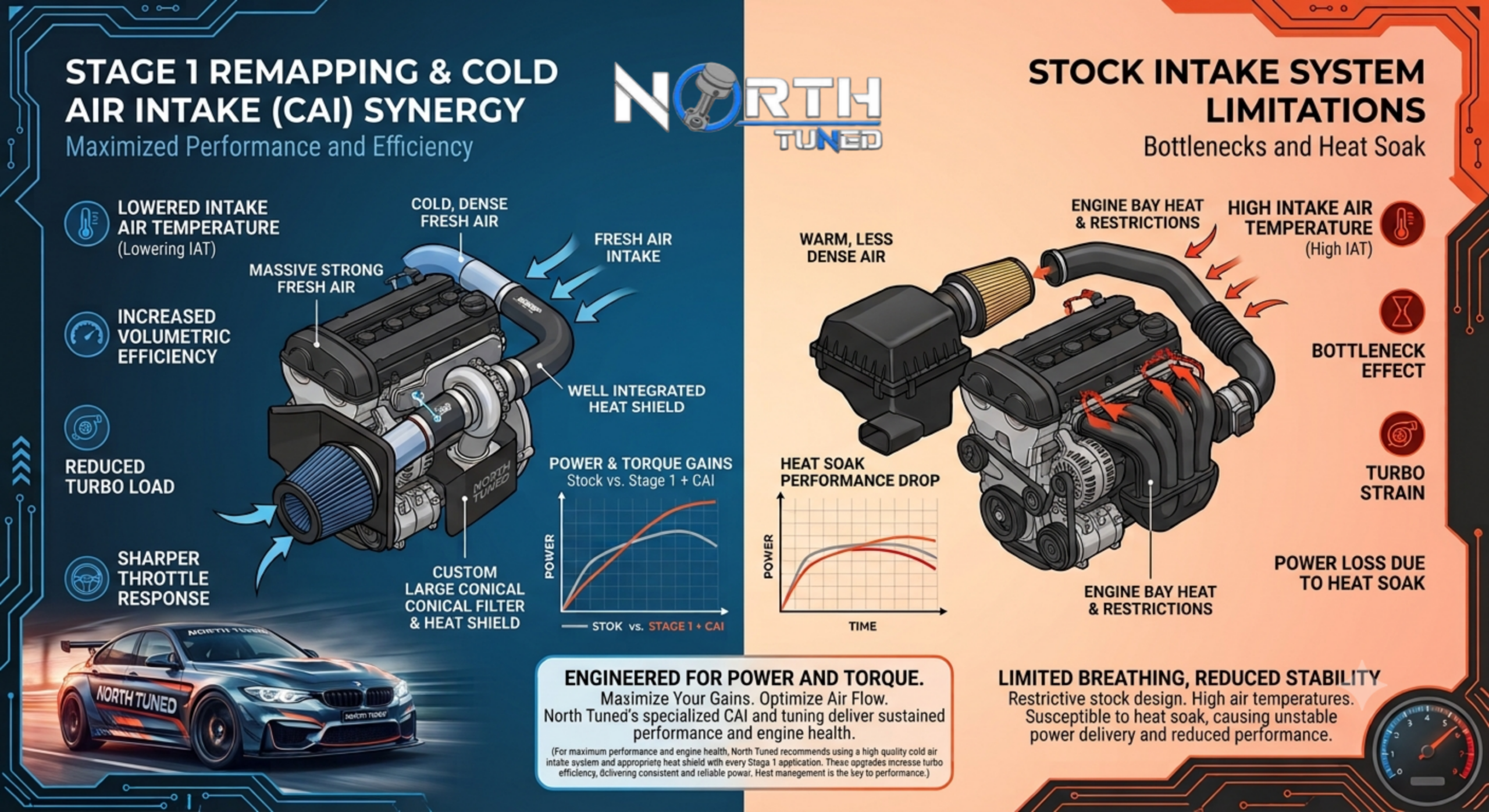
Car manufacturers often use restrictive air intake systems to keep mass-production costs down and comply with standard noise regulations. Aftermarket sports air filters, commonly known as Cold Air Intake Kits, eliminate this factory-induced shortness of breath. These performance-oriented kits maximize the air mass entering the engine per unit of time by channeling much cooler, denser oxygen directly into the combustion chambers. More oxygen means a more powerful combustion. As a result, your vehicle not only gains a noticeable performance boost with improved throttle response but also unleashes that deep, sporty intake growl we all love when you step on the gas.
Sports Exhaust Upgrades

Whether you own a naturally aspirated or a forced induction (turbocharged or supercharged) engine, this upgrade is a must-have for car enthusiasts looking to personalize their vehicle and push its performance limits. It stands out as one of the most popular modification steps taken to help the exhaust gases flow more freely, boost horsepower, and achieve that highly desired, deep, and aggressive sound.
Chip Tuning (ECU Remapping)
Thanks to giant leaps in automotive technology, modern vehicles roll out of the factory equipped with highly durable, efficient, and high-potential engines. This robust and tolerant foundation makes today’s cars perfect canvases for performance upgrades. Chip Tuning unlocks your vehicle’s hidden true capacity by professionally optimizing the original parameters and maps within the Engine Control Unit (ECU). Through this fine-tuning of the engine’s brain, it is possible to achieve significant increases in horsepower and torque without having to replace a single mechanical part. For a deeper dive into the technical details and specific gains for your car, feel free to check out our comprehensive Chip Tuning guide.
Turbocharger Upgrades

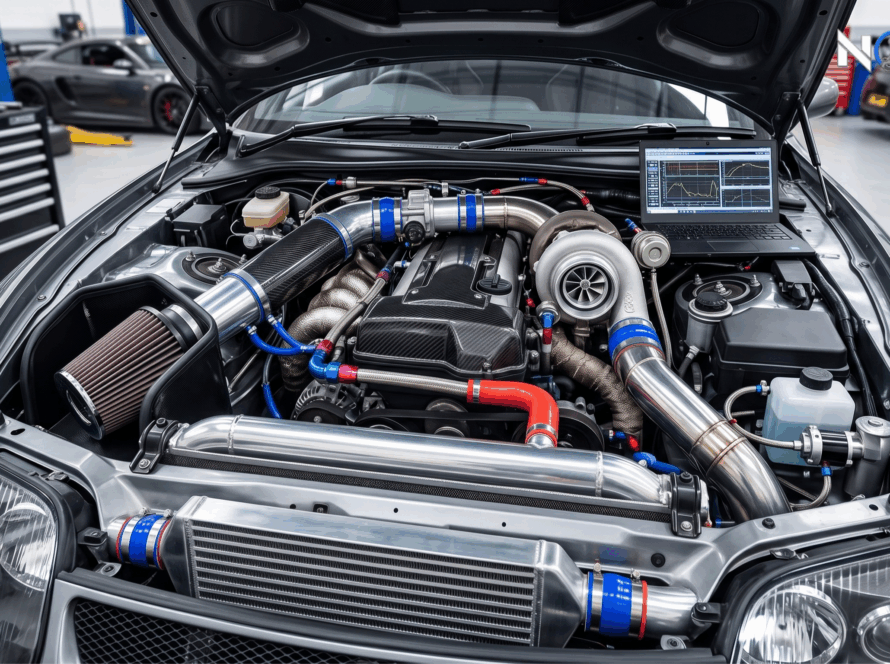
Strict modern emission standards and high taxation policies have driven automakers to extract maximum power from smaller displacement engines. The undisputed hero of this “downsizing” trend is the turbocharger. A turbo’s primary job is to force pressurized air into the combustion chambers, cramming a significantly higher volume of oxygen into the cylinders. The rule of thumb is simple: A larger turbo equates to massive power potential. However, blindly choosing an oversized turbo without considering the vehicle’s dynamics leads to “uncontrolled power” and frustrating turbo lag at lower RPMs.
To safely harness and regulate this increased boost pressure without stressing the engine, upgrades to the wastegate system are absolutely essential. Furthermore, when upgrading a turbo, the intercooler capacity must be re-evaluated and upsized if necessary to combat the extra heat generated by the higher boost levels. The intercooler’s job is to cool down the compressed air, thereby increasing its density; cooler, denser air results in a more violent, efficient combustion and yields extra horsepower. But there is a delicate balance to strike here: Installing an unnecessarily large intercooler will cause pressure drops in the charge piping, severely dulling your throttle response and ruining the sporty driving experience.
Methanol Injection (Water-Meth) Systems

Commonly utilized in high-performance builds, this system safely pushes an engine’s performance boundaries. Methyl alcohol, one of the most effective alcohols for internal combustion engines, is integrated into the system by being sprayed directly into the air intake tract.
Key Advantages:
Thermal Management: It rapidly lowers combustion chamber temperatures, preventing engine overheating.
High Octane Support: Due to its high octane rating, it allows tuners to aggressively adjust ignition timing during the remapping process.
Combustion Quality: It maximizes fuel burn quality, resulting in a cleaner and more efficient explosion.
Performance Gains: The synergy of these effects delivers significant increases in both horsepower and torque.
Potential Disadvantages:
High Consumption Rate: Since it evaporates much more easily than gasoline, the consumption rate is notably higher.
Corrosion Risk: By its chemical nature, prolonged use can lead to wear and corrosion within fuel system components.
Cold Start Issues: When used as a primary fuel source, it fails to atomize correctly in cold weather, making the engine difficult to start.