
Performance tuning is a craft that balances art and engineering. At North Tuned, we believe that true performance isn’t just about the peak numbers on a dyno sheet—it’s about how long that engine can sustain those numbers.
1. Tuning Without Pre-Inspection
Tuning an engine with existing mechanical issues is like building a skyscraper on a swamp.
The Mistake: Installing a performance map on a car with old spark plugs, a tired fuel pump, or vacuum leaks.
The Outcome: The added stress of increased boost or timing will inevitably cause the weakest link to fail.
North Tuned Pro-Tip: Always perform a diagnostic scan and check for boost leaks before modifying the ECU.
2. Neglecting Thermal Management
Power is a byproduct of combustion, and combustion generates heat. If you increase the energy, you must increase the cooling.
The Mistake: Pushing high boost levels on a stock intercooler.
The Outcome: High Intake Air Temperatures (IATs) lead to ignition timing pull and potential engine knock (detonation).
Solution: For Stage 2+ builds, upgrading the cooling system is not optional; it is a necessity for engine longevity.
3. Chasing Boost Instead of Efficiency
A common misconception is that “More Boost = More Power.”
The Mistake: Overworking a small turbocharger beyond its efficiency map.
The Technical Side: When a turbo is pushed too hard, it simply blows hot, turbulent air. This increases backpressure and heat without adding significant oxygen.
Solution: Focus on optimizing the Air-Fuel Ratio (AFR) and ignition timing. Sometimes, less boost with better timing yields more reliable power.
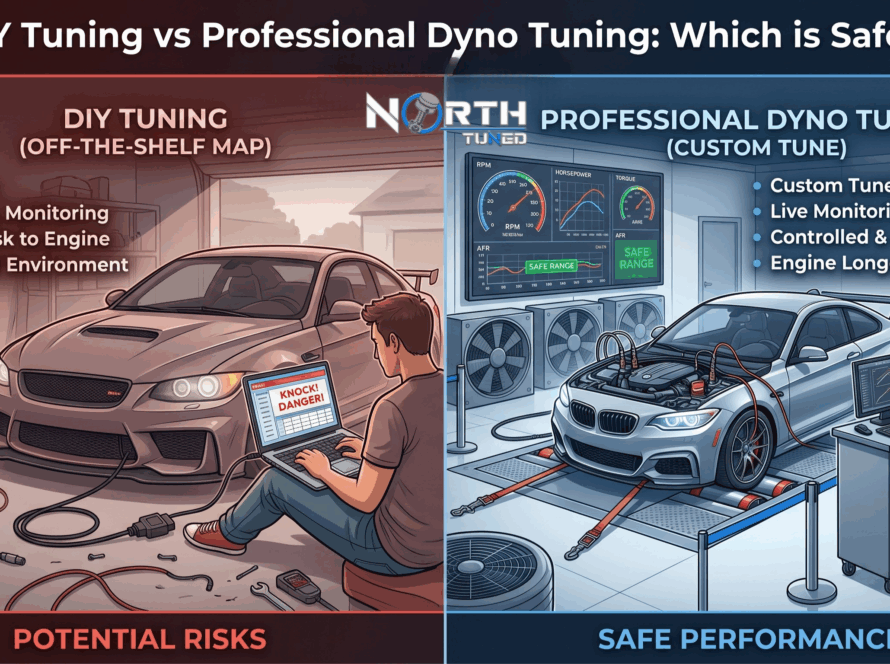
4. The Danger of “Generic” Off-the-Shelf Tunes
Every car lives a different life. A car in a high-altitude region needs different parameters than one at sea level.
The Mistake: Using cheap, non-adjustable files that don’t account for fuel quality or hardware health.
The Outcome: Poor drivability and a high risk of catastrophic failure under load.
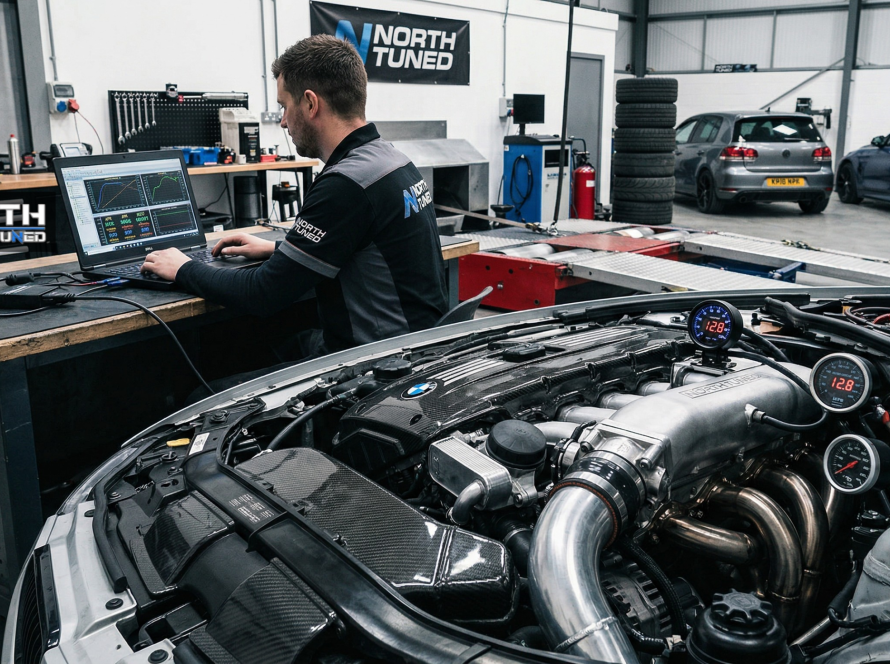
The North Tuned Approach: We prioritize Data Logging. By analyzing how your specific engine reacts in real-time, we fine-tune the software to ensure maximum safety margins.
5. Forgetting the Drivetrain
An engine is only as good as the wheels it turns.
The Mistake: Increasing torque significantly without recalibrating the Transmission Control Unit (TCU).
The Outcome: Slipped clutches in DSG/ZF gearboxes or snapped axles.
Solution: Match your ECU tune with a TCU tune to increase clutch clamping pressure and optimize shift points.
For performance enthusiasts, the sound and speed of a turbo are indispensable. However, managing and protecting that power is just as crucial as generating it. At North Tuned, we are diving deep into the Dump Valve (Blow-Off Valve) system, covering everything from technical mechanics to its vital role in high-performance tuning.
What is a Dump Valve and Why is it Essential?
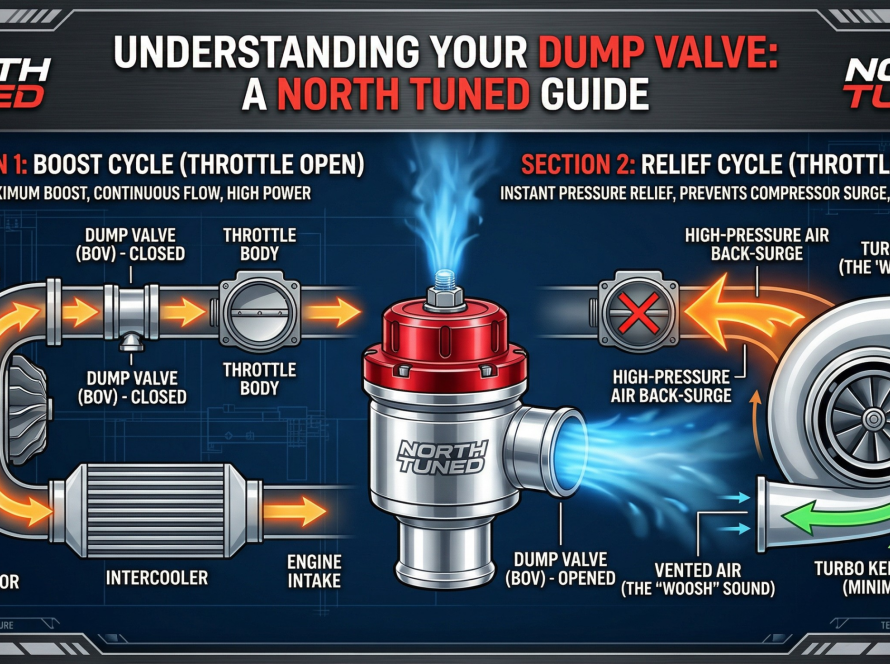
A turbocharger works by using exhaust gases to spin a compressor wheel, forcing high-pressure air into the intake manifold. As long as you are on the throttle, this cycle works perfectly. However, when you lift your foot off the gas to shift gears or decelerate, the throttle body closes instantly.
This creates a major physical problem: due to inertia, the turbo continues to spin at thousands of RPMs and keeps pushing air. With the throttle closed, this high-pressure air hits a “wall,” bounces back, and travels toward the spinning turbo blades. This phenomenon, known as compressor surge, applies massive counter-force to the turbine, trying to stop it or spin it backward. A Dump Valve is the safety component designed to vent this trapped air, allowing the turbo to spin freely.
Technical Mechanics: How It Operates at North Tuned Standards
The operation of a dump valve is a masterpiece of pressure dynamics:
The Vacuum Effect: When the throttle closes, a vacuum is created in the intake manifold.
Actuation: This vacuum pulls the internal piston or diaphragm of the dump valve open.
Pressure Release: Once open, the high-pressure air trapped between the turbo and the throttle is vented out—either to the atmosphere (creating the signature “pssh” sound) or recirculated back into the intake.
Maintaining Momentum: Because the backpressure is removed, the turbo doesn’t lose its speed. It keeps spinning freely.
Why Should You Install a High-Quality Dump Valve?
Eliminating Turbo Lag: Since the turbocharger maintains its RPM during gear shifts, you get nearly instantaneous boost response the moment you step back on the accelerator.
Protecting Your Investment: High-performance turbos are expensive. A dump valve protects the internal shafts, bearings, and compressor wheels from the violent “shocks” of air surges, significantly extending the turbo’s lifespan.
Optimized Thermal Management: Trapped, compressed air heats up rapidly. By venting this hot air and allowing the intercooler to process fresh, cool air, the engine benefits from a denser oxygen mixture and better combustion.
Getting a professional tune (remapping) is the most exciting way to unlock your vehicle’s hidden potential. However, simply saying “it feels faster” isn’t enough. To truly understand the gains, you need empirical data. Here is how we at North Tuned recommend verifying your performance increase:
1. Dyno (Dynamometer) Testing
This is the gold standard. A dyno measures the horsepower (HP) and torque (Nm) delivered to the wheels.
Before/After: Performing a run right before and right after the tune provides a clear picture of the changes in the power band.
Health Check: It allows technicians to monitor Air-Fuel Ratios (AFR) to ensure the tune is running safely under load.
2. GPS-Based Performance Meters (Dragy or VBOX)
Devices like Dragy are the best way to turn feelings into facts. These use high-frequency GPS (10Hz or higher) to track acceleration with extreme precision.
0-100 km/h & 100-200 km/h: These are the industry standards for measuring real-world acceleration.
Slope Correction: These devices account for road incline, giving you a “valid” and honest result regardless of the terrain.
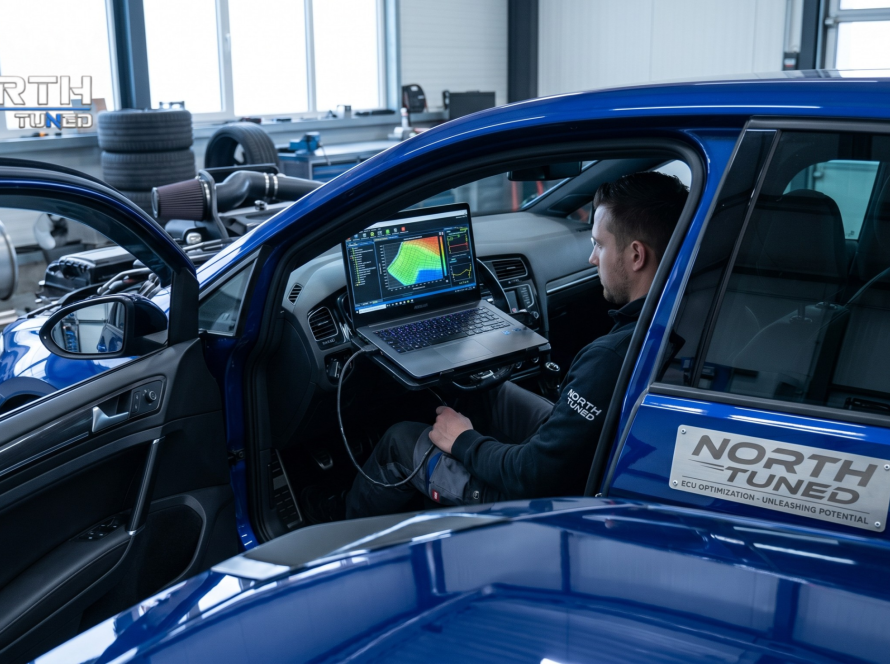
3. OBDII Data Logging
Speed is only one part of the story; how the engine achieves that speed matters for longevity. Use an OBDII scanner to log:
Boost Levels: Is the turbo hitting the requested targets?
Ignition Timing: Is the engine running efficiently without “pulling” timing due to knock?
Intake Air Temperatures (IAT): Is your cooling system handling the extra power effectively?
4. In-Gear Acceleration (Flexibility)
This is the most relevant metric for daily driving. For example, measure the time it takes to go from 80 km/h to 120 km/h in 4th gear. The reduction in this timeframe is the best indicator of your car’s increased “punch” and torque delivery.