
Tag: performance upgrades

Performance Mods That Pair Perfectly With ECU Tuning

Performance Mods That Pair Perfectly With ECU Tuning

When it comes to unlocking a vehicle’s true potential, ECU Tuning is often the first step. However, at North Tuned, we believe that software is like a conductor; for it to produce the best symphony, the instruments beneath it must be up to the task.

Here are the top performance modifications that complement your tune and help your engine “breathe” better.

1. High-Flow Air Filters & Cold Air Intakes
A tuned engine demands more fuel, which in turn requires more oxygen. Stock paper filters often create a bottleneck.

Benefit: Increases airflow volume and sharpens throttle response.

2. Downpipe and Exhaust Upgrades
In turbocharged engines, getting exhaust gases out quickly is crucial. Standard catalytic converters can create backpressure and trap heat during high-performance driving.

Benefit: Lowers Exhaust Gas Temperatures (EGT) and allows the turbo to spool up faster.

3. Upgraded Intercooler
More boost equals more heat. When intake air gets too hot, it loses density, leading to “heat soak” and power loss.

Benefit: Keeps intake temperatures low, ensuring consistent power delivery even under hard driving.

4. Ignition System (Spark Plugs & Coils)
Under increased boost and cylinder pressure, stock spark plugs might struggle to ignite the mixture, leading to misfires.

Benefit: A stronger spark ensures complete combustion and a smoother power band.

North Tuned Insight: To get the most out of these hardware changes, your ECU map should be calibrated to recognize the improved airflow and cooling. Efficiency and longevity go hand in hand.

read more
What is an Oil Catch Tank? Why It's Essential for Performance Cars

What is an Oil Catch Tank? Why It’s Essential for Performance Cars

In this article, we will examine the purpose and working principle of the Oil Catch Tank, one of the critical components of forced induction and modified vehicles, from the perspective of North Tuned.

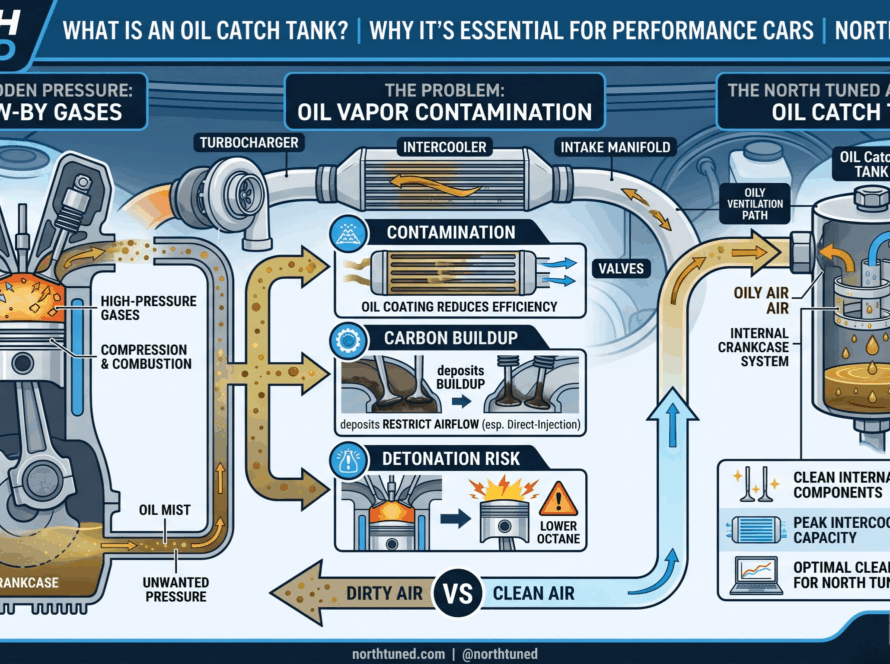
The Hidden Pressure: Blow-By Gases
In a four-stroke engine, as the piston moves from the top to the bottom, the intake valves open to draw in the air-fuel mixture. When the piston moves back up, all valves close to compress this mixture.

During this compression and combustion phase, a portion of the high-pressure gases leaks past the piston rings into the crankcase. This is known as “Blow-by.” To manage this unwanted pressure without releasing harmful gases into the atmosphere, manufacturers route this air back into the intake system through a ventilation channel.

What is an Oil Catch Tank? Why It's Essential for Performance Cars
What is an Oil Catch Tank? Why It’s Essential for Performance Cars

The Problem with Oil Vapor
The air evacuated from the crankcase is not just air; it contains a significant amount of oil vapor from the engine oil being tossed around at high temperatures. In factory setups, this oily mist is sent directly back into the turbocharger, intercooler pipes, and intake manifold.

Over time, this leads to:
Contamination: Oil coating the inside of the intercooler significantly reduces its cooling efficiency.

Carbon Buildup: In direct-injection engines, oil accumulates on the intake valves, hardening into carbon deposits that restrict airflow.

Detonation Risk: Oil mist entering the combustion chamber lowers the effective octane rating, which can lead to engine knock.

What is an Oil Catch Tank? Why It's Essential for Performance Cars
What is an Oil Catch Tank? Why It’s Essential for Performance Cars

The North Tuned Advantage: Why Use a Catch Tank?
An Oil Catch Tank acts as a high-efficiency filter. Instead of the oily crankcase air going straight to the intake, it first passes through this tank. The internal baffling system causes the oil droplets to condense and settle at the bottom of the reservoir.

The result: Only purified air is returned to the engine. This keeps your internal components clean, ensures your intercooler works at peak capacity, and allows your North Tuned performance map to operate under optimal, clean conditions.

What is an Oil Catch Tank? Why It's Essential for Performance Cars
What is an Oil Catch Tank? Why It’s Essential for Performance Cars
read more
What Are Stage 1, 2, and 3 Tunes?

What Are Stage 1, 2, and 3 Tunes?

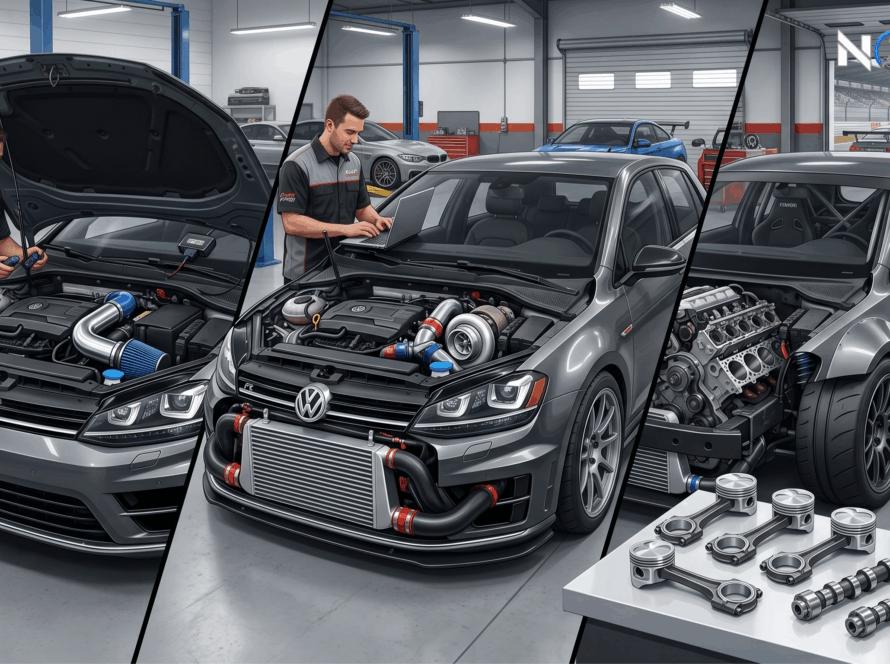
In the car modification world, the concept of a tuning “Stage” is something we hear frequently, yet even experienced car enthusiasts sometimes struggle to define their exact boundaries. Let’s summarize what kind of modifications are done at each level to improve your car’s performance, using a clear and straightforward approach:

Stage 1: The Beginner and Foundation Phase
This is the most practical modification step, achieved without altering the car’s original mechanical structure, opening the engine block, or engaging in heavy fabrication. It mostly utilizes “plug-and-play” parts. While being the most cost-effective stage, it allows the car to breathe better and builds a solid foundation for future, larger power upgrades.

Key Upgrades Include:

Cold Air Intake kits

Sports exhaust systems and Downpipes (catalytic converter removal/decats)

Colder performance spark plugs and ignition coils

Blow Off / Dump Valves for turbocharged cars

Mild performance software that doesn’t stress the engine internals (Soft Chip Tuning / Remap)

Ignition timing optimization

Stage 2: The Intermediate Level and Mechanical Enhancement
This is the stage you move to when the power gained from Stage 1 simply isn’t enough, marking the beginning of significant hardware changes to the engine. Although it doesn’t require a heavy internal engine rebuild, professional labor and a custom software update are mandatory to ensure the new, larger parts work together in harmony.

Key Upgrades Include:

Enlarging the existing turbo (Hybrid turbo upgrades)

Installing a larger capacity Intercooler to better cool the compressed air

Fuel injector and high-pressure fuel pump upgrades to supply more fuel

Street-profile upgraded camshafts

Upgraded Stage 2 clutch to transmit the increased power to the transmission without slipping

Custom-made, large-volume intake or exhaust manifolds

Supercharger or larger turbo conversions

Stage 3: The Advanced Level and Track-Focused Phase
This is the most aggressive stage where the car almost completely breaks away from comfortable, daily street use and transforms into a purebred race car. You literally dive into the heart of the engine (opening the engine block), and the internal moving parts are replaced with heavy-duty materials designed to withstand extreme pressure.

Key Upgrades Include:

High-pressure resistant Forged pistons and connecting rods (Forged internals)

Upgraded engine valves, heavy-duty valve springs, and titanium retainers

Race-spec (highly aggressive) camshafts that noticeably alter the engine’s idle

Heavy-duty Stage 3 bronze/puck clutch kits

Drivetrain upgrades (heavy-duty driveshafts, axles) to prevent snapping under load

Massive Big Brake Kits (BBK) to tame the dangerous speeds the car can now reach

A completely Custom Engine Tune (Remap) built from scratch specifically for this extensive hardware list

A Quick Summary:
A Stage 3 setup is absolutely not recommended for a daily driver that you use to commute to work or go grocery shopping. Vehicles pushed to their absolute mechanical limits like this require a much more expensive, frequent, and highly meticulous maintenance routine compared to standard cars.

read more