
Tag: performance

Best Cars for Stage 3 Tuning in Australia: A Complete Guide

Best Cars for Stage 3 Tuning in Australia: A Complete Guide

If you are looking to build a true power monster on Australian streets or tracks, “Stage 1” and “Stage 2” are merely the appetizers. Stage 3 is where the rules of the game truly change. This level involves turbo upgrades, fuel system overhauls, and internal engine reinforcements, turning a standard daily driver into a “supercar killer.”

At North Tuned, we have selected the best platforms for Stage 3 tuning, keeping in mind Australia’s unique climate conditions and fuel quality.

What is Stage 3?
Stage 3 is the phase where we go beyond just software (ECU remapping) and push the physical limits of the hardware. It typically includes:

Upgraded Hybrid or Big Turbo kits.

High-pressure fuel pumps (HPFP) and larger injectors.

Advanced intercoolers and cooling systems.

Transmission (TCU) tuning and clutch upgrades.

Top Stage 3 Candidates in the Australian Market
1. Volkswagen Golf R (Mk7 / Mk7.5 / Mk8)
VAG group vehicles are the gold standard for Stage 3 tuning. The EA888 engine block can easily reach 500+ hp with just a turbo swap and a precision North Tuned map.

Why? Massive aftermarket support and the 4Motion AWD system that puts the power down effectively.

2. BMW M3/M4 (S55 & S58 Engines)
Bavarian engineering takes on a whole new identity at Stage 3. The new S58 engine, in particular, is so robust that pushing past the 700hp mark with “bolt-on” turbo kits is becoming a common sight at Australian drag strips.

3. Nissan Patrol (Y61 & Y62) – Australia’s Heavyweight
Australia is synonymous with off-roading. Adding a supercharger or a twin-turbo setup to the Y62’s V8 transforms this massive SUV into a desert-conquering rocket.

4. Audi RS3 (DAZA / DNWA)
The legendary 5-cylinder engine is a masterpiece. A Stage 3 RS3 is perhaps the most efficient way to achieve 0-100 km/h times in the 2-second range. With a TTE or Garrett turbo upgrade, the sound and speed are unmatched.

Why Choose North Tuned?
Stage 3 tuning leaves no room for error. An incorrect air-fuel ratio or excessive boost can lead to catastrophic engine failure. At North Tuned, we specialize in Custom Dyno Tuning tailored to your specific hardware, ensuring that your quest for more power doesn’t compromise reliability.

read more
The Importance of Engine Oil: North Tuned Guide

The Importance of Engine Oil: North Tuned Guide

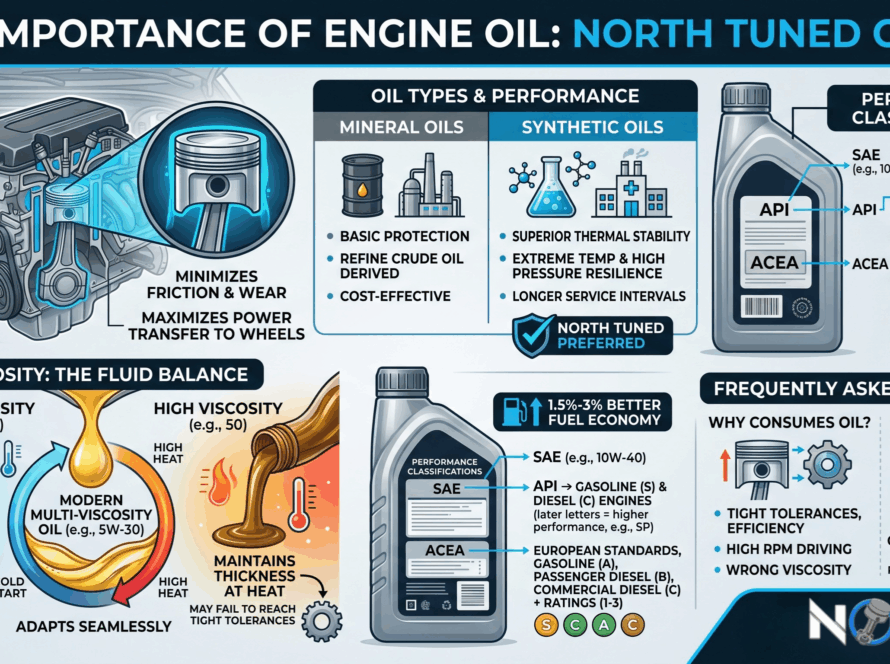
Engine oil is more than just a lubricant; it is a protective shield within your vehicle’s engine. By forming a microscopic film over moving components, it minimizes friction and wear. At North Tuned, we emphasize that selecting the premium oil reduces friction-induced power loss, allowing more effective power transfer to the wheels.

Oil Types and Performance Variations
Mineral Oils: Derived from refined crude oil. While cost-effective, they typically provide only basic protection for modern, high-performance engines.

Synthetic Oils: Engineered in laboratory environments using advanced chemical processes. Within North Tuned performance standards, synthetic oils are preferred for their superior thermal stability and resilience under extreme temperatures or high pressure. They offer longer service intervals and maximum engine longevity.

Viscosity: The Fluid Balance
Viscosity measures an oil’s resistance to flow.

Low Viscosity (e.g., 0W): Flows quickly in cold temperatures, ensuring protection during cold starts.

High Viscosity (e.g., 50): Maintains thickness at high heat but may fail to reach tight engine tolerances if too thick.

North Tuned Note: Modern multi-viscosity oils (like 5W-30) adapt seamlessly to changing climates. These oils provide 1.5% to 3% better fuel economy compared to single-grade oils.

Performance Classifications (SAE, API, ACEA)
The codes on the back of the bottle are vital for your engine’s health:

SAE: Defines the flow grade (e.g., 10W-40).

API: Indicates suitability for Gasoline (S) or Diesel (C) engines. Later letters in the alphabet (e.g., SP) signify higher performance levels.

ACEA: European standards categorizing oils for Gasoline (A), Passenger Diesel (B), and Commercial Diesel (C), followed by performance ratings (1-3).

Frequently Asked Questions
Why does my engine consume oil? Modern engines use tight metal-to-metal tolerances for efficiency, which can lead to slight consumption. Excessive loss is often due to high RPM driving, incorrect oil viscosity, or mechanical wear.

Can I mix different brands? In emergencies, you can top up with the same viscosity and API class. However, mixing mineral and synthetic oils compromises the chemical structure. North Tuned recommends a full oil change as soon as possible after mixing.

read more