
Tag: Stage 3 tune
What Are Stage 1, 2, and 3 Tunes?
In the car modification world, the concept of a tuning “Stage” is something we hear frequently, yet even experienced car enthusiasts sometimes struggle to define their exact boundaries. Let’s summarize what kind of modifications are done at each level to improve your car’s performance, using a clear and straightforward approach:
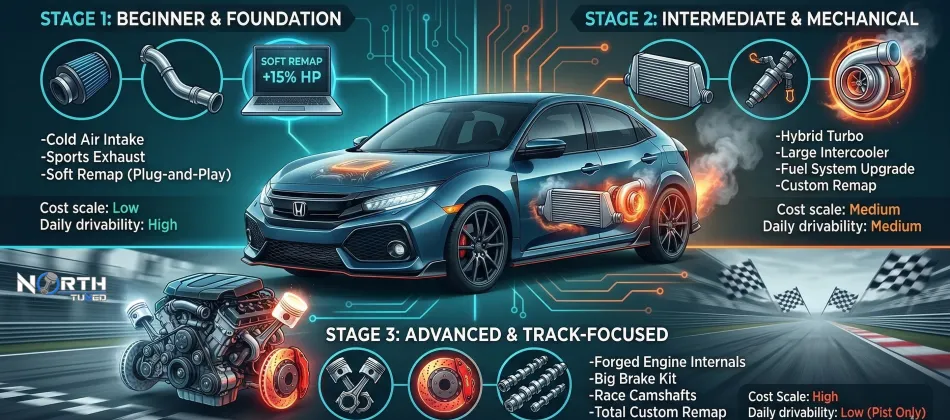
Stage 1: The Beginner and Foundation Phase
This is the most practical modification step, achieved without altering the car’s original mechanical structure, opening the engine block, or engaging in heavy fabrication. It mostly utilizes “plug-and-play” parts. While being the most cost-effective stage, it allows the car to breathe better and builds a solid foundation for future, larger power upgrades.
Key Upgrades Include:
Cold Air Intake kits
Sports exhaust systems and Downpipes (catalytic converter removal/decats)
Colder performance spark plugs and ignition coils
Blow Off / Dump Valves for turbocharged cars
Mild performance software that doesn’t stress the engine internals (Soft Chip Tuning / Remap)
Ignition timing optimization
Stage 2: The Intermediate Level and Mechanical Enhancement
This is the stage you move to when the power gained from Stage 1 simply isn’t enough, marking the beginning of significant hardware changes to the engine. Although it doesn’t require a heavy internal engine rebuild, professional labor and a custom software update are mandatory to ensure the new, larger parts work together in harmony.
Key Upgrades Include:
Enlarging the existing turbo (Hybrid turbo upgrades)
Installing a larger capacity Intercooler to better cool the compressed air
Fuel injector and high-pressure fuel pump upgrades to supply more fuel
Street-profile upgraded camshafts
Upgraded Stage 2 clutch to transmit the increased power to the transmission without slipping
Custom-made, large-volume intake or exhaust manifolds
Supercharger or larger turbo conversions
Stage 3: The Advanced Level and Track-Focused Phase
This is the most aggressive stage where the car almost completely breaks away from comfortable, daily street use and transforms into a purebred race car. You literally dive into the heart of the engine (opening the engine block), and the internal moving parts are replaced with heavy-duty materials designed to withstand extreme pressure.
Key Upgrades Include:
High-pressure resistant Forged pistons and connecting rods (Forged internals)
Upgraded engine valves, heavy-duty valve springs, and titanium retainers
Race-spec (highly aggressive) camshafts that noticeably alter the engine’s idle
Heavy-duty Stage 3 bronze/puck clutch kits
Drivetrain upgrades (heavy-duty driveshafts, axles) to prevent snapping under load
Massive Big Brake Kits (BBK) to tame the dangerous speeds the car can now reach
A completely Custom Engine Tune (Remap) built from scratch specifically for this extensive hardware list
A Quick Summary:
A Stage 3 setup is absolutely not recommended for a daily driver that you use to commute to work or go grocery shopping. Vehicles pushed to their absolute mechanical limits like this require a much more expensive, frequent, and highly meticulous maintenance routine compared to standard cars.
The Ultimate Guide to Stage 1, 2, and 3 ECU Tuning in Australia
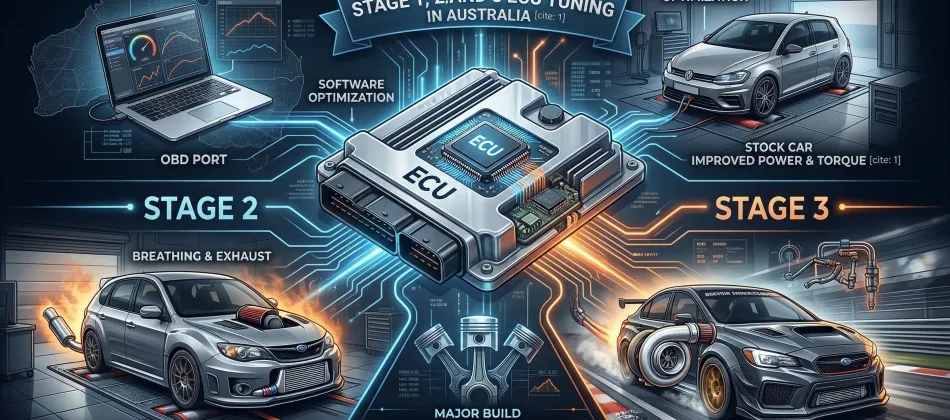
Australia has a massive and incredibly diverse car culture. From touring the rugged Outback in heavy-duty turbo-diesel 4x4s to carving up mountain roads in nimble European hot hatches, Aussie drivers demand a lot from their vehicles. One of the most effective ways to unlock your vehicle’s true potential is through ECU tuning.But as you dive into the aftermarket world, you are bound to encounter a lot of jargon. Tuners constantly talk about “stages,” which can be confusing if you are new to the scene. What exactly does it mean when a shop says your car is ready for a “Stage 2” package?Let’s break down exactly what ECU tuning is and explore everything you need to know about Stage 1, 2, and 3 modifications in the Australian context.What is ECU Tuning?Modern vehicles are essentially computers on wheels. The Engine Control Unit (ECU) is your car’s brain. It constantly monitors and controls crucial engine parameters, including how much fuel is injected, ignition timing, and turbocharger boost pressure.Manufacturers often restrict these settings straight from the factory. They do this to ensure the car can survive on poor-quality fuel in different countries, withstand extreme climates, and comfortably pass stringent global emission standards.ECU tuning, often referred to as “remapping,” involves accessing the software inside the ECU and altering it to optimize these parameters. By safely adjusting the fuel-air mixture, timing, and boost pressure, tuners can unlock the hidden horsepower and torque that the manufacturer deliberately left on the table. In Australia, where we have access to high-quality 98 RON premium unleaded and reliable diesel, remapping is an incredibly effective and safe modification.Stage 1 Tuning: The Software Sweet SpotStage 1 tuning is by far the most common, cost-effective, and accessible modification. It is specifically designed to work perfectly with a completely stock vehicle. There are no mechanical parts to replace; it is a purely digital upgrade.The Process: A professional tuner reads your factory ECU data and writes a new, optimized software file to it.The Benefits: You will experience a noticeable increase in both horsepower and torque across the entire rev range. For modern turbocharged petrol cars, this translates to faster acceleration and sharper, more responsive throttle feel. For turbo-diesel 4x4s like the Toyota Hilux or Ford Ranger, a Stage 1 tune drastically improves towing capacity, eliminates sluggishness, and can even improve highway fuel economy.Hardware Required: None. The factory air intake, exhaust system, and intercooler are perfectly capable of handling the increased output of a Stage 1 tune.Who it is for: The everyday driver who wants a bit more punch for safely overtaking on the highway, or a more capable rig for towing a caravan, all without sacrificing daily reliability.Stage 2 Tuning: Letting the Engine BreatheStage 2 is where software meets hardware. To push the engine further safely, you need to improve its ability to inhale dense, cold air and quickly exhale hot exhaust gases.The Process: A custom ECU remap is paired with specific, bolt-on mechanical modifications.Hardware Required: Typically, a Stage 2 package requires a high-flow cold air intake, an upgraded intercooler (to keep intake temperatures down under higher boost), and a less restrictive exhaust system. For petrol cars, this usually means installing a larger downpipe with a high-flow catalytic converter.The Benefits: This yields a massive step up in power delivery and a much more aggressive sound. The engine revs much more freely, turbo lag is significantly reduced, and the vehicle will pull much harder at higher speeds.Who it is for: The weekend enthusiast who wants serious, aggressive performance, a sportier exhaust note, and is willing to invest in quality hardware upgrades.Stage 3 Tuning: The Big BuildStage 3 is not for the faint of heart. This level of tuning moves entirely away from factory components. You are now replacing major engine parts to chase maximum horsepower.The Process: Extensive mechanical modifications are followed by a highly customized dyno tune. Off-the-shelf software files no longer work; the ECU must be meticulously calibrated specifically to the brand new hardware.Hardware Required: Upgraded, larger turbochargers (or superchargers), high-capacity fuel injectors, upgraded high-pressure fuel pumps, and often forged engine internals (like stronger pistons and connecting rods) to handle the extreme stress. Upgraded clutches or heavy-duty automatic transmission builds are also mandatory so the driveline doesn’t snap under the massive torque.The Benefits: Supercar-level performance. Stage 3 completely transforms a standard street car into a track-ready weapon.Who it is for: Hardcore motorsport enthusiasts, drag racers, and owners with a serious budget who want the absolute fastest version of their vehicle possible.Tuning Stages at a GlanceStageFocusHardware RequiredCost LevelPower GainStage 1Software OptimizationNone (Stock vehicle)LowModerateStage 2Breathing & ExhaustIntake, Intercooler, DownpipeMediumHighStage 3Major Component UpgradeBig Turbo, Injectors, Forged InternalsVery HighExtremeImportant Considerations for Australian DriversModifying your vehicle down under comes with specific legal and financial responsibilities that you must be aware of:Australian Design Rules (ADR): All modifications must comply with ADRs and your specific state-level regulations. Removing emissions equipment, such as Catalytic Converters or Diesel Particulate Filters (DPFs), for a street-driven car is illegal in Australia and carries severe fines. Always ensure your Stage 2 or 3 hardware uses compliant, high-flow emission controls.Insurance Disclosure: You are legally required to inform your auto insurance provider about any performance modifications. Failure to disclose an ECU tune or an aftermarket exhaust can completely void your policy in the event of an accident.Manufacturer Warranty: An ECU tune will almost certainly void your manufacturer’s new-car powertrain warranty. If your engine fails, the dealership will check the ECU flash counter. However, many reputable tuning shops in Australia offer their own driveline warranties for peace of mind.Ultimately, whether you are looking for a slight bump in towing torque or building a track monster, ECU tuning is the most rewarding modification you can make. Always do your research and choose a reputable, experienced tuner who understands the specific needs of your engine and the Australian driving environment.