
Tag: turbo maintenance

The Ultimate Guide to Dump Valves: Performance and Protection

The Ultimate Guide to Dump Valves: Performance and Protection

For performance enthusiasts, the sound and speed of a turbo are indispensable. However, managing and protecting that power is just as crucial as generating it. At North Tuned, we are diving deep into the Dump Valve (Blow-Off Valve) system, covering everything from technical mechanics to its vital role in high-performance tuning.

What is a Dump Valve and Why is it Essential?
A turbocharger works by using exhaust gases to spin a compressor wheel, forcing high-pressure air into the intake manifold. As long as you are on the throttle, this cycle works perfectly. However, when you lift your foot off the gas to shift gears or decelerate, the throttle body closes instantly.

This creates a major physical problem: due to inertia, the turbo continues to spin at thousands of RPMs and keeps pushing air. With the throttle closed, this high-pressure air hits a “wall,” bounces back, and travels toward the spinning turbo blades. This phenomenon, known as compressor surge, applies massive counter-force to the turbine, trying to stop it or spin it backward. A Dump Valve is the safety component designed to vent this trapped air, allowing the turbo to spin freely.

Technical Mechanics: How It Operates at North Tuned Standards
The operation of a dump valve is a masterpiece of pressure dynamics:

The Vacuum Effect: When the throttle closes, a vacuum is created in the intake manifold.

Actuation: This vacuum pulls the internal piston or diaphragm of the dump valve open.

Pressure Release: Once open, the high-pressure air trapped between the turbo and the throttle is vented out—either to the atmosphere (creating the signature “pssh” sound) or recirculated back into the intake.

Maintaining Momentum: Because the backpressure is removed, the turbo doesn’t lose its speed. It keeps spinning freely.

Why Should You Install a High-Quality Dump Valve?
Eliminating Turbo Lag: Since the turbocharger maintains its RPM during gear shifts, you get nearly instantaneous boost response the moment you step back on the accelerator.

Protecting Your Investment: High-performance turbos are expensive. A dump valve protects the internal shafts, bearings, and compressor wheels from the violent “shocks” of air surges, significantly extending the turbo’s lifespan.

Optimized Thermal Management: Trapped, compressed air heats up rapidly. By venting this hot air and allowing the intercooler to process fresh, cool air, the engine benefits from a denser oxygen mixture and better combustion.

read more
What is an Oil Catch Tank? Why It's Essential for Performance Cars

What is an Oil Catch Tank? Why It’s Essential for Performance Cars

In this article, we will examine the purpose and working principle of the Oil Catch Tank, one of the critical components of forced induction and modified vehicles, from the perspective of North Tuned.

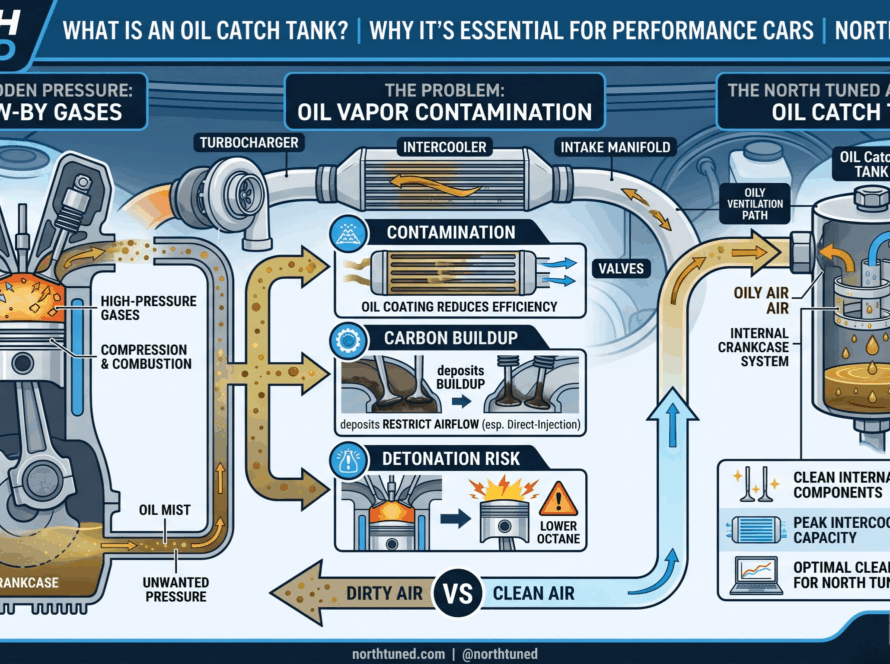
The Hidden Pressure: Blow-By Gases
In a four-stroke engine, as the piston moves from the top to the bottom, the intake valves open to draw in the air-fuel mixture. When the piston moves back up, all valves close to compress this mixture.

During this compression and combustion phase, a portion of the high-pressure gases leaks past the piston rings into the crankcase. This is known as “Blow-by.” To manage this unwanted pressure without releasing harmful gases into the atmosphere, manufacturers route this air back into the intake system through a ventilation channel.

What is an Oil Catch Tank? Why It's Essential for Performance Cars
What is an Oil Catch Tank? Why It’s Essential for Performance Cars

The Problem with Oil Vapor
The air evacuated from the crankcase is not just air; it contains a significant amount of oil vapor from the engine oil being tossed around at high temperatures. In factory setups, this oily mist is sent directly back into the turbocharger, intercooler pipes, and intake manifold.

Over time, this leads to:
Contamination: Oil coating the inside of the intercooler significantly reduces its cooling efficiency.

Carbon Buildup: In direct-injection engines, oil accumulates on the intake valves, hardening into carbon deposits that restrict airflow.

Detonation Risk: Oil mist entering the combustion chamber lowers the effective octane rating, which can lead to engine knock.

What is an Oil Catch Tank? Why It's Essential for Performance Cars
What is an Oil Catch Tank? Why It’s Essential for Performance Cars

The North Tuned Advantage: Why Use a Catch Tank?
An Oil Catch Tank acts as a high-efficiency filter. Instead of the oily crankcase air going straight to the intake, it first passes through this tank. The internal baffling system causes the oil droplets to condense and settle at the bottom of the reservoir.

The result: Only purified air is returned to the engine. This keeps your internal components clean, ensures your intercooler works at peak capacity, and allows your North Tuned performance map to operate under optimal, clean conditions.

What is an Oil Catch Tank? Why It's Essential for Performance Cars
What is an Oil Catch Tank? Why It’s Essential for Performance Cars
read more