
Tag: vehicle optimization

What is Horsepower (HP)? A Brief History of Power

What is Horsepower (HP)? A Brief History of Power

The term Horsepower (HP) is undoubtedly one of the most frequently used terms by car enthusiasts. Although it is the first criterion we look at when measuring a vehicle’s performance, it is not exactly equal to “the power of a single horse,” contrary to popular belief. So, how did this unit, which we at North Tuned place at the center of performance, come about?

James Watt and Marketing Genius
The term was first coined in 1782 by James Watt, a successful Scottish engineer and inventor who improved steam engines. To explain the capability of his engines to the public, Watt chose horses—the most common “engine” of that era—as a point of comparison.

How Was 1 Horsepower Calculated?
Watt observed horses working in coal mines. He calculated that, on average, a horse could pull 45 kg of coal 1.1 meters in one second. This mathematically equated to approximately 50 kg-m/s of work. However, to make his engines seem even more reliable and impressive, Watt increased this figure by 50%, rounding it up to 75 kg-m/s, and defined this as 1 Horsepower (HP).

In short, the modern definition is:

1 Horsepower (HP) is the amount of power required to lift a 75 kg load 1 meter vertically in 1 second.

Today, at North Tuned, we take James Watt’s fundamental legacy and optimize it with modern software and engineering solutions, efficiently awakening the “sleeping” horses within your vehicle.

read more
Performance Mods That Pair Perfectly With ECU Tuning

Performance Mods That Pair Perfectly With ECU Tuning

When it comes to unlocking a vehicle’s true potential, ECU Tuning is often the first step. However, at North Tuned, we believe that software is like a conductor; for it to produce the best symphony, the instruments beneath it must be up to the task.

Here are the top performance modifications that complement your tune and help your engine “breathe” better.

1. High-Flow Air Filters & Cold Air Intakes
A tuned engine demands more fuel, which in turn requires more oxygen. Stock paper filters often create a bottleneck.

Benefit: Increases airflow volume and sharpens throttle response.

2. Downpipe and Exhaust Upgrades
In turbocharged engines, getting exhaust gases out quickly is crucial. Standard catalytic converters can create backpressure and trap heat during high-performance driving.

Benefit: Lowers Exhaust Gas Temperatures (EGT) and allows the turbo to spool up faster.

3. Upgraded Intercooler
More boost equals more heat. When intake air gets too hot, it loses density, leading to “heat soak” and power loss.

Benefit: Keeps intake temperatures low, ensuring consistent power delivery even under hard driving.

4. Ignition System (Spark Plugs & Coils)
Under increased boost and cylinder pressure, stock spark plugs might struggle to ignite the mixture, leading to misfires.

Benefit: A stronger spark ensures complete combustion and a smoother power band.

North Tuned Insight: To get the most out of these hardware changes, your ECU map should be calibrated to recognize the improved airflow and cooling. Efficiency and longevity go hand in hand.

read more
What is an Oil Catch Tank? Why It's Essential for Performance Cars

What is an Oil Catch Tank? Why It’s Essential for Performance Cars

In this article, we will examine the purpose and working principle of the Oil Catch Tank, one of the critical components of forced induction and modified vehicles, from the perspective of North Tuned.

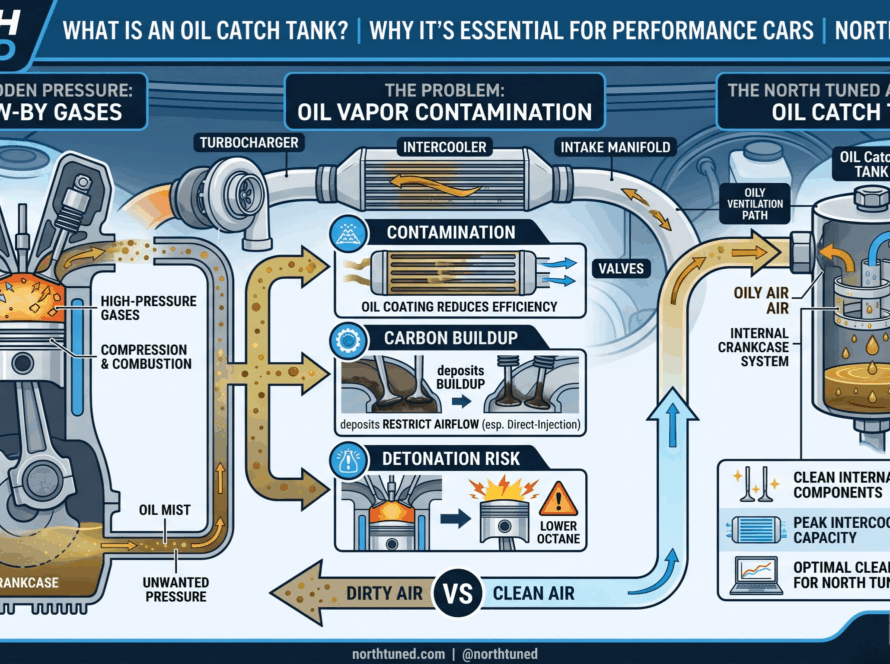
The Hidden Pressure: Blow-By Gases
In a four-stroke engine, as the piston moves from the top to the bottom, the intake valves open to draw in the air-fuel mixture. When the piston moves back up, all valves close to compress this mixture.

During this compression and combustion phase, a portion of the high-pressure gases leaks past the piston rings into the crankcase. This is known as “Blow-by.” To manage this unwanted pressure without releasing harmful gases into the atmosphere, manufacturers route this air back into the intake system through a ventilation channel.

What is an Oil Catch Tank? Why It's Essential for Performance Cars
What is an Oil Catch Tank? Why It’s Essential for Performance Cars

The Problem with Oil Vapor
The air evacuated from the crankcase is not just air; it contains a significant amount of oil vapor from the engine oil being tossed around at high temperatures. In factory setups, this oily mist is sent directly back into the turbocharger, intercooler pipes, and intake manifold.

Over time, this leads to:
Contamination: Oil coating the inside of the intercooler significantly reduces its cooling efficiency.

Carbon Buildup: In direct-injection engines, oil accumulates on the intake valves, hardening into carbon deposits that restrict airflow.

Detonation Risk: Oil mist entering the combustion chamber lowers the effective octane rating, which can lead to engine knock.

What is an Oil Catch Tank? Why It's Essential for Performance Cars
What is an Oil Catch Tank? Why It’s Essential for Performance Cars

The North Tuned Advantage: Why Use a Catch Tank?
An Oil Catch Tank acts as a high-efficiency filter. Instead of the oily crankcase air going straight to the intake, it first passes through this tank. The internal baffling system causes the oil droplets to condense and settle at the bottom of the reservoir.

The result: Only purified air is returned to the engine. This keeps your internal components clean, ensures your intercooler works at peak capacity, and allows your North Tuned performance map to operate under optimal, clean conditions.

What is an Oil Catch Tank? Why It's Essential for Performance Cars
What is an Oil Catch Tank? Why It’s Essential for Performance Cars
read more
Top 5 Signs Your Car Needs a Performance Tune

Top 5 Signs Your Car Needs a Performance Tune

Your car is capable of much more than what the factory settings allow. Manufacturers often “detune” engines to account for global variables like low-grade fuel or extreme environmental conditions. If you are a driving enthusiast, these restrictions are holding you back.

Here are the top 5 signs it’s time to visit North Tuned for a professional remap:

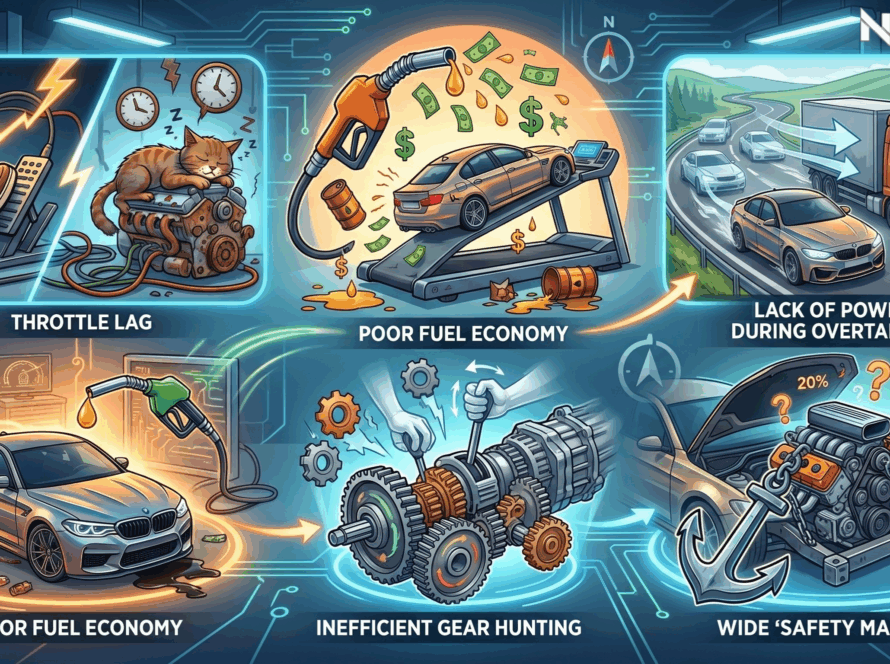
1. Significant Throttle Lag
Does your car feel “disconnected” when you hit the accelerator? This delay is often due to restrictive factory throttle mapping. A professional ECU remap sharpens the communication between your foot and the engine, providing instant power delivery.

2. Poor Fuel Economy Relative to Output
A performance tune isn’t just about speed; it’s about efficiency. By optimizing the air-fuel ratio and increasing low-end torque, the engine works less to maintain cruising speeds. If you’re visiting the gas station more often than you’d like, a specialized tune can actually improve your MPG.

3. Lack of Power During Overtaking
Overtaking requires a burst of confidence. If you find yourself hesitating because the car lacks that “punch” in the mid-range RPM, you are missing out on essential torque. Tuning expands the power band, making highway merges and overtaking maneuvers safer and more exhilarating.

4. Inefficient Gear Hunting
If you drive an automatic or dual-clutch vehicle, you might notice the car “hunts” for gears or stays in a high gear for too long during an incline. A North Tuned performance map harmonizes the engine’s output with the gearbox logic, ensuring you are always in the optimal power range.

5. The “Safety Margin” Is Too Wide
Standard cars are built for the “average” driver. If you maintain your vehicle well and use high-quality fuel, you don’t need the massive safety buffers set by the factory. Unleashing that dormant 20-30% of horsepower and torque is the most cost-effective way to transform your driving experience without mechanical modifications.

Why Choose North Tuned?
At North Tuned, we don’t just “plug and play.” We provide custom-tailored software solutions that respect your engine’s longevity while maximizing its output. Whether you are looking for a Stage 1 remap, DPF/EGR solutions, or Eco-Tuning, our expert team ensures your vehicle performs at its peak.

read more