

In the automotive enthusiast community, the journey of performance tuning progresses in clear stages. Stage 1 software unlocks the factory-hidden potential of an engine, while Stage 2 integrates high-flow exhaust and upgraded cooling components to yield more aggressive power figures. However, for a select group of drivers, these levels represent merely the baseline. When the goal is to transform a production street car into an absolute performance monster, exceed standard benchmarks, and push engine blocks to their mechanical limits, the path required is 第 3 阶段.
Stage 3 is far beyond connecting a tuning cable to upload software or installing a few basic bolt-on parts. Stage 3 represents a ground-up engineering process built upon precise calculations, advanced mechanical re-engineering, and the seamless integration of high-grade competition components.
In this comprehensive guide by North Tuned, we break down what truly goes into a Stage 3 build, examining every critical area from internal engine strengthening and fueling to turbocharger systems and drivetrain reinforcement.
1. Large Turbochargers and Hybrid Turbo Systems
The heart and focal point of any Stage 3 build is the forced induction system. Factory-installed turbochargers possess mechanical flow limits; once pushed past their efficiency window, they generate excessive heat rather than usable air volume.
- Hybrid Turbo Upgrades: The original turbocharger housing is precisely machined (via CNC milling) to house larger compressor and turbine wheels. While maintaining a factory external appearance, it delivers significantly higher airflow rates.
- Big Turbo Kits: The stock turbocharger is completely removed and replaced with a larger frame competition turbocharger from manufacturers like Garrett, BorgWarner, or Precision. This conversion requires custom exhaust manifolds, external wastegates, and custom charge piping.
A larger turbocharger forces vastly greater volumes of oxygen into the combustion chamber, providing the foundation for exponential horsepower gains.
2. Internal Engine Strengthening (Forged Engine Build)
Multiplying turbo boost levels and power output creates immense Peak Cylinder Pressure (PCP) and thermal stress on internal engine components. Standard cast or cast-alloy factory pistons and connecting rods cannot withstand these forces and will inevitably bend or fracture. The most vital phase of a Stage 3 build is upgrading internal components from cast to forged materials.
Forged Pistons
Engineered from high-strength aluminum alloys capable of enduring extreme combustion temperatures and pressure spikes. They allow custom configuration of compression ratios specifically tailored to high boost levels.
Forged Connecting Rods
Connecting the pistons to the crankshaft, forged H-Beam or I-Beam connecting rods eliminate the risk of bending or snapping under severe torque loads.
Upgraded Bearings and Fasteners
Main and rod bearings are replaced with race-grade high-durability materials. Standard head bolts and main cap bolts are upgraded to high-tensile ARP studs to prevent head lift under high boost.
3. Redesigning the Fuel Delivery System
Increased airflow generates power only when paired with a proportional volume of fuel. On a high-boost Stage 3 engine, the stock fuel delivery system quickly becomes inadequate, creating a lean air-fuel mixture that can instantly cause catastrophic engine failure.
- High-Pressure Fuel Pump (HPFP): Upgraded to maintain adequate fuel rail pressure in direct-injection engines under heavy load.
- Low-Pressure Fuel Pump (LPFP): Replaced with a high-flow unit to ensure sufficient volume is supplied from the fuel tank.
- Upgraded Fuel Injectors: Higher-flow injectors capable of delivering precise, high-volume fuel charges in compressed time windows.
- E85 / Ethanol Conversions or Water-Methanol Injection: Integrated to raise fuel octane ratings, lower cylinder temperatures, and prevent pre-ignition (knock).
4. Advanced Thermal Management and Cooling
The massive power generated by a Stage 3 engine produces an equally massive amount of heat. Thermal buildup is the ultimate enemy of performance consistency and engine longevity.
- Over-Sized Front Mount Intercooler (FMIC): Maximizes charge air cooling before it enters the intake manifold, preserving air density.
- External Oil Cooler Kits: Prevents engine oil temperatures from exceeding safe limits during prolonged high-RPM loads, maintaining critical lubrication properties.
- Performance Radiators and Low-Temp Thermostats: Accelerates coolant circulation and manages engine operating temperatures under extreme stress.
5. Drivetrain and Transmission Reinforcement
Generating 600, 700, or 800+ Nm of torque is meaningless if the drivetrain cannot reliably transfer that power to the pavement. Standard transmissions and clutches will fail rapidly when exposed to these load levels.
- Dual-Clutch Transmissions (DSG/DCT): Upgraded with heavy-duty multi-plate clutch packs and increased hydraulic clamping pressure calibration.
- Manual Transmissions: Fitted with twin-disc or triple-disc competition clutch setups paired with lightweight single-mass flywheels.
- Axles and Differential: Reinforced driveshafts and Limited-Slip Differentials (LSD) are installed to prevent axle shear and optimize traction.
6. Custom ECU and TCU Calibration
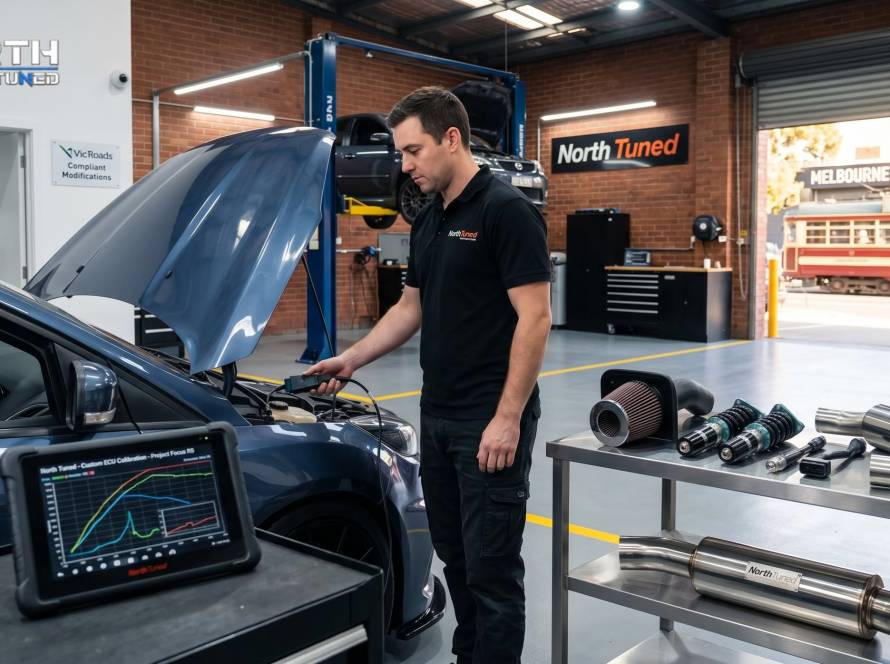
Once all mechanical components are meticulously assembled, the brain of the operation is the custom calibration of the Engine Control Unit (ECU) and Transmission Control Unit (TCU). Off-the-shelf or generic tuning maps cannot be used for a Stage 3 build.
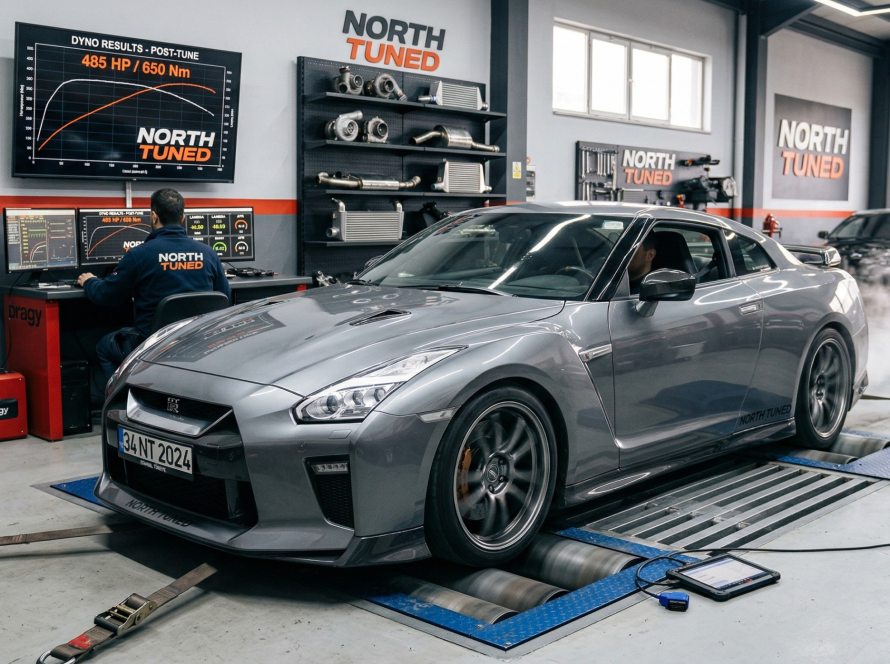
The vehicle undergoes extensive live calibration on a chassis dynamometer (dyno). Engineers monitor critical real-time parameters including Exhaust Gas Temperatures (EGT), Air-Fuel Ratios (AFR), boost pressure, ignition timing, and knock activity:
- Turbo boost spool characteristics and wastegate control,
- Ignition timing advance curves and fuel mapping,
- Transmission shift points and clutch line pressures, are custom-programmed specifically for that exact vehicle configuration.
Conclusion: Engineering Your Ultimate Build with North Tuned
Stage 3 tuning is the art of re-engineering a production vehicle through advanced mechanics and software precision. Success requires careful component matching, flawless mechanical execution, and meticulous software calibration.
At North Tuned, we possess the technical expertise, mechanical engineering vision, and custom calibration experience required to turn ambitious Stage 3 builds into reliable, high-performance realities. Contact us to discuss taking your vehicle beyond standard limits.

 English
  Turkish
  German
  Spanish
  Hindi
Hindi  Arabic
  Italian
  Greek
Greek  Vietnamese
  Chinese
  Malay
Malay